 How-to
How to Help a Child With Dyslexia Learn to Read at Home
Last Updated: November 5, 2026
Quick Summary
To help a child with dyslexia learn to read at home, use structured, explicit practice that moves in a clear order: sounds first, then letter-sound links, blending, and longer patterns. Keep daily sessions short, repeat the same decodable book over several days, and stop before frustration builds.
- Dyslexia is a difference in how the brain processes language sounds, not a sign of low intelligence.
- Teach skills in order, climbing one rung at a time without skipping steps.
- Practice sound games for about five minutes, and read the same short book several days in a row.
- Praise effort rather than only accuracy, and end sessions on a small win.
- Ask the teacher for a written reading evaluation if you have concerns.
Table of Contents
- Start With the Signs: Recognizing Dyslexia Early
- Step 1: Get Clear on What Dyslexia Is (and Isn't)
- Step 2: Build Reading Skills With Structured, Explicit Practice
- Step 3: Make Reading Less Stressful and Build Confidence
- Step 4: Work With the School and Know When to Ask for Help
- Your First Step Tonight: Starting a Simple Home Reading Plan
- Frequently Asked Questions
Start With the Signs: Recognizing Dyslexia Early
Picture this: your child sits down with a picture book, and within seconds they're guessing at words instead of reading them. If you're wondering how to help a child with dyslexia learn to read, you're in the right place.
That feeling is worth paying attention to. This guide is here to help you turn that worry into a plan, one small step at a time. You don't need a teaching degree to start.
What the warning signs can look like
Dyslexia is a learning difference that makes it hard to link letters to sounds and turn those sounds into words. It has nothing to do with intelligence. Many children with dyslexia are bright, curious, and great talkers.
Watch for patterns like these:
- Trouble rhyming, such as not hearing that "cat" and "hat" sound alike
- Letter or word reversals that continue well past age 7
- Slow, effortful reading where your child sounds out almost every word
One sign alone doesn't mean much. A cluster of these, lasting for months, is worth a closer look.
When to talk with a teacher or pediatrician
If you notice several of these signs, start a conversation. You don't need proof or a diagnosis to ask questions. Ask the teacher what they see during reading time. Ask your pediatrician whether a reading evaluation makes sense.
Early support tends to work best, so waiting rarely helps. Think of this step as gathering information, not labeling your child.
Step 1: Get Clear on What Dyslexia Is (and Isn't)
Before you change anything at home, it helps to know what you're working with, especially if you want your child to learn to read with dyslexia in a way that actually sticks. Our full parent's guide to teaching reading at home walks you through each stage in order.
Dyslexia is a difference in how the brain processes the sounds of language. Kids with dyslexia usually need more explicit, repeated practice to learn sound-letter links. They learn to read with the right support.
Here's what dyslexia is not:
- It is not a sign of low intelligence
- It is not caused by laziness or a lack of effort
- It is not fixed by reading more books alone
Knowing this helps you show up with patience. When your child struggles, you can say, "This part is hard for your brain right now, and we'll practice it together." That message builds trust.
Step 2: Build Reading Skills With Structured, Explicit Practice
This is where the real work happens, and it's also where most home reading advice gets fuzzy. "Read more" isn't a strategy for a child with dyslexia. Structured literacy is.
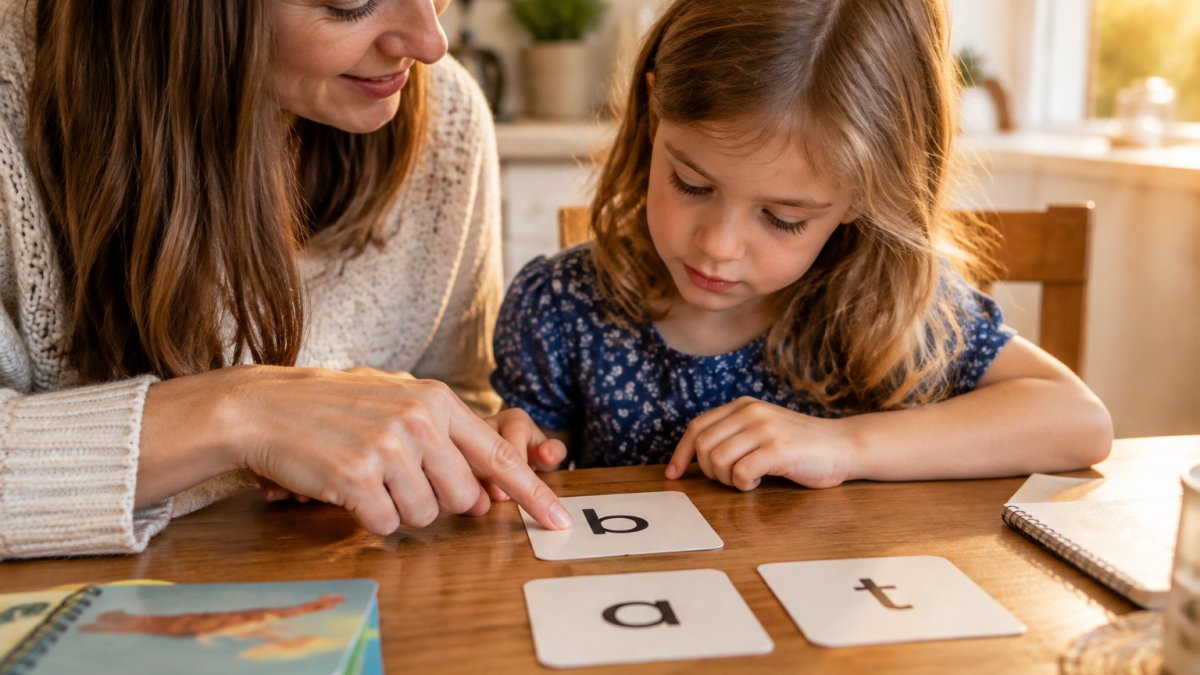
You don't need an expensive curriculum to get started. A notebook, a few index cards, and 10 to 15 minutes a day can do a lot. What matters is the sequence and the repetition.
What structured literacy actually looks like
Think of it as a ladder. A common sequence looks like this: for a practical, step-by-step phonics routine you can follow at home, see our guide.
- Sounds first. Hearing and playing with individual sounds in words (phonemic awareness) before letters get involved.
- Letter-sound links. One letter, one sound, practiced until it's automatic.
- Blending and segmenting. Pushing sounds together into words and pulling words apart into sounds.
- Short vowel patterns. Simple consonant-vowel-consonant words like "map," "sit," and "hop."
- Digraphs and blends. Letter pairs like "sh," "ch," "th," and clusters like "st" and "bl."
- Longer patterns. Silent e, vowel teams, and r-controlled vowels, added slowly.
Kids with dyslexia often need more repetition at each rung than their peers, and that's normal. The goal isn't speed. It's automaticity, so the brain stops working so hard on decoding and can start thinking about meaning.
Phonemic awareness and letter-sound practice at home
Phonemic awareness is the ability to hear and play with the individual sounds in words. It's the foundation for phonics, which connects those sounds to letters. Try these simple routines:
- Sound games in the car. Say "cat" and ask your child to say it without the /k/ sound ("at").
- Letter-sound cards. Show one letter at a time and say its sound. Keep sessions to five minutes.
- Sound-spotting walks. For more quick ideas, try these playful sound games you can start tonight. Point out objects and ask, "What sound does 'sock' start with?"
Keep it playful. Short, frequent practice beats one long, tiring session every time. You'll find more concrete at-home phonemic awareness activities in this guide.
Short, repeated reading routines that stick
Repetition is not boring when it builds confidence. Reading the same short book several times helps your child recognize words faster and feel successful. Here's a simple routine:
- Pick a short book at your child's level, ideally a decodable book with words that match the sounds they've practiced. You can compare decodable books suited to dyslexia before you choose.
- Read it aloud to them first, pointing at each word.
- Read it together, with you taking the harder words.
- Let your child read it alone, or read it back to you.
- Repeat the same book over several days.
A 10-minute routine, done five days a week, can help build steady practice. Consistency matters more than intensity.
Watch out: If your child is guessing at words from pictures or the first letter, that's a sign the practice is too hard or the book isn't decodable enough. Drop back a level rather than pushing through.
A quick progress check that isn't a test
You don't need formal assessments to know if practice is working.
Chapter 6 of Literacy Roots covers the signs that warrant a closer look, and Chapter 4 reminds us that reading is only one piece of the literacy mosaic. Speaking, listening, and writing all feed the same brain.
Here's the ladder most structured literacy programs follow, so you can see the order at a glance.
| Step | What to do | Time or frequency |
|---|---|---|
| Sounds first | Hear and play with individual sounds in words | Short, playful sessions |
| Letter-sound links | Practice one letter, one sound until automatic | Five minutes at a time |
| Blending and segmenting | Push sounds into words and pull words apart | Daily practice |
| Short vowel patterns | Read simple consonant-vowel-consonant words | Build slowly |
| Digraphs and blends | Teach pairs like sh, ch, th and st, bl | Add gradually |
| Longer patterns | Add silent e, vowel teams, r-controlled vowels | One at a time, slowly |
Step 3: Make Reading Less Stressful and Build Confidence
A child who dreads reading will avoid it, and avoidance slows progress. Your goal is to make reading feel safe.
Try these habits:
- Praise effort, not just accuracy. Say, "You worked hard on that word," instead of only "Good job."
- Stop before frustration builds. End sessions on a win, even a small one.
- Read for fun, too. Audiobooks and read-alouds let your child enjoy stories without the pressure of decoding.
Common mistake: pushing harder when your child is tired or upset. Take a break, then return to the same skill later. A calm reader learns faster than a stressed one.
Remember, you're not the teacher alone. You're the steady, encouraging presence who keeps the habit alive.
Step 4: Work With the School and Know When to Ask for Help
Home practice works best when it matches what's happening at school. Two adults pulling in the same direction give your child the strongest support. But "talk to the teacher" is easier said than done, and most parents have no idea what to ask or how to tell whether the help their child is getting is actually the right kind.
Here's how to connect, and how to evaluate what you're offered.
Start with a specific conversation, not a vague worry
Instead of "How is reading going?", try questions that get you real information:
- Ask the teacher which reading skills your child is working on right now, and what the next skill in the sequence will be.
- Request a reading evaluation in writing if you have concerns. Keep a copy of your request. A paper trail matters if you need to follow up.
- Ask about accommodations, such as audiobooks, extra time, or text-to-speech tools. These don't replace instruction, but they keep your child from falling behind in other subjects while reading skills catch up.
How to tell if a tutor or intervention is the right fit
If your child isn't making steady progress after several months of consistent support, it's time to look at structured literacy intervention.
When you talk with a provider, ask these questions:
- What program do you use, and is it structured and systematic? You're listening for a named, sequenced approach, not "we work on whatever they need."
- Is it multisensory? Good structured literacy instruction engages seeing, hearing, saying, and writing at the same time.
- How do you measure progress? A good provider can tell you what they track and how often.
Some families spend months on general reading help before finding instruction designed for dyslexia. Trust your gut if something feels off, and don't be afraid to ask for a sample session or a progress report.
Watch out: More practice isn't always better. Piling on extra drills at home on top of school intervention can exhaust a child and backfire.
Know when to seek an evaluation
If your child is struggling with rhyming, letter sounds, or sounding out words despite steady practice, or if reading is causing real distress, talk with your pediatrician or school team about a formal evaluation. Early support tends to work best, so waiting rarely helps.
Chapter 5 of Literacy Roots uses the image of parents and teachers as two rowers in one boat, and Chapter 6 covers the signs that warrant a closer look. You're not the teacher alone. You're the steady, encouraging presence who keeps the habit alive and asks the right questions when something isn't working.
Your First Step Tonight: Starting a Simple Home Reading Plan
You don't need to do everything at once. Start small and build from there.
Tonight, try this:
- Choose one short book at your child's level.
- Spend five minutes on one sound game, like rhyming or blending.
- Read the book together, and let your child read one page on their own.
- End with a sentence of praise about effort.
Repeat it tomorrow. Over time, these small moments add up to a reader who believes in themselves.
Start with one routine this week, and let your child's progress show you what's working.
Frequently Asked Questions
What is the best way to teach a child with dyslexia to read?
A helpful approach is structured literacy: explicit, systematic instruction that teaches letter-sound relationships, phonemic awareness, and decoding in a clear sequence. At home, you can practice a few sounds at a time, review them often, and move forward only when your child is ready. Short, daily sessions of about 10 to 15 minutes usually work better than long, occasional ones. Pair this with a calm, encouraging tone so reading practice feels safe rather than stressful.
Is dyslexia related to a child's intelligence?
No. Dyslexia is a difference in how the brain processes language, especially the sounds in words, and it is unrelated to intelligence. Many children with dyslexia are bright, curious, and strong in reasoning, speaking, and listening. Their reading may simply take more explicit teaching and more practice to develop. Keeping that in mind can help you focus on the way your child learns rather than on any idea that they are less capable.
How can I make reading practice less stressful for my child?
Keep sessions short, end on a success, and celebrate effort rather than speed. Let your child choose some of the books, and read aloud together so the story stays enjoyable while the decoding work happens in small doses. Audiobooks can also help your child keep up with stories above their current reading level. If a session goes badly, it is fine to stop and try again tomorrow. Consistency and warmth matter more than perfect practice.
When should I talk to my child's teacher about reading difficulties?
Reach out if your child struggles to rhyme, has trouble connecting letters to sounds, reads very slowly, or avoids reading in ways that persist over time. Ask the teacher what they are seeing in class and whether your child could benefit from a reading screening or additional support. Bring specific examples from home, such as a word your child consistently misreads. These warning signs are reasons to start a conversation, not a diagnosis, and a pediatrician can also help you decide on next steps.



