How-to
How to Read Aloud to a Baby Every Day Without the Guilt
Last Updated: November 23, 2026
Quick Summary
Aim to read aloud to your baby most days, in short stretches, whenever your baby is calm and curious. Ten minutes beats a perfect hour you never get around to, so frequency matters more than length. One book a day is a great start.
- Your baby's brain is about 80% of its adult size by age 3, and nearly 90% by age 5.
- Newborns to 6 months: one or two short sessions a day of 1 to 3 minutes.
- Babies 6 to 12 months do well with 2 to 3 short sessions daily of 2 to 5 minutes.
- Keep three books in three places: the diaper bag, the car, and the crib.
- Stop when your baby looks away, arches, or fusses, and try again tomorrow.
Table of Contents
- Why Reading Aloud to Your Baby Matters More Than You Think
- How Often Should You Read Aloud to a Baby? A Practical Guide
- How Many Books Should I Read to My Baby a Day?
- How Long Should You Read to a Baby?
- When to Start Reading to Baby at Bedtime (and How to Make It Stick)
- Building a Baby Reading Routine That Actually Works
- What to Do When Your Baby Won't Sit Still
- Your Next Step: Start Tonight with One Book
- Frequently Asked Questions
Why Reading Aloud to Your Baby Matters More Than You Think
It's 8 p.m. The dishes are still in the sink. Your baby is finally calm, and you're wondering if ten minutes with a board book even counts. It does. Those small, warm moments add up more than you might expect. If you're wondering whether daily read-aloud is worth it for toddlers, the answer is yes.
So how often should you read aloud to a baby? The honest answer is most days, in short stretches, whenever your baby is calm and curious. Ten minutes beats a perfect hour you never get around to.
The Brain Science in Plain English
Your baby's brain grows fast in the first few years. In Literacy Roots, Lauren Daugherty points to research showing the brain is about 80% of its adult size by age 3, and nearly 90% by age 5. Every time you read aloud, your baby hears words, sees your face, and feels your rhythm. Researchers call this back-and-forth "serve and return."
It's Not Just About Words
Reading aloud builds more than vocabulary. It also builds bonding and comfort. When you point to a picture and name it, you're practicing communication before your baby can talk.
Zero to Three on early brain development
How Often Should You Read Aloud to a Baby? A Practical Guide
Aim for daily shared reading, even if it's just a few minutes. Frequency matters more than length. Think of it like brushing teeth: small, regular, and part of the day.
Short sessions tend to work well because young babies can only hold focus for a brief stretch. Lauren Daugherty ties repetition and serve-and-return to everyday talk in Chapter 2 of Literacy Roots, "Parents as First Teachers."
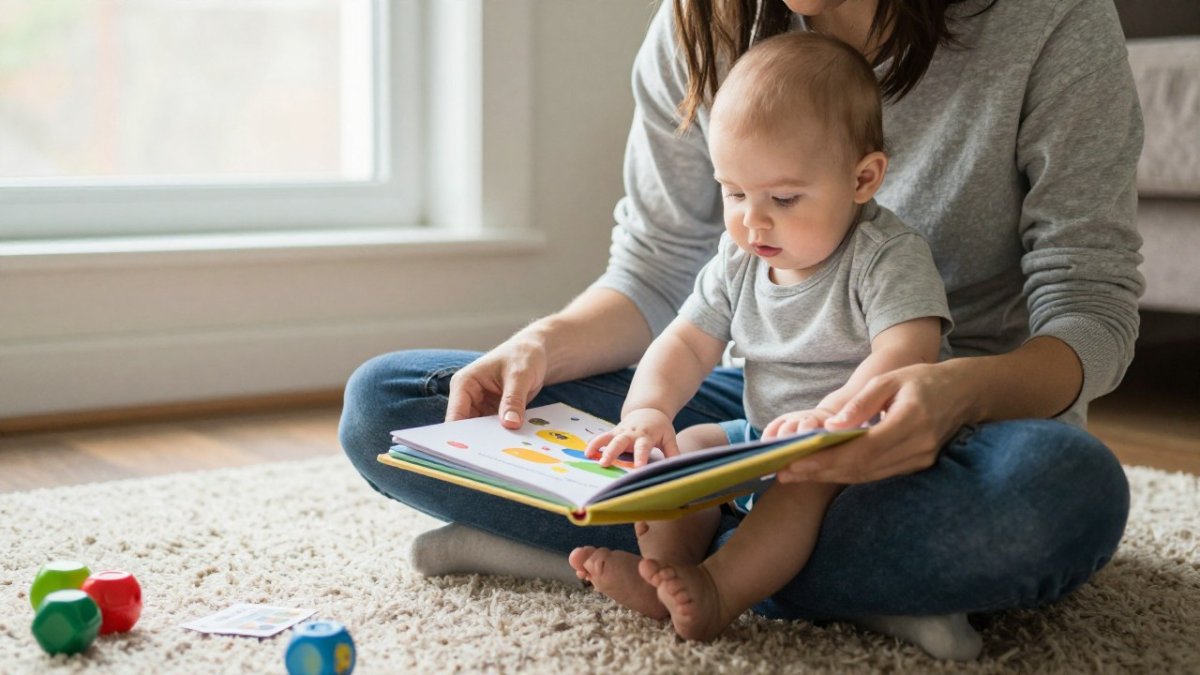
Newborns to 6 Months: Follow the Cues
At this age, reading aloud is really about your voice. Read anything: a picture book, a poem, even the back of a cereal box. Stop when your baby turns away. For book ideas that fit this stage, see our list of sensory books for infants.
A realistic rhythm: one or two short sessions a day, plus any time you're already holding your baby and have a free hand. Reading during a feeding or a diaper change counts. So does narrating the mail.
6 to 12 Months: Building a Rhythm
Babies this age grab, chew, and pat the pages. That's reading. Short sessions of a few minutes, a few times a day, work well.
Try anchoring sessions to things you already do: after waking, after a diaper change, before a nap. The anchor does the remembering for you. If your baby is in child care or with a grandparent during the day, ask them to do one short session too. Shared reading does not have to come only from you.
12 to 24 Months: Short and Sweet
Toddlers want the same book again and again. Repetition is how they learn. Two or three minutes at a time is plenty.
This is also the age when a toddler may bring you the same book for the fifth time in a row. Read it again. The repetition is the point.
A Realistic Frequency and Duration Guide by Age
| Age | How Often | How Long | What It Looks Like |
|---|---|---|---|
| Newborn to 6 months | Most days, whenever calm | 1-3 minutes | Your voice, any book, following cues |
| 6 to 12 months | 2-3 short sessions daily | 2-5 minutes | Grabbing, patting, naming pictures |
| 12 to 24 months | Daily, plus favorite repeats | 3-10 minutes | Same book again, pointing, repeating words |
Watch out: a table like this can turn into a scoreboard. If your week looks nothing like it, that is not a failure. The pattern to protect is regular and warm, not perfect and daily.
What the Research Can and Cannot Tell You
It's tempting to read a study and hear a promise: read every day and your baby will be ahead. The honest version is quieter. Babies learn language through back-and-forth interaction, and reading aloud is one easy way to get more of it. Treat any routine as a flexible starting point, not a prescription.
Free and Low-Cost Ways to Read More Often
You do not need a shelf of new books. Libraries are a free option, and many have board book sections and story times. Borrowed books count. So do digital books on a tablet, household objects with words on them (cereal boxes, junk mail, a takeout menu), and books in your home language. Chapter 7 of Literacy Roots covers how home languages strengthen English learning.
Reading Is a Team Effort
You don't have to be the only reader. Grandparents, older siblings, a partner, a babysitter, and child care providers can all do a short session. A sibling reading to a baby counts twice: the baby hears language, and the sibling gets practice. The goal is a day sprinkled with reading, not one perfect block of it.
How Many Books Should I Read to My Baby a Day?
There's no magic number. One book a day is a great start. On good days, read two or three. The goal is connection, not a quota.
- One book on busy days
- Two or three when your baby is engaged
- The same book as many times as your baby asks
How Long Should You Read to a Baby?
Keep it short. A few minutes is enough for infants. Toddlers may last ten minutes. Watch your baby's cues: looking away, arching, or fussing means it's time to stop. For more on why short, daily sessions work, read our guide to daily reading routines.
When to Start Reading to Baby at Bedtime (and How to Make It Stick)
You can start at bedtime from day one. Newborns don't need to understand the story. They need your voice and the routine. If you're wondering when to begin, our article on when to start reading to your newborn walks through it.
Pick one book and one spot. Same book, same chair, same soft voice. That's how a bedtime habit sticks.
Building a Baby Reading Routine That Actually Works
A reading routine works when it's small and repeatable. Tie it to something you already do: after a diaper change, before a nap, at bedtime.
The 3-Book Rule for Busy Days
Keep three books in three places: the diaper bag, the car, and the crib. When you're waiting or winding down, a book is already there. No planning needed.
What to Do When Your Baby Won't Sit Still
Don't force it. A wiggly baby is a normal baby. The trick is to stop treating reading as something that requires a lap and a still body. Most of the time, it doesn't.
Here are specific things to try, roughly in order of how well they work for most families.
Read while your baby is contained. A high chair, a stroller, a baby carrier, or a bouncy seat gives you a few minutes of shared attention without a wrestling match. Read while your baby is strapped in for a walk.
Let your baby hold a second book. One book for you to read, one for your baby to chew, pat, and flip. It can cut down on the tug-of-war over pages.
Read while they crawl. You don't need eye contact for the language to land. Narrate what you're reading while your baby explores the room. They're still hearing words, rhythm, and your voice.
Use songs and rhymes instead of a book. If a book gets tossed, switch to a song or a finger play. The language-building mechanism is the same: rhythm, repetition, and back-and-forth. For hands-on ideas, try these reading activities for 8-month-olds.
Point and name. You don't have to read the words. Open to a picture, point, and say what it is. Pause. See if your baby looks. That pause is the kind of back-and-forth Chapter 2 of Literacy Roots describes.
Stop when interest drops. Looking away, arching, or fussing means the session is over. Ending on a calm note makes the next session easier to start.
Watch out: turning reading into a battle teaches a baby that books are stressful. If it's not working today, put the book down and try again tomorrow. A skipped session costs nothing.
How to Read Aloud So It Actually Lands
Frequency is only half the question. How you read matters too, and it's the part most guides skip. A few techniques make a short session do more work:
- Name the pictures. Point and say the word, then pause.
- Repeat key words. Say "dog" again when you turn the page.
- Use an expressive voice. Change pitch, slow down, add a pause before the funny part.
- Respond to your baby's sounds. If they coo or babble, answer back. That turn-taking is the whole point.
- Follow their page. If your baby wants to skip ahead or go back, go with it. The book is a tool, not a script.
None of this requires a special book or a quiet house. It works with a borrowed board book, a library book, or a cereal box. The goal is a warm back-and-forth, not a performance.
Your Next Step: Start Tonight with One Book
You don't need a perfect routine. You need one book and a few minutes. That's it.
Literacy Roots walks through all of this in Chapter 2, "Parents as First Teachers," with research, real family stories, and simple exercises. Endorsed by Dr. Susan Neuman of NYU, it's a warm, practical guide.
Here's the challenge: tonight, grab one board book and read it out loud, even if your baby crawls away halfway through. That counts.
Get the book and start building your child's reading roots today. Literacy Roots is $14.99 on Amazon, and every chapter gives you one small step to try.
Frequently Asked Questions
What is the 5-3-3 rule for babies?
The 5-3-3 rule is a parenting guideline often shared online, but it is not a medical or literacy standard. It typically refers to a feeding or sleep schedule, not reading. For reading aloud, there is no official rule. The best approach is flexible: aim for a few short sessions each day, follow your baby's cues, and focus on consistency over strict numbers. Your pediatrician can advise on feeding and sleep schedules.
How many books should you read to a baby each day?
There is no magic number. The goal is connection and language exposure, not volume. Focus on a few minutes of engaged reading rather than hitting a book count.
When should you start reading aloud to your baby?
You can start from birth. Newborns benefit from hearing your voice, even if they do not understand words. Reading aloud supports bonding. Start with short sessions when your baby is calm and alert. There is no deadline, so if you are starting at three months or six months, you are right on time. Consistency matters more than the exact start date.
Should you read to a newborn while they're sleeping?
It is not necessary. Newborns need plenty of sleep. Instead, read when your baby is awake and calm. If you want to incorporate reading into a sleep routine, read softly before they fall asleep. The goal is shared engagement, not passive listening during sleep.