 How-to
How to Teach Phonics at Home: A Parent's Step-by-Step Guide
Table of Contents
- What You'll Need Before You Start
- Step 1: Build Phonemic Awareness Before Letters
- Step 2: Introduce Letter-Sound Correspondence
- Step 3: How to Teach Blending Sounds Into Words
- Phonics Activities for Parents to Use Daily
- A Daily Phonics Lesson Plan for Parents
- The Best Phonics Tools for Home Practice
- Common Mistakes to Avoid When You Teach Phonics
- Frequently Asked Questions
Last Updated: September 12, 2026
What You'll Need Before You Start
When you teach phonics at home, it starts with a mindset shift: you are not replicating a classroom, you are building a daily habit of sound play. Before you print a single worksheet, gather a few basics. You need a quiet spot with minimal background noise, a set of lowercase letter cards you can make yourself, and ten to fifteen minutes of protected time each day. That's it. Consistency is what moves children forward. The National Center on Improving Literacy notes that a child's early language environment shapes later reading outcomes, which is why the routine matters more than the resources.
Step 1: Build Phonemic Awareness Before Letters
Phonemic awareness is the ability to hear and manipulate individual sounds in spoken words, and it comes before any letter instruction. A child who cannot hear the three sounds in "cat" will struggle to connect those sounds to letters later (improvingliteracy.org). Start with listening games, not print. Clap syllables in your child's name, play "I spy something that starts with /m/," and practice segmenting simple words aloud. This is oral work, done with eyes and ears, not pencils. Most children can blend and segment spoken words before they can decode them on a page, so resist the urge to rush toward letters. The International Literacy Association describes this oral foundation as a prerequisite for decoding, and skipping it is one of the most common reasons home phonics stalls.
Step 2: Introduce Letter-Sound Correspondence
Letter-sound correspondence is the relationship between a written letter (a grapheme) and the sound it represents (a phoneme). Introduce two to four letters at a time, always by sound first, then name. Say "/s/," show the card, and let your child repeat. A common mistake is teaching letter names too early, which leads children to read "s-a-t" as "ess-ay-tee" instead of blending the sounds. Once your child reliably recognizes a small set, add digraphs like sh, ch, and th; trigraphs such as igh come later.
Step 3: How to Teach Blending Sounds Into Words
To teach blending sounds, say each sound slowly and then push them together: "/c/ /a/ /t/, cat." Blending is the bridge between knowing sounds and reading words, and it is where many children hit their first plateau. Start with two-sound words (at, it, up), then move to three-sound words with continuous sounds that are easy to stretch, like m, s, and f. Avoid stopping sounds like /t/ and /p/ until your child is comfortable, since they cannot be held. Practice segmenting in reverse too: you say "cat," and your child separates it into /c/ /a/ /t/. This back-and-forth builds the word recognition that eventually becomes reading fluency.
Phonics Activities for Parents to Use Daily
Phonics activities for parents work best when they are short, tactile, and repeated. Multisensory learning, using touch, movement, and sound together, helps children hold onto letter-sound pairs far better than worksheets alone. Try these:
- Sound hunt: Hide letter cards around a room and have your child find one and say its sound.
- Playdough letters: Shape a letter, then say its sound and trace it.
- Sound boxes: Draw three boxes and push a token into each as your child says a sound in a word.
- Magnetic letters: Build a word on the fridge, then swap one letter to make a new one.
A Daily Phonics Lesson Plan for Parents
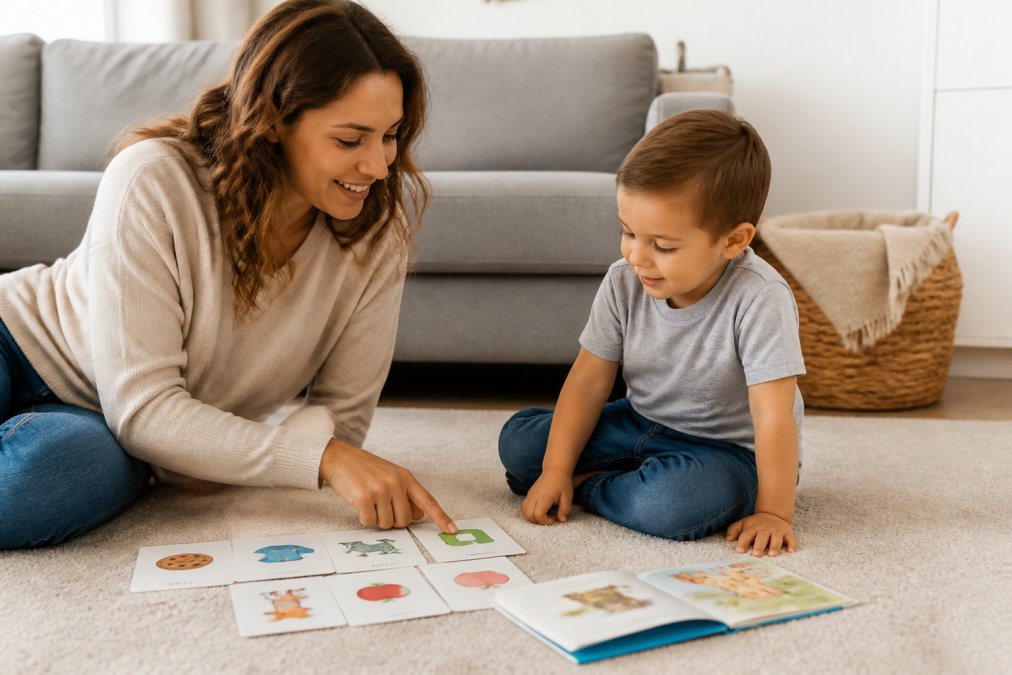
A daily phonics lesson plan for parents should run ten to fifteen minutes and follow the same shape every day. Predictability reduces resistance and lets you spend your energy on teaching rather than deciding what to do next. Here is a simple structure you can reuse:
| Part of Lesson | Time | What You Do |
|---|---|---|
| Warm-up | 2 min | Review sounds your child already knows |
| New sound | 3 min | Introduce one new letter-sound pair |
| Blending practice | 4 min | Build and read 3-5 words together |
| Game | 3 min | Play a quick sound or word game |
| Read-aloud | 3 min | Read a simple book and point out known sounds |
The read-aloud portion matters more than parents expect: hearing fluent reading while seeing print builds oral language and print awareness at once. Keep the same plan for a week before changing it, and stop while your child still wants more.
A Four-Week Scope and Sequence You Can Actually Follow
Most parents stall because they do not know what to teach after the first few letters. A simple sequence removes that guesswork: start with continuous sounds that are easy to stretch, add a vowel, then build words immediately.
Week 1, Continuous sounds and one vowel. Introduce m, s, f, and the short a. Practice blending two-sound combinations (am, as) before moving to three-sound words (sam, mat, fan). By day five, your child should read three or four short-a words without prompting.
Week 2, Add stop sounds. Introduce t, p, and n to build sat, tap, pan, and map. Stop sounds (/t/, /p/) are harder to stretch, so say them quickly and let the next sound carry the blend. Review week-one sounds for two minutes at the start of every session.
Week 3, Short i and more consonants. Add short i, then c, d, and g. Words like sit, dip, and pig become readable. This is the week most children first read a full sentence in a decodable book.
Week 4, Short o and u, plus first digraphs. Add short o and u, then introduce sh and ch. Words like shop, chip, and shut open up. If your child is still mixing up short vowels, slow down here rather than pushing forward, vowel confusion is the single most common reason progress stalls in month two.
How to Know When to Move On
Do not advance on a calendar; advance on evidence. Move to a new sound when your child correctly identifies the current set on three separate days without a reminder. If they need a prompt more than twice in a session, repeat the same set the next day. This mastery-before-motion approach prevents the slow slide into guessing.
What to Do When the Plan Breaks Down
Even a good plan hits friction. If your child refuses to sit, shorten the session to five minutes and move blending practice to a standing game at the kitchen counter. If they breeze through everything, add a new sound and more words rather than time. The ten-to-fifteen-minute window is a ceiling, not a target: consistency across weeks beats intensity in any single session.
The Best Phonics Tools for Home Practice
The best phonics tools for home practice are the ones your child will actually use, not the most expensive kit. Flashcards remain one of the most effective tools for sound recognition because they force quick recall, but they work only when you say the sound, not the letter name. Decodable readers, which use only the letter-sound patterns your child has learned, prevent guessing and build confidence. Magnetic letters and sound boxes cover the tactile side. A structured curriculum pulls these pieces into a sequence so you are not guessing what to teach next. Literacy Roots Nurturing Your Child's Reading Journey from Birth to Brilliance empowers parents to be the best first teachers.
Common Mistakes to Avoid When You Teach Phonics
Most home phonics failures come down to a handful of predictable, fixable errors. Watch for these:
- Teaching letter names before sounds. This slows blending because children read the name instead of the sound.
- Rushing to sight words. Sight words have their place, but leaning on them too early teaches guessing over decoding.
- Long, infrequent sessions. Ten minutes daily beats an hour on Saturday.
- Too much screen time, too little touch. Apps can help, but tactile work with real letters builds stronger sound-symbol associations.
- Skipping review. New sounds fade without daily revisiting.
Troubleshooting a Learning Plateau
When progress stalls, it is almost never a sign that your child cannot learn. It usually means one skill was skipped, and the fix is diagnostic rather than motivational. Work through this sequence:
1. Check phonemic awareness first. Ask your child to say the sounds in a spoken word with no letters in front of them. If they cannot separate /c/ /a/ /t/ out loud, the problem is oral, not visual, and no amount of flashcard drilling will fix it. Go back to listening games.
2. Isolate the specific sound that is breaking down. A common pattern is that a child reads every word correctly except those containing one vowel or digraph. Note which sound it is, then practice only that sound in isolation, then in two-sound combinations, then in words. Do not re-teach the whole set.
3. Check for a blending bottleneck, not a knowledge gap. Some children know every sound but cannot hold them in working memory long enough to push them together. Try two-sound words (at, up, it) for several days. If those are easy and three-sound words are not, the issue is memory load.
4. Rule out fatigue and timing. A child who reads well at 9 a.m. and falls apart at 5 p.m. does not have a phonics problem. Move the session and see if the plateau disappears.
5. Watch for loss of interest as a signal, not a cause. Boredom usually means the work is either too hard or too easy. If your child guesses at words they know, the material is too hard; if they race through with no effort, it is too easy. Adjust the difficulty before the reward.
Adapting Phonics for Neurodivergent Learners
Most home phonics guides treat every child the same, and that is a real gap. Children with dyslexia or ADHD often need the same sequence with different delivery: the order of instruction does not change, but the repetition, sensory channel, and segment length do.
For a child with dyslexia, expect several times more repetitions before a sound is secure. Keep the sequence explicit and cumulative, review every previous sound daily, and lean on multisensory work: trace the letter in sand while saying the sound. Avoid picture cues that encourage guessing, since guessing is the habit you are trying to break.
For a child with ADHD, shorten each segment to two or three minutes and build in movement. Sound hunts, standing blending games, and magnetic letters on a vertical surface work better than seated worksheets. Keep the same daily structure so the routine carries the focus when attention flags. If your child receives school-based services, mirror the school's sequence at home so the two do not conflict.
A Simple Progress Check You Can Run Yourself
You do not need a formal assessment to know whether phonics is working. Once a month, ask your child to read ten words that use only the sounds you have taught, and count how many they read correctly without a prompt. If the number rises month over month, the instruction is working, even if it feels slow. If it is flat for two consecutive months, revisit the troubleshooting steps above before changing programs.
Frequently Asked Questions
What is the best way to practice phonics at home?
Short, consistent sessions beat long ones. Ten to fifteen minutes a day, five days a week, works better than an hour once a week. Start with phonemic awareness games, then move to letter-sound correspondence, then blending. Use multisensory learning: trace letters in sand, build them with blocks, say the sounds out loud. Keep it playful and stop before your child gets tired.
At what age should you start teaching phonics?
Most children are ready for formal phonics instruction around age four or five, when they can hold a book, follow a pointing finger, and repeat sounds. Before that, from birth to age three, focus on oral language, rhyming, and reading aloud. Those early experiences build the phonological awareness that phonics instruction depends on later.
How can I help my child blend sounds together?
Start with two-sound words like 'at' and 'up.' Say each sound slowly, then push them together: '/a/ ... /t/ ... at.' Use your finger to slide under the letters as you blend. Practice with continuous sounds first (m, s, f) because they are easier to stretch. Once two-sound blending is smooth, move to three-sound words like 'cat' and 'sun.'
How much time should I spend on phonics practice daily?
Ten to fifteen minutes a day is enough for most children under six. Consistency matters more than length. A simple routine: two minutes of phonemic awareness, five minutes of letter-sound review, five minutes of blending or word building, and three minutes of reading a decodable book together. If your child loses focus, shorten the session rather than pushing through.


