 How-to
How to Teach Phonemic Awareness at Home
Table of Contents
- What Phonemic Awareness Is and Why It Matters
- The Progression: Easy to Complex Sound Skills
- Phonemic Awareness Activities at Home
- Phoneme Blending Activities
- Phoneme Segmentation Activities
- Phonemic Awareness Games for Preschoolers
- Troubleshooting: When Your Child Struggles with Sounds
- Building Your Family's Sound Routine
- Frequently Asked Questions
Last Updated: October 17, 2026
What Phonemic Awareness Is and Why It Matters
Your child is sitting in the car, singing along to a song. They pause and say, "Hey, 'cat' and 'bat' sound the same at the end." That's phonemic awareness in action, and it's something you can nurture with phonemic awareness at home.
Phonemic awareness is different from phonological awareness, even though the terms get mixed up. Phonological awareness is the bigger umbrella. It includes hearing rhymes, clapping syllables, and noticing words that start the same way. Phonemic awareness is more specific. It's about the smallest sounds in words.
Why? Because reading uses letters to represent sounds. Before your child can connect a letter to its sound, they need to know that sounds exist inside words. That's what phonemic awareness builds.
How phonemic awareness differs from phonological awareness
Think of phonological awareness as the broad foundation. It includes all the sound-play skills: noticing that "dog" and "dig" rhyme, clapping out syllables in "el-e-phant," or spotting alliteration in "Peter Piper picked a peck of pickled peppers."
Phonemic awareness is narrower and deeper. It zooms in on individual phonemes. Your child needs to isolate the /d/ sound in "dog," blend /c/ /a/ /t/ into "cat," or notice that if you change the /c/ to /b/, you get "bat." These are phonemic awareness tasks.
Both matter. Phonological awareness builds the foundation. Phonemic awareness builds the bridge to reading.
Why your child needs this skill before learning to read
Here's the research piece: the brain is about 80% adult size by age 3, nearly 90% by age 5. During these early years, your child's brain is wiring up language pathways. Phonemic awareness is one of those critical wires.
When kids understand how sounds work in words, they're ready to learn that letters represent those sounds. Without phonemic awareness, letters feel random. With it, reading becomes decoding. Your child sees the letter "c" and knows it makes the /c/ sound they already know from "cat." That connection is everything.
The Progression: Easy to Complex Sound Skills
Sound skills build in order. You don't start with phoneme manipulation. You start with noticing sounds, then isolating them, then blending them, then breaking them apart. Understanding this order helps you pick the right activity for where your child is right now.
Where to start based on your child's age
Birth to 18 months: Your child is soaking up sounds. Sing, talk, narrate what you're doing. No formal activities needed. Just language.
18 months to 3 years: Start with rhyming books and songs. "Goodnight Moon," nursery rhymes, and silly sound games ("What rhymes with cat?"). Your child doesn't need to answer.
3 to 4 years: Move to alliteration and syllable clapping. Play with words that start the same: "Sam, sun, silly." Clap syllables in "ba-na-na." Still playful, still songs and books.
4 to 5 years: Now you can introduce isolating and identifying individual sounds. "What's the first sound in 'sun'?" "Can you hear the /s/?" This is where phonemic awareness officially starts.
5 to 6 years and beyond: Blending and segmentation become more natural.
Phonemic Awareness Activities at Home
You don't need special materials. You need time, a willingness to be silly, and patience when your child isn't ready yet. Building phonemic awareness at home happens through activities that work in real life.
Isolating and identifying individual sounds
Start with first sounds. Ask your child, "What sound does 'dog' start with?" Let them say it or just listen. You can exaggerate the sound: "D-d-dog. /d/." Over time, they'll start hearing it.
Move to ending sounds. "What sound does 'sit' end with?" /t/. This is harder than first sounds, so don't rush it.
Try middle sounds last. "What sound is in the middle of 'cat'?" This is the trickiest, so save it for when your child is confident.
Use familiar objects. Pick a toy, a food, a pet. "This is a 'ball.' What's the first sound? /b/." Repeat with other objects.
Rhyming games and alliteration practice
Rhyming is fun and natural. Read rhyming books. Play rhyming games: "I say 'cat.' You say a word that rhymes." Accept any attempt, even if it's not a real word.
Alliteration is a bridge. "Let's say words that start with /s/: sun, silly, sock, sad." Your child might add their own. This is phonological awareness, but it preps them for phonemic awareness.
Use songs and chants. Nursery rhymes and children's songs are packed with rhyme and alliteration. "Twinkle, Twinkle, Little Star" has rhyme. "Sing a Song of Sixpence" has alliteration. Your child learns through repetition and joy.
Phoneme Blending Activities
Blending is when your child hears separate sounds and pushes them together to make a word. It's a crucial step toward reading.
Teaching your child to blend sounds into words
Start with two sounds. Say them slowly, then blend: "/m/ /e/... me." Your child echoes or just listens. Either way, they're learning.
Move to three sounds. "/c/ /a/ /t/... cat." Go slowly. Pause between sounds. Then blend them smoothly.
Use hand motions. Hold up a finger for each sound, then clap your hands together as you blend. The motion helps kids understand what's happening.
Play with familiar words. Use your child's name, favorite foods, pets. "/j/ /a/ /m/... jam." Personal words stick better.
Don't correct harshly. If your child says "tac" instead of "cat," smile and repeat the correct blend. They're practicing. It takes time.
Phoneme Segmentation Activities
Segmentation is the opposite of blending. Your child hears a whole word and breaks it into sounds. This is harder than blending, so introduce it after your child is comfortable with blending.
Breaking words into individual sounds
Use fingers or objects. Say a word: "sit." Your child holds up a finger for each sound: /s/ (finger 1), /i/ (finger 2), /t/ (finger 3). Three sounds, three fingers.
Try with blocks or buttons. Say "cat." Your child pushes one block forward for each sound: /c/, /a/, /t/. Three blocks. The visual helps.
Start with short words. Two or three sounds only. "Go" (/g/ /o/). "It" (/i/ /t/). "Up" (/u/ /p/). Success builds confidence.
Name the sounds, not the letters. You're working with sounds, not reading yet. Say "/c/" not "the letter c."
Phonemic Awareness Games for Preschoolers
Games make sound practice feel like play. Your child won't feel like they're learning. They'll just feel like they're having fun with you.
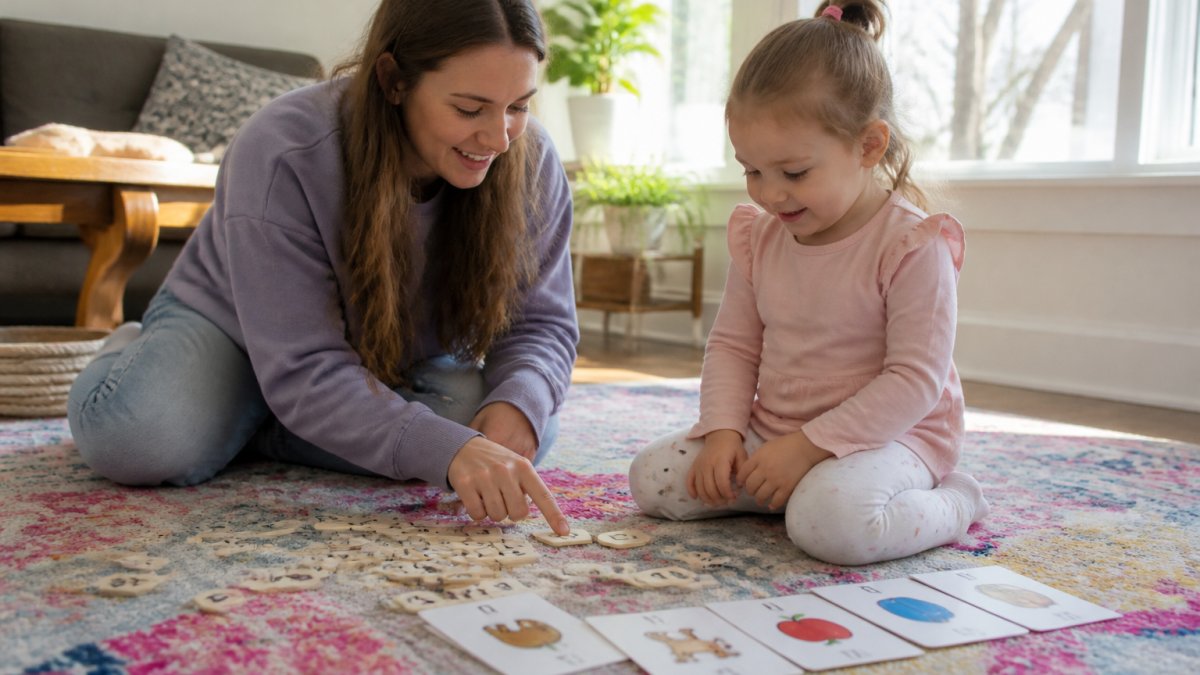
Making sound practice fun with everyday items
Sound hunt. Pick a sound like /s/. Walk around the house. "Can we find things that start with /s/? Sock, spoon, soap." You name them.
Sound match. Say two words. Do they start the same? "Sun and sock?" Yes. "Sun and cat?" No. Your child claps for yes, shakes their head for no.
Rhyme with toys. Pick a toy: "This is a cat. What rhymes with cat?" Offer choices: "Hat or dog?" Kids love picking the right answer.
Sound-and-move. Say a sound. Your child does a movement. "/s/ means spin. /j/ means jump." Silly, memorable, and it gets energy out.
I spy with sounds. "I spy with my little eye something that starts with /m/." Your child looks around. It's a classic game with a sound twist.
Troubleshooting: When Your Child Struggles with Sounds
Not every child picks up phonemic awareness at the same pace. Some need more time. Some need different approaches. Here's what to watch for and what to do.
Signs to watch for and when to reach out
Rhyming trouble past age 4. By age 4, most kids start noticing rhymes.
Reversals past age 7. Reversing sounds ("pot" for "top") is normal in early readers. But if it's still happening regularly after age 7, talk to a teacher.
Slow reading or avoidance. If your child is avoiding reading or reading much slower than peers, that's a flag. It doesn't mean there's a problem.
Difficulty with rhyming and alliteration. If your child isn't picking up rhymes or alliteration by age 5, that's earlier to address.
Remember: dyslexia and other reading challenges are not about intelligence. They're about how a brain processes sound and symbol. Early support makes a huge difference.
Adapting activities for different learners
If your child is a visual learner. Use pictures or objects. Point to a picture of a "cat" as you say the sounds. Make it concrete.
If your child is a kinesthetic learner. Use movement. Clap for sounds, jump for rhymes, dance for blending. Get the body involved.
If your child is a listener. Use songs, chants, and repetition. Play music with rhymes. Sing the same song every day.
If your child speaks multiple languages. Phonemic awareness in one language transfers to another. Pick one language to focus on at first. The skills will help with both.
If your child has ADHD or attention challenges. Keep activities short: 3 to 5 minutes. Change activities often. Make them high-energy and playful. Pressure kills progress.
Building Your Family's Sound Routine
The secret to phonemic awareness isn't doing one perfect activity. It's consistency and joy. A five-minute game every day beats a long lesson once a month.
Keeping practice short, consistent, and joyful
Pick a time. Breakfast, car rides, bedtime, or bath time. Wherever you already have one-on-one time.
Start small. Three to five minutes. That's it. Your child's attention span is short. Stop before they're bored.
Repeat the same game. Kids learn through repetition. Play the same rhyming game for a week.
Follow your child's lead. If they're not interested today, stop. Come back tomorrow. Pressure turns play into work.
Make it part of your story. In Chapter 2 of Literacy Roots, Lauren talks about how parents are their child's first teachers.
The truth is simple: phonemic awareness grows in small, warm moments. A conversation in the grocery store.
Frequently Asked Questions
How is phonemic awareness different from phonics?
Phonemic awareness is about hearing and manipulating individual sounds in spoken words, with no letters involved. Phonics teaches the connection between those sounds and written letters. Your child can develop strong phonemic awareness just by listening and playing with sounds, even before they see a single letter. Both skills matter for reading, but phonemic awareness comes first.
What are some free activities for phonemic awareness at home?
You don't need special materials. Try rhyming games during car rides, clap syllables in words while cooking, or ask your child what sound they hear at the beginning of their name. Sing songs with repeated sounds, play "I Spy" with sounds instead of letters, or make silly rhyming sentences together. Books with rhymes and alliteration, like nursery rhymes, build these skills naturally while you read together.
How long should phonemic awareness practice last each day?
Keep it short and joyful. Five to ten minutes is plenty, and it doesn't have to be a separate lesson. Weave sound play into everyday moments: the grocery store, bath time, car rides, or bedtime. Consistency matters more than length. A few minutes every day beats a long, frustrating session once a week.
What should I do if my child struggles to hear sounds in words?
Start even simpler: focus on rhyming and rhythm first, then move to bigger sounds like syllables before isolating individual phonemes. Use exaggerated, playful pronunciation and repeat activities many times without pressure. If your child continues to struggle with rhyming or sound awareness by age 4 or 5, mention it to your pediatrician or teacher. Early support works best, and there's no shame in asking for guidance.
Ready to build a stronger foundation for your child's reading journey? Literacy Roots: Nurturing Your Child's Reading Journey from Birth to Brilliance by Lauren Daugherty walks you through phonemic awareness and every other literacy skill, with real family stories and research made simple. Chapter 2 digs deep into how parents are the first and most enduring teachers. Get the book on Amazon and start tonight.


