 How-to
Daily Reading Routines: Why Little and Often Wins for Kids
Last Updated: October 29, 2026
Quick Summary
Daily reading routines build vocabulary, listening skills, attention, and a secure bond between parent and child. Short, regular sessions work better than one long reading session each week. Even five to ten minutes a day, at a time that already fits your household, makes a real difference.
- Picture books introduce rich words like "enormous" that rarely come up in everyday talk.
- Ask one open question per book, such as "What do you think will happen?", then wait.
- For toddlers, five to ten minutes is plenty, often split into two short sessions.
- Keep a book in the car, diaper bag, and by the bed so missed days are easy to recover.
- Watch for engagement signs like reaching for a book or asking for "one more.
Table of Contents
- The Grocery Store Counts: Why Everyday Talk Starts Reading
- What a Daily Reading Routine Builds: Language, Focus, and Connection
- How to Read to a Toddler Without Forcing It
- How Long to Read to a Toddler (And What If Your Child Won't Sit Still)
- Building a Bedtime Reading Routine for Kids in a Busy Household
- Early Literacy Activities for Young Children You Can Do Anywhere
- Start Your Family's Reading Habit Tonight
- Frequently Asked Questions
The Grocery Store Counts: Why Everyday Talk Starts Reading
You're pushing a cart down the cereal aisle while your toddler points at every box and shouts, "Bear!" You're tempted to hurry. Don't. That running commentary you're giving about apples, bananas, and the bright blue box? It counts.
Parents are a child's first and most enduring teachers, and literacy grows in small, warm, daily moments. You don't need flashcards. You need talk.
Researcher Patricia Kuhl describes how children learn language through back-and-forth exchanges with the adults around them. This is often called "serve-and-return." You say something, your child responds, and you answer again. Each turn builds the brain's language pathways.
Try this tonight:
- Narrate your errand. "We're getting milk. This one is cold. Let's find the yellow cap."
- Pause and wait. Give your child a few seconds to answer, even if the answer is just a grunt.
- Expand on what they say. If they say "dog," reply, "Yes, a big brown dog!"
Chapter 2 of Literacy Roots explores how repetition and everyday talk, sometimes called "language nutrition," help young brains grow. The point is simple: you're already doing the work.
What a Daily Reading Routine Builds: Language, Focus, and Connection
A daily reading routine is one of the easiest ways to give your child a steady dose of language. Short, regular sessions beat a long reading marathon once a week. Here's what the routine actually builds, and why it works.
Vocabulary. Picture books introduce words you rarely use in conversation, like "enormous" or "wobbly." Words in books often run richer than everyday talk, so story time can quietly widen what your child understands. You don't need a word list. Just read the sentence and let the picture do the explaining.
Listening and comprehension. Kids learn to follow a story, predict what happens next, and talk about it. Literacy includes listening as well as reading, and a daily read-aloud is a simple place to practice it. Ask one open question per book: "What do you think will happen?" Then wait.
Attention. Sitting still for a short book builds focus, one page at a time. The trick is matching length to age. A baby might last one board book. A toddler might make it through two. A preschooler can often handle a longer picture book if you pause to talk about the pictures.
Connection. Snuggling up with a book gives your child a calm, secure moment with you. That warm, shared attention is its own benefit, and it's the reason kids ask for the same book again and again.
Here's how the routine looks at different ages:
- Babies (birth to about 12 months): Short board books, high-contrast pictures, and your voice. Two to five minutes is plenty. Chewing the book counts as engagement.
- Toddlers (about 1 to 3): Repetitive stories, lift-the-flap books, and naming pictures. Five to ten minutes, often split into two sessions.
- Preschoolers (about 3 to 5): Longer picture books, silly voices, and questions about the story. Ten to fifteen minutes, and let them "read" to you from memory.
You don't need a lab coat to make reading aloud a habit. Pick a time that already exists in your day, like after lunch or before bath, and make it your reading slot. Chapter 3 of Literacy Roots looks at how the home reading environment, including a steady read-aloud habit, supports kids over time.
How to Read to a Toddler Without Forcing It
Toddlers don't sit still for long, and that's normal. The goal is to make books feel like a fun part of the day, not a test. The good news is that the most effective reading techniques are also the most playful ones.
Try these easy steps:
- Let your child choose the book. Ownership builds interest fast. Offer two or three options and let them pick.
- Read the pictures first. Point and name things. "Truck! Red truck!" This is called interactive reading, and it's how toddlers connect words to the world.
- Ask open-ended questions. "What's the bear doing?" beats "Is that a bear?" Give a few seconds of quiet for an answer.
- Follow their interests. If your child fixates on the dog on every page, talk about the dog. You're building attention, not finishing a checklist.
- Encourage retelling. After a favorite book, ask them to tell you what happened. Even a two-word version counts.
- Skip pages if needed. You don't have to read every word.
- Use silly voices. Animal sounds work every time.
- Stop before they're done. Leaving them wanting more keeps them coming back.
If your toddler walks away mid-book, that's fine. Pick up the book later. Literacy Roots encourages parents to read the same favorite book again and again. Repetition is how toddlers learn new words and patterns, and it's also how they build the confidence to "read" along.
For busy or inconsistent households: you will miss days. That's normal. The fix isn't a stricter schedule, it's a smaller one. Keep a book in the car, in the diaper bag, and by the bed. On a hectic night, read one page instead of one book. Then start again the next day without a lecture, for them or for you.
For multilingual families: read in the language you're most comfortable in. Dr. Jim Cummins and Dr. Gloria Ladson-Billings have written about how home languages strengthen learning. A book in your first language is still a reading routine.
For kids who need extra support: audiobooks, tactile books, and wordless picture books all count. If your child has a disability or developmental difference, ask your pediatrician or teacher about formats that fit. That's a conversation, not a diagnosis.
Here's a quick look at the steps that keep toddler reading playful and low-pressure.
| Step | What to do | Time or frequency |
|---|---|---|
| Let your child choose | Offer two or three books | Every session |
| Read the pictures first | Point and name things | Start of reading |
| Ask open-ended questions | Give a few seconds to answer | During the book |
| Follow their interests | Talk about what they focus on | As it comes up |
| Encourage retelling | Ask what happened, even in two words | After a favorite book |
| Skip pages if needed | You don't have to read every word | As needed |
| Use silly voices | Animal sounds work every time | Throughout |
| Stop before they're done | Leave them wanting more | End of session |
How Long to Read to a Toddler (And What If Your Child Won't Sit Still)
Many parents ask how long a reading session should last. For most toddlers, five to ten minutes is plenty. Two short sessions a day often work better than one long one.
A wiggly child is still learning. Try reading while they stack blocks or bounce on your lap. Hearing the words matters more than staying in one spot.
If reading feels like a constant battle, it can help to talk with your child's pediatrician or teacher.
Building a Bedtime Reading Routine for Kids in a Busy Household
Bedtime is one of the most natural times for reading. The lights are low, the day is winding down, and your child is already close to you.
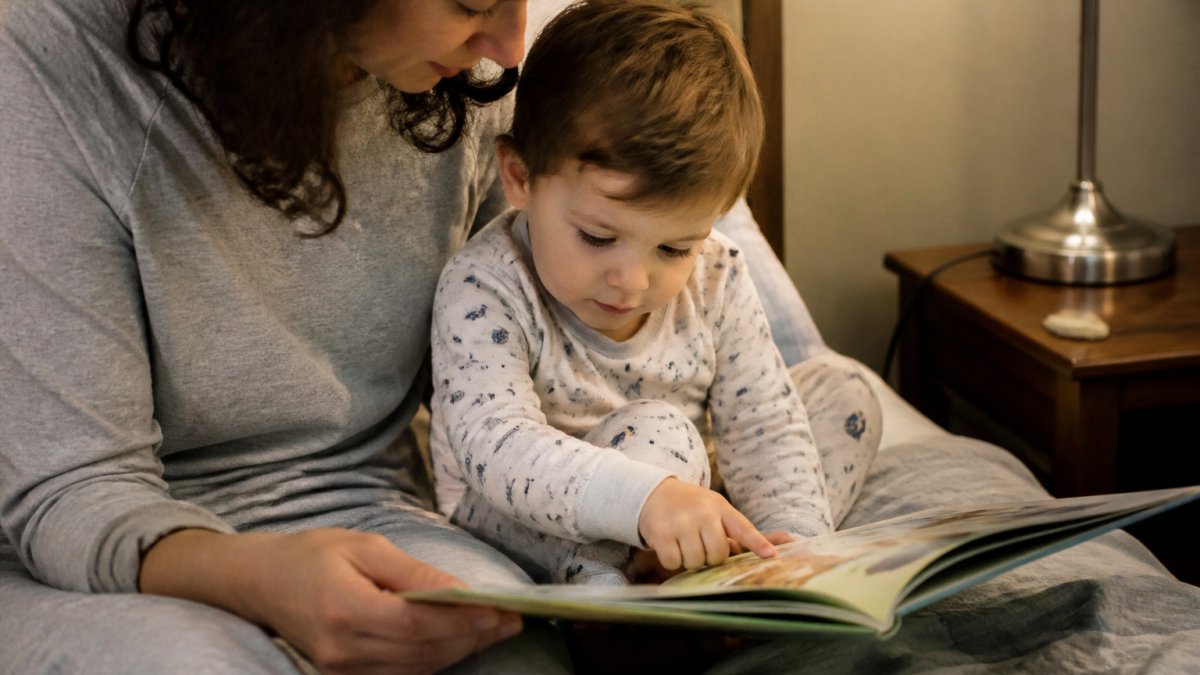
Picture this: a parent sits on the edge of a bed, a toddler in pajamas leaning in, the lamp casting a warm glow over a picture book. Ten minutes like that, every night, becomes a routine your child will remember.
To make it work in a busy home:
- Keep the same order each night. Bath, pajamas, one book, lights out.
- Limit choices. Offer two books, not twenty.
- Accept a short version. On hectic nights, read one book instead of three.
Routines don't need to be perfect. They need to show up often enough that your child expects them. Find simple, realistic reading routines that fit a crowded schedule.
Early Literacy Activities for Young Children You Can Do Anywhere
You don't need supplies or a schedule to build early literacy skills. Browse easy early literacy ideas for babies and toddlers. These activities fit into a car ride, a park bench, or the kitchen.
- Sing rhyming songs. Nursery rhymes teach kids to hear the sounds in words.
- Play "I spy" with letters. "I spy something that starts with B."
- Let them scribble. Scribbles count as early writing. Praise the effort.
- Read environmental print. Point out stop signs, cereal boxes, and store names.
- Tell family stories. Retelling a story from your day builds sequencing skills.
Simple moves like these, repeated often, add up to real progress. Try playful phonics games you can start at home tonight.
Start Your Family's Reading Habit Tonight
You don't have to overhaul your whole routine. Pick one small step and try it tonight. Read one book before bed. Narrate one errand. Let your child scribble on a grocery list.
Parents are a child's first teachers, and you're already doing the important work. Lauren's Literacy Lounge can help you go further with Literacy Roots: Nurturing Your Child's Reading Journey from Birth to Brilliance, a guide that mixes research, family stories, and easy exercises. You can get the book on Amazon for $14.99.
Frequently Asked Questions
What are the benefits of reading to young children every day?
Daily reading exposes children to new words, sentence patterns, and the rhythm of language, which supports the everyday talk that builds vocabulary. It also gives them practice with listening and comprehension, and many children start to connect books with comfort and closeness. Lauren Daugherty's book Literacy Roots describes these small, warm moments as the foundation of literacy. You do not need a perfect schedule. Five minutes of a shared book on most days adds up, and the habit matters more than the length of any single session.
How long should I read to my toddler each day?
There is no magic number, and a few short sessions often work better than one long one for a wiggly toddler. Many families aim for a few minutes at a time, spread across the day, with a longer story at bedtime if it fits. Pay attention to your child's cues. If they start walking away or grabbing the book, that is a good stopping point. End on a happy note so they want to come back tomorrow. For a child who needs more time, try adding a second short story rather than stretching one session.
What should I do if my young child won't sit still for a story?
Let your child move. Some children listen better while stacking blocks, sitting on your lap, or pointing at pictures. Try reading the same short book a few times, since familiar stories often hold attention better than new ones. Ask simple questions like Where is the dog? and let your child point or answer in any way they can. If restlessness continues across many settings, it is reasonable to mention it to your child's pediatrician or teacher. This is a conversation to have, not a diagnosis.
Is it okay to read the same book to a child every day?
Yes, and it is often exactly what children need. Repetition helps young children learn words, predict what comes next, and feel secure with the story. Lauren's book explores why reading the same book many times can be a powerful learning experience. Your child may ask for the same book again and again, and that is a sign of learning, not a problem. When you are ready for variety, add one new book at a time alongside a favorite.



