 Listicle
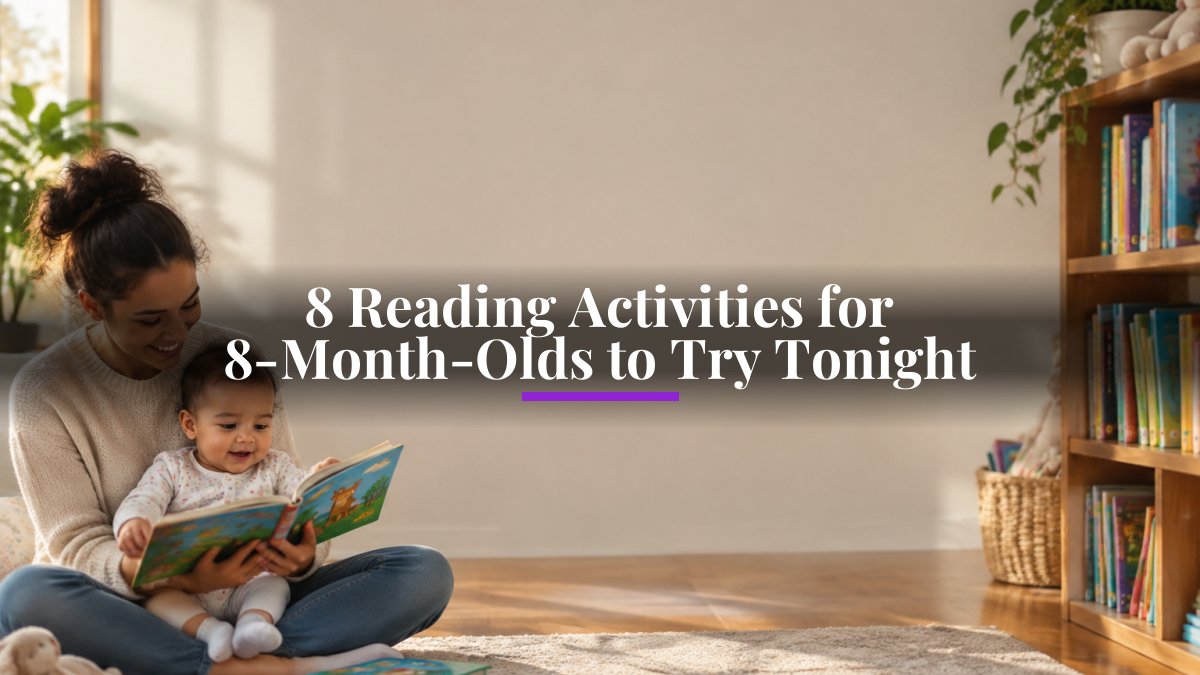
8 Reading Activities for 8-Month-Olds to Try Tonight
Last Updated: November 16, 2026
Quick Summary
Reading activities for an 8-month-old can be as simple as narrating everyday routines, pointing and naming objects, and pausing for babbling. You don't need flashcards or a program, because at this age your baby is already tuned in to your voice and face. Pick one activity and try it tonight.
- Narrate what you're doing out loud, like naming foods at the grocery store.
- Point to an object, name it, then pause so your baby can babble back.
- Choose sturdy board books, cloth books, or high-contrast books for little hands.
- Pair a book with a safe object, such as a wooden spoon and pot for a book about sounds.
- Use only objects too large to swallow, and supervise closely during mouthing.
Table of Contents
- Why Your 8-Month-Old Is Ready for Reading Activities
- Free Reading Activities for 8-Month-Olds You Can Start Today
- Book Choices and Caregiver Prompts That Keep Wiggly Babies Engaged
- Language Activities for Infants 6-12 Months, Including Songs and Rhymes
- Safe Sensory and Movement Play That Pairs With Reading
- Reading Activities for 8 Month Olds PDF: A Printable Plan You Can Make Yourself
- Your Next Step: Build a Simple Reading Routine This Week
- Frequently Asked Questions
Why Your 8-Month-Old Is Ready for Reading Activities
You don't need flashcards or a reading program to start. At eight months, your baby is already tuned in to your voice, your face, and the way you point at things. That's the raw material of early literacy.
Here's the research behind it. Research on early language, including Dr. Patricia Kuhl's work, points to the value of repeated, responsive back-and-forth with the people who care for babies. Lauren calls this the "serve-and-return" pattern: your baby babbles, you answer, and that loop builds language. In Literacy Roots (Chapter 2, Parents as First Teachers), Lauren describes everyday talk as "language nutrition." Every word you give your baby counts.
If your 8-month-old won't sit still for a book, that's normal. Reading with a wiggly baby is still reading. The activities below are short, flexible, and built around the moments you already have.
Free Reading Activities for 8-Month-Olds You Can Start Today
Most of these cost nothing and fit into routines you already do. Start with one tonight.

Narrate the Grocery Store and Everyday Routines
Narrate what you're doing, out loud, as you go. Name the things you see, touch, and hand your baby: "Apple. Red apple. Crunchy!" Describe your steps too: "Now we're putting the milk in the cart."
This is the "running commentary" Lauren talks about in Chapter 3 (Home Literacy Environment) and Chapter 12 (Empowered Parents). The Martinez family in Chapter 12 built grocery vocabulary this way. That chatter counts as reading time.
Point, Name, and Pause for Babbling
Point to something, name it, then pause. When your baby looks at the dog, say "Dog!" and wait. If your baby babbles or waves, treat it as a reply and respond: "Yes, that's a dog! Dog, woof!"
The pause is the important part. It gives your baby room to take a turn, which is the same back-and-forth that builds language. Dr. Catherine Snow's research on listening, covered in Chapter 4 (Beyond Reading), points to how much early listening and conversation matter.
Most of these cost nothing and fit into routines you already do, so you can start with one tonight.
| Activity | What to do | Where it comes from |
|---|---|---|
| Narrate the grocery store | Name what you see and touch out loud | Chapter 3 and Chapter 12 |
| Point, name, and pause | Name an object, then wait for babbling | Chapter 4 |
Book Choices and Caregiver Prompts That Keep Wiggly Babies Engaged
At eight months, the book matters less than how you use it. But the right format makes the whole thing easier. Here's how to pick by material and interaction type, plus the exact words to say while you read.
Match the book to how your baby explores
Board books: the workhorse. Thick pages survive grabbing, banging, and the occasional chew. Choose big, high-contrast pictures and one clear image per page. These are your best bet for a baby who wants to hold and turn pages alone.
Cloth and soft books: good for babies who mouth everything. They're light enough to clutch and safe to chew. Keep them in the diaper bag for on-the-go reading.
High-contrast books: black-and-white or bold primary-color patterns still hold attention at this age, especially during tummy time. Prop one open on the floor and let your baby look while you narrate.
Textured and touch-and-feel books: these invite hands. Guide your baby's fingers to the fuzzy patch or bumpy scale and say the word: "Soft. Feel the soft bunny." That pairs a sensation with a label, which is early vocabulary building.
Lift-the-flap books: great for cause and effect, but check that flaps are sturdy and securely attached. At eight months, a loose flap goes straight to the mouth.
Watch out: skip any book with torn pages, loose flaps, or small attached pieces, and check books before handing them over.
Prompts that work when your baby won't sit still
You don't need a full read-through. You need a few good exchanges. Try these:
- Point and label: "Where's the ball? There's the ball!" Point, then let your baby's eyes follow.
- Ask and wait: "What does the cow say?" Then pause. A squeal, a babble, or a grab all count as an answer. Respond to whatever you get.
- Make the sound effects: moo, vroom, splash. Sounds slow down the language and make it easier to hear.
- Read the faces: "Uh oh, the bunny looks sad. Can you make a sad face?" Mirror the expression back.
- Let baby flip the pages. Pages you don't finish still count. So does reading the same page five times.
If your baby crawls off mid-book, follow their lead. Read in short bursts, two minutes at a time, and pick the book back up when they return. A baby who associates books with freedom to move and a warm voice is a baby who comes back.
Chapter 3 (Home Literacy Environment) covers how the home environment shapes early reading. The short version: access and warm repetition beat perfect read-alouds.
Language Activities for Infants 6-12 Months, Including Songs and Rhymes
Songs and rhymes are some of the most powerful early literacy tools you have. Rhythm and repetition help babies hear the sounds that make up words. Sing "Itsy Bitsy Spider" with finger motions, or recite a simple rhyme at bedtime.
Keep it going all day. Hum while you change a diaper. Chant a silly rhyme on the walk to the car. The approach works in any language, too. Chapter 7 (Cultural Literacy) covers how home languages can support a child's later English learning, so sing the songs you already know.
Safe Sensory and Movement Play That Pairs With Reading
Eight-month-olds learn with their whole bodies. They touch, shake, drop, and mouth everything, and that's not a distraction from reading. It's how reading takes root. Pairing a book with a safe object or a bit of movement lets a wiggly baby stay connected to the story without being asked to sit still.
Pair an object with a book
Pick a book, then hand your baby one safe object that matches it:
- A book about sounds: give a wooden spoon and a metal pot to bang while you read. "Bang! Loud!"
- A book about animals: offer a soft washcloth "bunny" to pet as you name it.
- A book about bedtime: drape a soft scarf over your baby's hands during a peekaboo page.
- A textured book: guide little fingers to the bumpy page and say the word for the texture.
These pairings turn a book into a hands-on experience, which is exactly what holds an eight-month-old's attention.
Let movement lead back to the book
Place a sturdy board book just out of reach on the floor. Your baby crawls toward it, reaches, and grasps. That reach-and-grab connects the physical act of turning pages with the reading itself. Cheer when they get there, then open the book together.
Safety basics
- Use only objects too large to swallow. A good test: if it fits through a toilet paper tube, it's too small.
- Supervise closely during any mouthing or play.
- Skip anything with small parts, sharp edges, or long strings.
- Clean books and toys that go in the mouth, and check books for tears before handing them over.
Watch out: a baby who is cruising or pulling up can topple onto a hard toy. Clear the reading area of anything rigid before you set a book on the floor.
Adapt for your baby's pace
Not every eight-month-old is crawling or sitting independently, and that's fine. If your baby isn't mobile yet, bring the book to them: prop it open during tummy time, or hold it within batting range. If your baby has a sensory sensitivity, start with one soft texture and one quiet book rather than a noisy, busy one. If your baby is working with a physical therapist or early intervention provider, ask them how to fold a book into the exercises you already do. The goal is connection, not a milestone checklist.
Chapter 4 (Beyond Reading) describes literacy as a mosaic of reading, writing, speaking, and listening. A baby who bats at a book and chews its corner is already engaging with it.
Reading Activities for 8 Month Olds PDF: A Printable Plan You Can Make Yourself
Want a plan to follow? Grab a sheet of paper and write three columns: Morning, Playtime, and Bedtime. Under each, add one activity from this article. Pick a book, a song, and a narration moment. Stick the sheet on the fridge.
That's your printable reading routine. You don't need a fancy download. Keep it simple and adjust as your baby grows.
Your Next Step: Build a Simple Reading Routine This Week
Pick one activity from this list and try it tonight. Maybe it's narrating dinner, or reading one board book before bed. You don't have to do all eight. Consistency and joy matter more than perfection.
If you'd like a deeper look at early literacy, Lauren's book, Literacy Roots: Nurturing Your Child's Reading Journey from Birth to Brilliance, is available on Amazon and walks through these ideas chapter by chapter. Start small, have fun, and let your baby lead.
Frequently Asked Questions
What are some good learning activities for an 8-month-old baby?
Shared board-book reading, narrating what you do during daily routines, and singing simple songs all work well at this age. Pausing after you name something and waiting for your baby to babble or look back at you builds back-and-forth conversation, which is the foundation of early literacy. Peekaboo with a book flap or a cloth book is another easy favorite. You don't need special materials, just a few minutes and your voice.
How long should I read to my 8-month-old?
Short and frequent beats long and forced. Many babies this age enjoy two to five minutes at a time, and they may wiggle off the lap before the book ends. That's normal and still counts. Try reading a few times a day, especially at bedtime or during a calm moment after a meal. Follow your baby's cues and stop when they lose interest.
What kinds of books are best for an 8-month-old?
Sturdy board books with high-contrast images, simple pictures of familiar objects, and rhyming text work well. Cloth and textured books are great for little hands that like to grab, mouth, and explore. Look for books with a few words per page so you have room to talk about what's on it. Books with flaps or pull tabs add a fun surprise element.
What are some free reading activities for an 8-month-old?
Library story times, reading the same board book on repeat, and narrating a walk around the block all cost nothing. Pointing to pictures and naming them, then pausing to see what your baby does, is another free option. Singing nursery rhymes while you look at a book together works too. The most valuable resource is the back-and-forth time you already have with your baby.