 How-to
Why Is Reading Aloud to Toddlers Every Day Worth It?
Quick Summary
Reading aloud every day builds a toddler's language and brain development, because everyday talk acts as language nutrition. Even a short book before bed, with pointing and naming, counts toward that daily habit.
- Patricia Kuhl's research shows a baby's brain is about 80% adult size by age 3.
- Five minutes of warm, focused reading beats thirty minutes of rushed reading.
- Aim for two short read-alouds a day, anchored to routines you already have.
- Let your child hold the book, point, and name pictures, even if they wiggle.
- Reading in your home language supports later English learning, so keep it going.
Table of Contents
- Why Daily Read-Alouds Matter More Than You Think
- How to Read to a Toddler (Even If They Won't Sit Still)
- How Long to Read to a Toddler Each Day
- Interactive Read-Aloud Activities for Toddlers
- Choosing the Best Books for Toddlers
- Reading in Your Home Language Counts Too
- Your First Read-Aloud Tonight
- Frequently Asked Questions
Why Daily Read-Alouds Matter More Than You Think
Last night, your toddler grabbed the same board book for the fifth time. You sighed, opened it again, and wondered if this was really doing anything. Reading aloud can be a simple way to share a book with your child, and you don't need a fancy plan to start.
Lauren Daugherty's 12-chapter guide, Literacy Roots, covers building reading, writing, speaking, and listening skills. It starts from a simple truth: parents are a child's first and most enduring teachers (Literacy Roots, Chapter 2).
Here's the research piece in plain English. Patricia Kuhl's work on early brain development shows that a baby's brain is about 80% adult size by age 3 (Literacy Roots, Chapter 2). Everyday talk builds that brain. Lauren calls it "language nutrition." Every time you read, name a picture, or chat about a dog, you're feeding it.
Try this tonight: Read one book before bed, even if your child only sits still for two pages. That counts.
How to Read to a Toddler (Even If They Won't Sit Still)
Let's be honest. Toddlers don't sit still for long. Mine wiggled off the couch mid-page more times than I can count. A squirmy reader is still a reader.
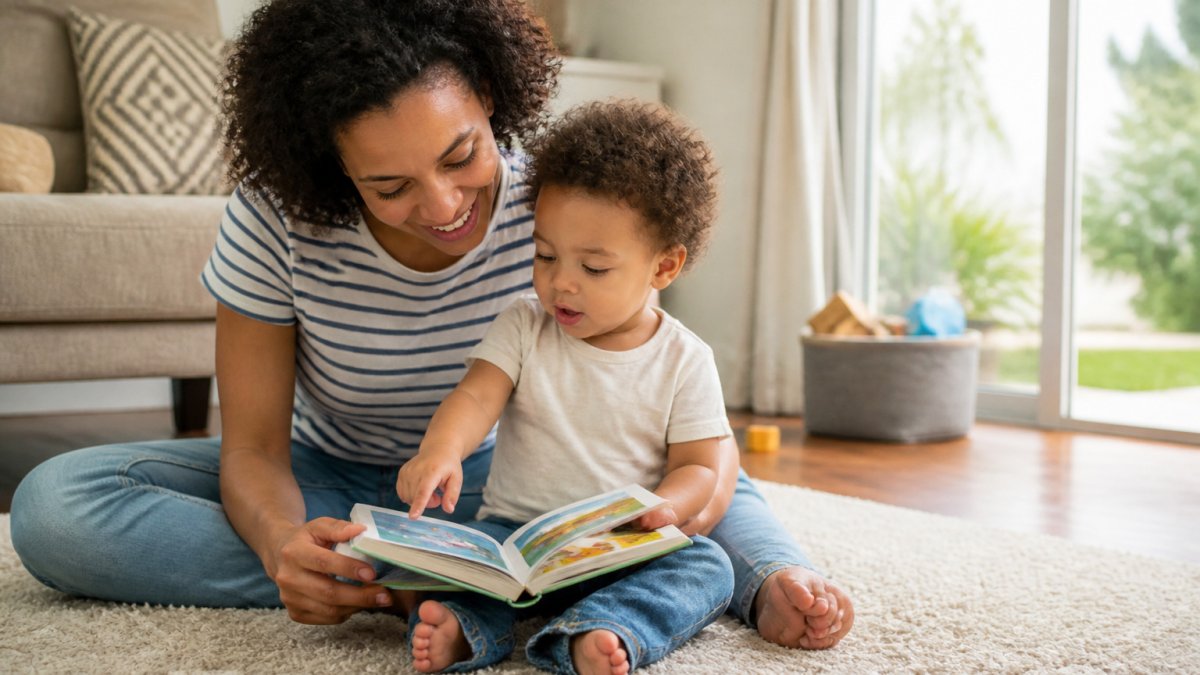
Try these easy moves:
- Let them hold the book. Turning pages gives little hands a job.
- Point and name. Say "Dog! Big dog!" and move on.
- Skip pages if needed. You don't have to read every word.
- Read on the floor. Lower energy often means longer attention.
- Use a different voice. Silly voices bring kids back fast.
Watch out: Keep it short and warm, and let your child walk away when they're done.
How Long to Read to a Toddler Each Day
There's no magic number, and that's actually good news. Five minutes of focused, warm reading beats thirty minutes of rushed reading every time. For most toddlers, two or three short books a day is a great rhythm, and some days will be one book, or half of one. That still counts.
Here's the mechanism in plain English. Toddlers build attention in short bursts, and the back-and-forth you do while reading (pointing, naming, waiting for a response) is what Lauren calls "language nutrition" (Literacy Roots, Chapter 2). The serve-and-return pattern matters more than the clock. A two-minute exchange where your child points and you name the picture is doing the work.
Build reading into routines you already have. The easiest way to hit a daily rhythm is to attach reading to something that already happens:
- After breakfast or lunch: one book while your child is still in the chair.
- Before nap: one short book as part of the wind-down.
- Bath time: a waterproof or plastic book in the tub.
- Before bed: the classic, and still the most reliable.
Pick two of those anchors and let the rest be bonus. For more simple, realistic options, see these simple reading routines for busy parents. A common pattern is one book in the morning and one at night, with a third whenever your child brings you one.
Watch for the stop signal. When your toddler slides off your lap, closes the book, or starts flipping fast, you can stop. You can always read again later.
Let the routine flex with your family. Shift workers, military families, and households with multiple kids often can't do the same slot every day. That's fine. The goal is a warm daily moment, not a perfect schedule. Lauren's book makes the case that literacy grows in small, everyday moments, and that consistency and joy beat perfection (Literacy Roots, Chapter 2).
Here's a quick way to see how the daily rhythm can fit into a real day.
| Routine anchor | When it happens | How long |
|---|---|---|
| After breakfast or lunch | While your child is still in the chair | One book |
| Before nap | Part of the wind-down | One short book |
| Bath time | In the tub | A waterproof or plastic book |
| Before bed | Nightly | One book, the most reliable slot |
| Flexible bonus | Whenever your child brings you one | As many as you can fit |
Interactive Read-Aloud Activities for Toddlers
Make reading a conversation instead of a lecture:
- Ask one question per page. "Where's the cat?" works well.
- Act it out. Stomp like a dinosaur or flap like a bird.
- Sing the words. Familiar tunes make rhymes stick.
- Make predictions. "What do you think happens next?"
- Find hidden details. Spot the red ball on every page.
These games are free and can fit into a day. Lauren's book discusses everyday talk as part of early literacy.
Choosing the Best Books for Toddlers
Here's a scene I know well: you're standing in the children's section, holding three books, and none of them feel right. Picking books for a toddler is less about finding the "best" one and more about matching the book to the kid in front of you. Lauren's book treats book choice as part of the home literacy environment, not a test you can fail (Literacy Roots, Chapter 3).
Start with a small, honest starter collection. Most families don't need a wall of books. A workable starter set is roughly 15 to 25 titles: a handful of sturdy board books, a few rhyming or sing-song books, two or three lift-the-flap or touch-and-feel books, one or two wordless picture books you can narrate together, and a couple of nonfiction picks about whatever your child is obsessed with (trucks, bugs, dogs, the moon). That mix gives you variety without overwhelm, and it grows naturally through library trips, gifts, and swaps.
Balance familiar favorites with new books. You can keep familiar books in rotation and add a book with a new word, a new idea, or a slightly longer story.
Choose inclusively on purpose. Look for books that show different kinds of families, cultures, languages, abilities, and neighborhoods.
Keep safety and access in mind. For toddlers, sturdy board books beat paper pages. Store books low and within reach, in bins or on a low shelf, and anchor any taller shelving to the wall so it can't tip. Keep a clear path to the reading spot, and rotate a small stack to the front every week or two so the collection feels new without costing anything.
Reading in Your Home Language Counts Too
Reading in your home language is not a step backward. Strong skills in one language help children learn another. When you're ready for your next book, see this guide to the best books for early readers. Lauren's book draws on research from Dr. Jim Cummins, who has long argued that home language strengths support English learning (Literacy Roots, Chapter 7).
You can read in your home language, tell stories from your family, and sing songs from your culture.
Your First Read-Aloud Tonight
Pick one book, grab a cozy spot, and read for five minutes. Point, name, and laugh together. Skip the pages that don't land and go back to the favorites.
Reading every day isn't about doing it perfectly. It's about showing your child that books are a place to connect with you.
Ready to go deeper? Learn more about Literacy Roots: Nurturing Your Child's Reading Journey from Birth to Brilliance by Lauren Daugherty, a guide to building reading, writing, speaking, and listening skills from birth onward.
Frequently Asked Questions
What are the benefits of reading aloud to toddlers every day?
Lauren Daugherty's Chapter 2 describes everyday talk as "language nutrition." You don't need perfect technique. Sharing a book together is one way to make room for a warm daily moment.
What should I do if my toddler won't sit still for a story?
Let your toddler move. You can keep the story short and stop when your child loses interest. Try again later in the day.
Does rereading the same book help toddlers learn?
Lauren's Chapter 2 discusses repetition. You can reread a favorite book if your child wants to hear it again.
Can I read aloud to my toddler in our home language?
Absolutely. Chapter 7 of *Literacy Roots* covers how home languages strengthen English learning. You can read, tell stories, name pictures, or sing in your home language.



