 Listicle
Sensory Activities for Early Reading: 7 Ideas to Try Tonight
Quick Summary
Sensory activities for early reading include sensory bins with foam letters hidden in dried beans, writing letters in shaving cream or sand, and multisensory practice that pairs sight, sound, and movement. These hands-on games help children connect letter shapes and sounds before they recognize words on a page. Most need only materials families already own.
- Sensory bins hide foam letters in dried beans or rice for letter practice.
- Write letters in a thin layer of shaving cream or sand, then wipe and start again.
- Keep multisensory rounds about five minutes and stop while your child still wants more.
- Air-writing and arm tapping need no materials and work well in car rides.
Table of Contents
- Why Sensory Play Helps Early Readers Get Ready to Read
- Sensory Bin Ideas for Letters You Can Set Up at Home
- Writing Letters in Shaving Cream, Sand, and Other Easy Materials
- Multisensory Reading Strategies That Use Sight, Sound, and Movement
- Air-Writing, Arm Tapping, and Other Movement Games for Letters
- Age Guide, Safety Notes, and Adaptations for Sensitive Kids
- Picking Your First Activity and Checking Whether It Helps
- Frequently Asked Questions
Last Updated: November 10, 2026
Your toddler is pulling foam letters out of a tub of dried beans, and you're thinking this is the mess you signed up for. Here's the good news: that tub is a reading lesson. Sensory play gives children a way to feel letters, hear them, and move them around before they recognize them on a page. At Lauren's Literacy Lounge, we've built this guide around seven sensory activities for early reading you can set up at home tonight, with materials most families already own.
Sensory activities are hands-on experiences that engage touch, sight, sound, and movement to help children build the skills that come before reading. Hands-on practice can help children remember a letter more easily than seeing it on a card alone. Lauren Daugherty's book Literacy Roots makes the same point: learning happens in small, warm, everyday moments, not just at a desk.
Why Sensory Play Helps Early Readers Get Ready to Read
Reading depends on connecting sounds to shapes. Our guide to games that build real reading skills explains how play supports reading readiness. A child who can feel the curve of a letter and say its sound is building both pieces at once. Sensory play gives that connection a physical anchor.
Young Learners Grow Through Sensory Play and Reading describes how tactile, hands-on writing connects sensory-based learning with early literacy.
Sensory Bin Ideas for Letters You Can Set Up at Home
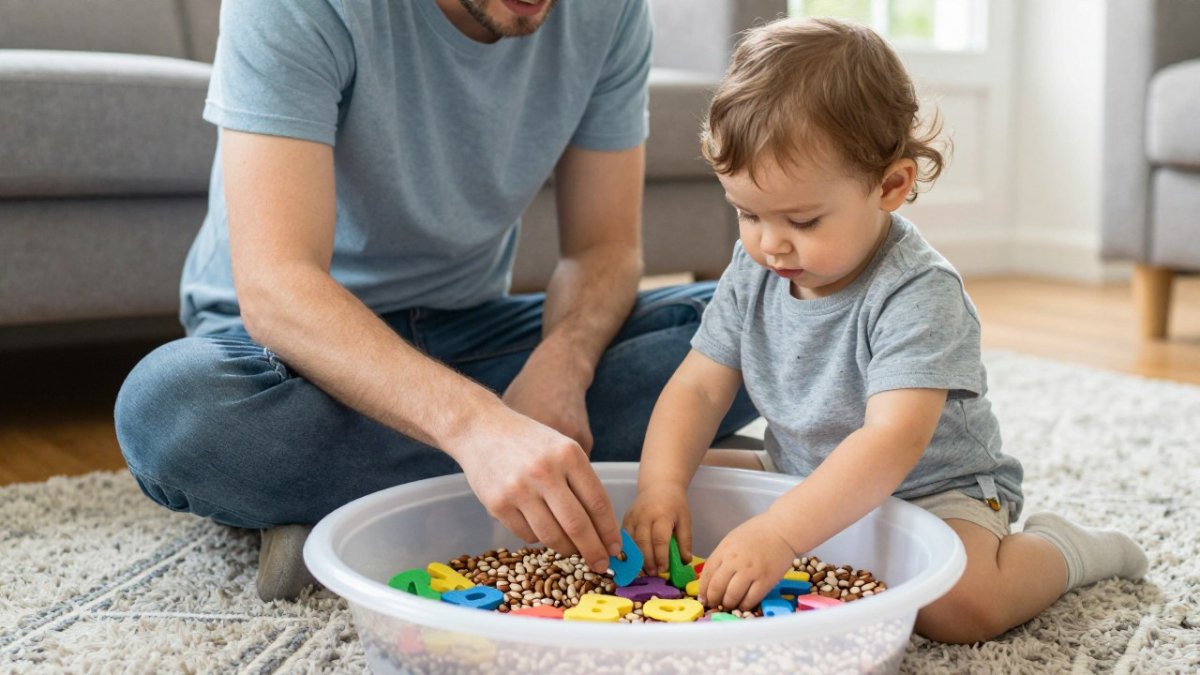
A sensory bin is a shallow tub filled with one material, such as dried beans, rice, or sand, with letters or small objects hidden inside. Hunting for foam letters in a tub of beans is a playful way to practice letter recognition and sounds. For more hands-on games you can play at home tonight, check out ready-made phonics games. Rotate the letters each week so the game stays new.
Writing Letters in Shaving Cream, Sand, and Other Easy Materials
Writing in a thin layer of shaving cream or sand lets a child practice letter shapes without the pressure of paper. Smooth the surface, then model a letter slowly and have your child copy it with a finger. Cleanup is simple: wipe the tray and start again.
Multisensory Reading Strategies That Use Sight, Sound, and Movement
Multisensory reading strategies pair what a child sees, hears, and does at the same time, so one letter or sound gets practiced through several channels. The payoff is practical: each channel reinforces the others, giving a child more ways to practice the same idea. Think of it as giving the same idea three handholds.
Here is how that looks with one target sound, the short /m/. Show the letter m on a card while you say "mmm" slowly, then trace the letter in the air or on your child's back. Next, ask your child to say a word that starts with /m/, like mop or milk, and finish with a movement such as bringing their hands together like lips pressed closed. Each step targets a different early-reading skill, such as letter recognition and letter sounds.
Keep each round short, about five minutes, and stop while your child still wants more so the game stays fun. You can also adapt this for different needs. A child with low vision can feel a raised or textured letter instead of looking at a card, and a child who finds movement overwhelming can simply tap the sound on a table.
To see whether a multisensory round is helping, notice whether your child offers the sound on their own later in the day, or whether they can name a second word that starts with the same sound. If progress stalls over several weeks, a teacher or pediatrician can suggest next steps.
Literacy Roots by Lauren Daugherty (Chapter 2) reminds parents that early learning grows from repeated, playful exchanges.
Here is a quick way to see how each channel reinforces the same sound, step by step.
| Step | What to do | Time |
|---|---|---|
| Show the letter | Show the letter m on a card while you say "mmm" slowly | Short round |
| Trace it | Trace the letter in the air or on your child's back | Short round |
| Name a word | Ask your child to say a word starting with /m/, like mop or milk | Short round |
| Add movement | Bring hands together like lips pressed closed | Short round |
| Keep it short | Stop while your child still wants more | About 5 minutes |
Air-Writing, Arm Tapping, and Other Movement Games for Letters
Air-writing asks your child to draw a letter in the air with a big arm movement while saying its sound. For more practical guidance on teaching sounds without screens, see how to teach phonemic awareness at home. Arm tapping works similarly: tap one syllable on each arm or shoulder as you say a word. You'll find easy kindergarten activities to try tonight that build phonemic awareness through play. These games need no materials at all, which makes them perfect for car rides and waiting rooms.
Age Guide, Safety Notes, and Adaptations for Sensitive Kids
The same sensory activity can work for a toddler and a preschooler if you change the materials and the goal. For toddlers, focus on exploring textures and hearing sounds, using big items they can't swallow. For preschoolers, add small letters and simple copying tasks, since their fine-motor skills are ready for more precision.
Here is a quick age progression you can use for any activity in this guide. Toddlers (about 1 to 2 years) can scoop and dump large dry materials like sturdy pasta or oversized wooden letters while you name each letter. Preschoolers (about 3 to 5 years) can match letters to sounds, trace shapes in sand, and try writing their first name. Keep the same activity and just raise or lower the challenge.
Safety comes first. Supervise every sensory bin and remove any piece small enough to be a choking hazard for young children. Choose non-toxic, food-safe or craft-labeled materials, and check the label of any shaving cream or sand for allergens and skin sensitivities before use. If your child has a food allergy, consider swapping edible materials like dried beans or rice for non-food materials.
For children who dislike certain textures or sounds, adapt rather than push through. Start with one dry material, use a single tool like a spoon or a paintbrush, or keep a towel nearby so hands can be wiped between turns. A child who is sensitive to noise can do the listening games in a quiet room with the sound turned down, and a child with motor differences can trace letters with a large foam shape instead of a pencil.
If an activity causes distress every time, that is useful information, not a failure. Try a different material or a shorter session, and mention the pattern to a teacher or pediatrician who knows your child.
Literacy Roots by Lauren Daugherty (Chapter 6) notes that early, gentle support works best, and small adjustments like these help every child stay engaged.
Picking Your First Activity and Checking Whether It Helps
Start with one activity this week, not all seven. Pick the one that matches what your child already enjoys. To see whether it helps, notice whether your child names a letter or sound more often after a few sessions, or whether they ask to play again. If progress is slow, a teacher or pediatrician can offer more guidance.
Ready for more ideas like these? Lauren's book Literacy Roots gives you a full set of family-friendly routines that build reading from birth onward. [CHECK: insert Amazon link for Literacy Roots, $14.99]
Frequently Asked Questions
How does sensory play help with early reading development?
Sensory play gives children a physical way to notice shapes, sounds, and patterns before they read. When a child traces a letter in sand or feels a foam letter while saying its sound, the shape and the sound get linked in memory. That link between a letter's look, feel, and sound can help a child begin to connect shapes with sounds. It also builds the fine-motor control children need later for handwriting. Keep sessions short, playful, and focused on one or two letters at a time.
What are the 5-finger rule and the 3-2-1 reading strategy?
These are simple reading-support routines rather than formal programs. The 5-finger rule has a child open a book to any page and read it, then raise one finger for each unknown word to check for a good fit. The 3-2-1 approach works similarly: a child reads a page, names three things they noticed, two questions they have, and one thing they can predict next. Both routines fit easily into everyday reading and pair well with sensory activities, since the physical counting keeps young hands and minds busy.
Can sensory bins help children learn to read?
Yes, when the bin is built around letters, words, or sounds instead of only filling and dumping. A bin of dried rice with plastic letters, a few picture cards, and a scoop lets a child find the letter that matches a card and say its sound. This kind of practice gives children a chance to work on letter recognition and sounds. Rotate the letters every week or two so the activity stays fresh, and sit with your child to model the sounds.
What are some easy sensory activities for toddlers that support literacy?
Start with materials you already have. Writing letters in a tray of salt, sand, or shaving cream lets a toddler see and feel a letter shape. Finding hidden foam letters in dried beans builds visual scanning. Tracing a letter on a child's back while saying its sound combines touch and listening. For toddlers, keep the focus on play and talk: name the letter, make its sound, and let your child explore at their own pace.