 Listicle
Best Educational Apps for Early Literacy: A Parent's Guide
Last Updated: November 19, 2026
Quick Summary
The best early literacy apps build letter knowledge, letter sounds, and blending skills, but they work best as one tool alongside reading aloud and everyday talk. Strong options include Khan Academy Kids and Duolingo ABC, which are both free. Choose an app whose focus matches your child's current skill, and check whether it teaches sounds rather than just letter shapes.
- Look for apps that cover alphabet knowledge, letter sounds, blending, and early word recognition.
- Khan Academy Kids is free and combines read-along stories with literacy activities.
- Duolingo ABC focuses on phonics and first words and is free.
- Avoid apps that only quiz letter names, since they teach recognition rather than reading.
- Pair any app with daily read-alouds and talk about the sounds together.
Table of Contents
- Why Apps Can Support Early Literacy (and Where They Fall Short)
- Free Early Literacy Apps Worth Trying
- Phonics and Letter-Sound Apps Compared
- Comparison Table: Pricing, Skills, and Best Fit
- 5 Early Literacy Practices to Pair With Any App
- Early Literacy Tips for Storytime and Early Literacy Activities at Home
- Start Tonight: Pick One App and One Read-Aloud
- Frequently Asked Questions
Why Apps Can Support Early Literacy (and Where They Fall Short)
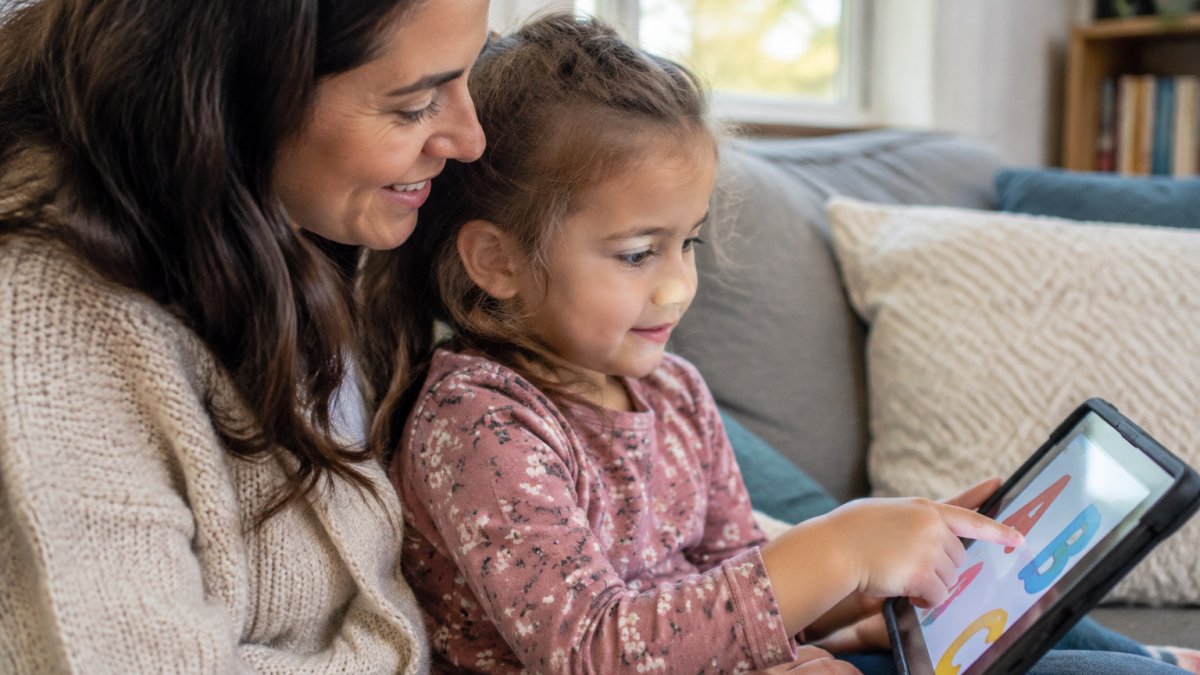
Your toddler is swiping at the tablet before you've finished your coffee. Maybe you're wondering whether those screens are helping or quietly hurting. Our article on how toddlers learn to recognize letters, step by step, walks through the early skills to watch for, how toddlers learn letters. Here's the honest answer: a good early literacy app can build letter knowledge and sound awareness, but it can't replace the bedtime story, the running commentary in the grocery store, or your voice saying "That's a B, like Bear!" Apps work best as one tool in a bigger routine.
Lauren Daugherty's book, Literacy Roots, makes the same point: parents are a child's first and most enduring teachers. Chapter 8, "Digital Literacy," covers the idea that technology is a tool that needs guidance from you.
Good early literacy apps tend to focus on a few core skills: alphabet knowledge, letter sounds (phonics), blending sounds into words, and early word recognition. Look for those. Be wary of apps that mostly reward tapping with no real practice behind it.
Free Early Literacy Apps Worth Trying
Free options are a great place to start, and several strong ones don't cost a dime. Try one for a week with your child before you spend anything. For most families, the free tier is enough to see whether a child enjoys the activities.
Khan Academy Kids
Khan Academy Kids is a free app that mixes stories and interactive exercises with math and social-emotional learning. Use it for read-along stories and short literacy activities, then let your child move on to other play.
Duolingo ABC
Duolingo ABC focuses on phonics and first words. It's a good fit for a preschooler who is starting to notice that letters make sounds. Sit beside your child for the first few sessions so you can say the sounds out loud together.
Phonics and Letter-Sound Apps Compared
Phonics apps teach the sound each letter makes and how sounds blend into words. If your child already knows some letters, a phonics-focused app can be the next step. The trick is telling a real phonics lesson apart from a tapping game with letters painted on it.
What evidence-based phonics looks like in an app
Most reading researchers agree that explicit, systematic phonics works: letters and sounds are taught in a set order, practiced to mastery, then blended into words. In an app, that shows up as a few concrete features. Look for a clear sequence (short vowels before long ones, for example), sound practice before letter-name quizzes, blending activities where your child hears and builds a word, and review that brings back earlier sounds. If an app only asks your child to tap the letter B, it's teaching recognition, not reading.
How the well-known apps compare
Duolingo ABC is free and focuses on phonics and first words, which makes it a low-risk way to see whether your child takes to sound practice at all.
Matching the app to your child's needs
Age labels are a rough guide at best. Match the app to the skill your child is working on right now. A child who knows letter names but not sounds needs sound practice. A child who knows sounds but can't blend them needs word-building activities. A child who reads simple words needs decodable stories, not more letter drills.
If your child has dyslexia, speech or language needs, or is learning in more than one language, ask two questions before you download. Does the app let you slow down audio or repeat sounds? Can you turn off timers and background music? Those features matter more than a cute mascot. For multilingual families, an app that lets you hear sounds in English while you talk about them in your home language keeps both languages strong. Chapter 7 of Literacy Roots covers how home languages strengthen English learning.
Watch out: an app that only quizzes letter names won't teach sounds. Make sure it practices what the letter says, not just what it looks like.
Progress you can actually see
A good app tells you what your child has mastered, not just how many stars they earned. Look for a parent dashboard or skill report that names the sounds and words your child knows. Then use that report away from the screen: point out those sounds in the grocery store, in signs, and in the books you read together. That back-and-forth is what turns screen practice into real reading, and it's the heart of Chapter 8, "Digital Literacy," in Literacy Roots.
Comparison Table: Pricing, Skills, and Best Fit
Below is what each app is built to teach and who it suits. Prices and free-tier terms change often, so confirm in the app store before you subscribe.
| App | Free Tier | Paid Tier (confirm current price) | Skills Covered | Best Fit |
|---|---|---|---|---|
| Khan Academy Kids | Yes, free and ad-free | None (no paid upgrade) | Read-along stories, early literacy, math, social-emotional learning | Broad early learning on a no-cost budget |
| Duolingo ABC | Yes, free | None for the literacy app | Phonics, letter sounds, first words | Preschoolers noticing that letters make sounds |
| Starfall | Limited free activities | Paid home subscription [CHECK: current annual price] | Letter sounds, early phonics, beginning reading | Practicing letter sounds with a low-cost add-on |
| Reading Eggs | Free trial period [CHECK: length] | Monthly or annual subscription [CHECK: current prices] | Phonics, spelling, vocabulary, sight words | Kids ready for word-level practice who will use it often |
| Teach Your Monster to Read | Free web version | Paid app version [CHECK: current price] | Phonics through games | Game-loving early readers |
| Hooked on Phonics | Trial [CHECK: terms] | Subscription [CHECK: current price] | Systematic phonics, letter sounds, blending | Families who want a structured phonics sequence |
| SmartKidzClub | Limited free ebooks | Subscription [CHECK: current price] | Narrated, illustrated ebooks | Listening and story exposure |
Before you pay, check three things: whether the free tier covers the skill your child needs, whether the subscription auto-renews, and whether you can cancel in the app store rather than on a website. A monthly plan you can stop beats an annual plan you forget. If a paid app is the right fit, try it for one billing cycle first and watch whether your child returns to it without prompting.
Watch out: a free trial that converts to a full annual charge is easy to miss. Set a phone reminder for two days before the trial ends so the decision stays yours.
5 Early Literacy Practices to Pair With Any App
No app works alone. These five habits make any screen time more useful.
- Read aloud every day. Even ten minutes of a picture book builds vocabulary and listening skills. Chapter 2 of Literacy Roots explains why reading the same book many times is so valuable.
- Talk through the app. Ask, "What sound does that letter make?" Your conversation teaches more than the screen does.
- Point out print in real life. Read the cereal box, street signs, and menus together.
- Let your child write, even scribbles. Pencil marks on paper are early writing practice.
- Keep sessions short. Five to ten minutes with a clear stopping point beats a long, frustrating sitting.
Early Literacy Tips for Storytime and Early Literacy Activities at Home
Storytime doesn't need a special setup. Let your child pick the book, and let them turn the pages. Pause to ask what they think will happen next. For toddlers, name the things in the pictures. For preschoolers, point to words as you read them.
At home, try simple early literacy activities that cost nothing. Play "I spy" with letters on food packaging. Sing alphabet songs in the car. Make a shopping list together and let your child draw or write the first letter of each item. These small, warm moments add up.
For military families moving every year or two, a few favorite books and one app your child already knows can make a new school or new house feel familiar. Chapter 3 of Literacy Roots covers the home literacy environment, including ideas for setting up reading space.
Start Tonight: Pick One App and One Read-Aloud
You don't need to do everything at once. Tonight, choose one free app from this list and one picture book from your shelf or library. Spend ten minutes on each, sitting together.
That's it. You're already doing the most important part: showing your child that reading and learning are close and fun. If you want a fuller plan, Literacy Roots by Lauren Daugherty is available on Amazon, with a chapter-by-chapter approach to building reading, writing, speaking, and listening skills.
Frequently Asked Questions
What are the five early literacy practices?
Early literacy practices are everyday habits that build the foundation for reading. Many educators name five: talking with your child, reading aloud, singing and playing with rhyme, playing with letters and sounds, and letting children write or scribble. Lauren's Literacy Lounge's book Literacy Roots describes these moments as small, warm, daily routines rather than formal lessons. You can do all five without spending money, and an app can add a few minutes of practice on top.
Can educational apps help preschoolers learn to read?
Apps can help preschoolers practice letter recognition, letter sounds, and early phonics, especially when the activities are short and playful. They work best as one piece of a bigger routine that includes real conversation and shared books. Look for apps that match your child's current skill level instead of pushing ahead. If your child struggles with rhyming, letter sounds, or reading, talk with a teacher or pediatrician rather than relying on an app alone.
How much time should young children spend using literacy apps?
Short sessions usually work better than long ones for young children. Many parents aim for about 10 to 20 minutes a day, split into one or two sessions, and pair the app with books and conversation. Pay attention to how your child responds, and stop when they lose interest. Treat the app as a supplement, not a replacement for talking, reading aloud, and playing together.
How can parents use apps to support early literacy at home?
Sit with your child for the first few sessions so you can see what they are practicing. Then ask a question about what they learned, like naming a letter sound they just heard or pointing out a word that starts with the same sound. Follow up with a book on the same topic at bedtime. Lauren's Literacy Lounge's book Literacy Roots (Chapter 3) suggests building literacy into daily routines, and a short app session can fit right into that rhythm.