 Listicle
Reading Readiness Games for Home That Build Real Skills
Last Updated: November 5, 2026
Quick Summary
Reading readiness games work because kids learn early literacy skills through play, not quizzing. Five-minute games like Magnetic Letter Hunt, Sound Basket, Name Chant, and Label the Room build letter recognition, phonemic awareness, syllables, and print awareness at home. Short, frequent bursts beat long sessions, so stop while it is still fun.
- Aim for three to five minutes per game with threes and fours, and five to ten with fives.
- Magnetic Letter Hunt uses magnetic letters and a metal baking sheet or fridge door.
- Sound Basket needs a basket and five to eight small objects with clear starting sounds.
- Name Chant requires no materials and works in the car, bathtub, or store line.
- Jot one thing you noticed once a week on your phone instead of testing your child.
Table of Contents
- Why Play Beats Flashcards for Reading Readiness
- Reading Readiness Activities for Preschoolers That Take Five Minutes
- Phonological Awareness Games at Home: Hearing Sounds Before Seeing Letters
- Rhyming Games for Kids That Make Bedtime Easier
- Letter Sound Games for Preschoolers: Matching Sounds to Symbols
- How to Know It's Working: Signs of Readiness and Progress
- Try One Game Tonight With Literacy Roots
- Frequently Asked Questions
Why Play Beats Flashcards for Reading Readiness
You're folding laundry while your four-year-old narrates a very dramatic story about a squirrel who stole a cracker. That's reading readiness happening in your living room, and it counts more than any flashcard drill.
Here's the short version: reading readiness games work because kids learn through play, not through quizzing. The skills that matter most before formal reading, hearing sounds, noticing rhymes, matching letters to sounds, building vocabulary, grow fastest when a child is laughing, moving, and talking with you. Kids who get games and conversation tend to walk into school with more confidence than kids who only get worksheets.
The Skills Hiding Inside Ordinary Games
Every good game sneaks in a skill. "I Spy" builds sound recognition. Silly rhymes build phonemic awareness. A matching card game builds letter recognition. You don't need a curriculum. You need a few minutes and a willing partner.
Reading readiness is the set of early literacy skills a child needs before formal reading instruction takes off: sound awareness, letter knowledge, vocabulary, and print awareness. Games deliver all four without the pressure of a lesson.
Reading Readiness Activities for Preschoolers That Take Five Minutes
Five minutes is genuinely enough. Short, frequent bursts beat long sessions, because attention spans are short and repetition is what makes skills stick. Short, frequent bursts tend to work better than one long sit-down, because attention spans are short.
Here is the part most activity lists skip: name the skill, gather the stuff, set a timer, and stop while it is still fun. Each game below follows that format so you can run it tonight without planning.
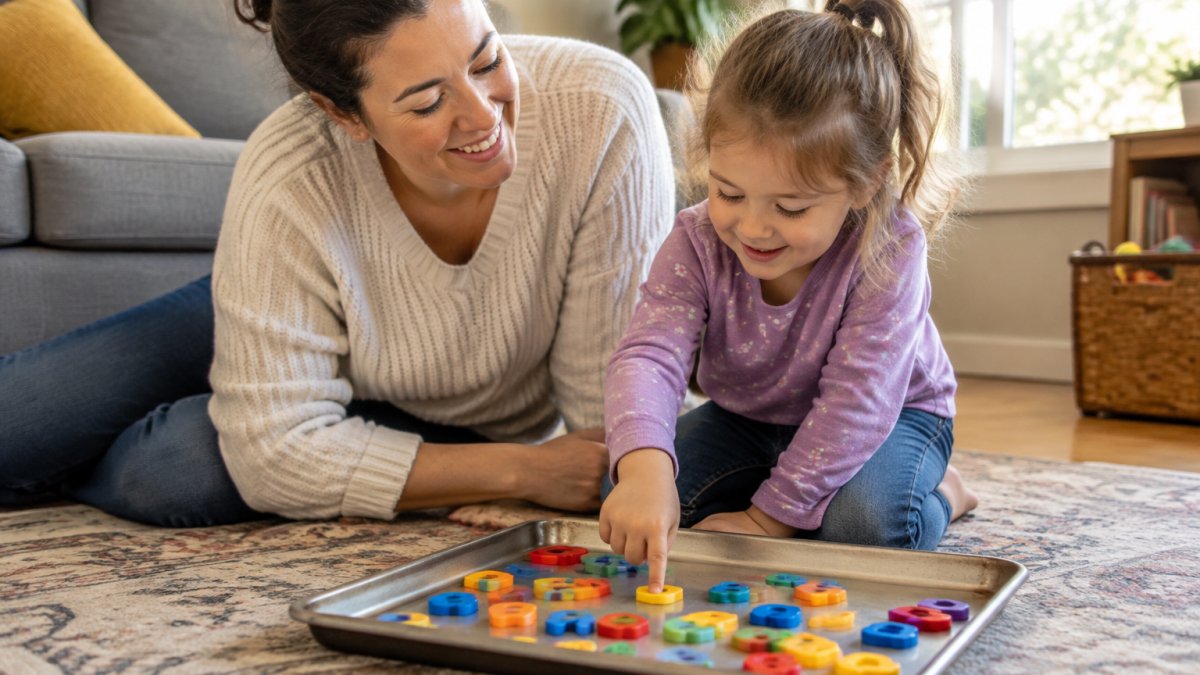
1. Magnetic Letter Hunt (letter recognition, about 5 minutes)
Materials: a handful of magnetic letters and a metal baking sheet or the fridge door. That is it.
Setup: hide four or five letters around one room while your child waits. Keep it to one room so the game stays short.
Play: your child finds a letter, names it, and sticks it on the sheet. If naming is still hard, you say the name and they echo it. That counts.
Skill link: repeated exposure to letters through search and touch is a simple way to build letter recognition.
Watch out: if your child starts hiding letters for you instead, let them.
2. Sound Basket (phonemic awareness, about 5 minutes)
Materials: a basket and five to eight small objects from around the house (a spoon, a sock, a block, a toy car).
Setup: no prep beyond gathering. Pick objects with clear starting sounds.
Play: pull out two objects and ask which one starts with the same sound as your child's name, or as a word you pick. Sort into piles by first sound.
Skill link: hearing and comparing first sounds is phonemic awareness, the sound-level skill that sits underneath phonics later on.
Watch out: don't correct a wrong answer with a lecture. Just say the word slowly together and let them hear it.
3. Name Chant (syllables and sounds, about 3 minutes)
Materials: none.
Setup: none. This is the car, the bathtub, or the line at the store.
Play: clap the beats in family names, then move to first sounds. "Grand-ma" gets two claps. "Mom-my" starts with /m/.
Skill link: syllable clapping builds the rhythm awareness that rhyming and sound blending depend on.
4. Label the Room (print awareness, about 5 minutes to set up, then ongoing)
Materials: sticky notes or index cards and a marker.
Setup: tape simple words to furniture: door, bed, chair, cup. Write them in your home language too if you speak more than one.
Play: once a day, do a quick lap and read the labels together. Point to the word as you say it.
Skill link: print awareness, the understanding that written words carry meaning and go in a certain direction, is a readiness skill kids pick up from seeing words in their space.
Watch out: don't quiz. If your child ignores the labels for a week, leave them up. They are still being seen.
A Quick Note on Session Length
For threes and fours, aim for three to five minutes. For fives and early kindergartners, five to ten works if they are still engaged. The timer is your friend, not because learning is timed, but because stopping early is what makes them ask for it again tomorrow.
Watch out: don't turn these into a test. If your child loses interest, stop. A game that ends early gets played again tomorrow.
Here are the four five-minute games at a glance, with the skill each one builds.
| Game | Skill | Materials | Time |
|---|---|---|---|
| Magnetic Letter Hunt | Letter recognition | Magnetic letters and a metal baking sheet or fridge | About 5 minutes |
| Sound Basket | Phonemic awareness | A basket and five to eight small objects | About 5 minutes |
| Name Chant | Syllables and sounds | None | About 3 minutes |
| Label the Room | Print awareness | Sticky notes or index cards and a marker | About 5 minutes to set up, then ongoing |
Phonological Awareness Games at Home: Hearing Sounds Before Seeing Letters
Sound games come first. Before a child can match a letter to a sound, they need to hear that words are made of sounds. This is the foundation of phonological awareness games at home, and it costs nothing.
Phonological awareness is the ability to notice and work with the sounds in spoken language, separate from letters. It includes hearing syllables, rhymes, and individual sounds in words.
For more ideas you can run tonight, try these phonemic awareness games for kindergarteners. They work just as well with younger kids.
Three Sound Games You Can Play in the Car
- Sound hunt. "I'm thinking of something that starts with /s/." Let them guess.
- Syllable clap. Clap the beats in words like "but-ter-fly."
- Sound swap. "What if we changed the first sound in 'cat' to /b/?"
Rhyming Games for Kids That Make Bedtime Easier
Bedtime is a natural fit for rhyming games for kids, because rhymes calm and connect. Start with a word and take turns adding a rhyme. Read a rhyming book and pause before the last word so your child fills it in. Silly wins here. The goofier the rhyme, the more they remember it.
If you want a step-by-step approach for your preschooler, this guide on how to teach rhyming to 4-year-olds walks through it.
Letter Sound Games for Preschoolers: Matching Sounds to Symbols
Now connect sounds to letters. Letter sound games for preschoolers should stay light: letter-sound bingo, a sound-to-picture match, or a simple "find the letter" hunt around the house. Keep sessions short and let your child lead.
Ready to go further? These phonics games to play at home give you ready-to-run options.
How to Know It's Working: Signs of Readiness and Progress
Progress shows up quietly. Your child starts hearing rhymes, naming letters, retelling a story, or asking what a word says. Those are signs the games are working. No test needed.
Here is the unique angle most activity roundups miss: you can watch for specific, observable skills and track them without turning play into a quiz. Think of it as noticing, not grading.
What to Watch For, by Skill
Sound awareness (phonemic awareness): your child hears that two words rhyme, claps the beats in a name, or tells you what sound a word starts with. A three-year-old who giggles at "cat, bat, hat" is showing you this skill.
Letter knowledge: your child names some letters on signs, on cereal boxes, or in books, and starts pointing them out without being asked.
Print awareness: your child holds a book the right way, runs a finger along words, or asks what a sign says. That is the understanding that print carries meaning.
Vocabulary: your child uses new words from books in everyday talk, or asks what a word means. That is language nutrition paying off.
Comprehension: your child retells a story, predicts what comes next, or asks why a character did something. That is understanding, not just decoding.
A Simple Way to Track Without Testing
Keep a running note on your phone or the back of a grocery list. Once a week, jot one thing you noticed: "named the M on the mailbox," "clapped three syllables in dinosaur." That is it.
If you want a clearer picture, this reading readiness checklist for 3-year-olds helps you track what to look for.
Watch out: don't turn the note into a scorecard. If you catch yourself counting how many letters your child knows compared to a cousin or a classmate, put the note down.
Adapting Games for Every Learner
Every child learns differently, and the same game can flex to fit. A wiggly kid can jump for each sound instead of clapping.
If you speak more than one language at home, use your home language alongside English.
If your child has an identified learning difference or you suspect one, these games are still for them. Keep sessions short, follow your child's lead, and talk with a teacher or pediatrician about what you are noticing.
Not sure if your child is ready to start? This guide on what age to start reading games answers that.
Try One Game Tonight With Literacy Roots
Pick one game from this list and try it tonight. That's the whole assignment. Small, warm, daily moments are what build readers, and that idea runs through every chapter of Literacy Roots: Nurturing Your Child's Reading Journey from Birth to Brilliance, especially Chapter 2, "Parents as First Teachers," where the everyday talk you already do gets credit as real teaching.
You don't need a teaching degree or a big budget. You need five minutes and a little play.
Get the book and start with one chapter tonight.
Frequently Asked Questions
How long should reading readiness activities last?
Short is better. Aim for five to ten minutes, and stop while your child is still having fun. Two short games a day beat one long session. If your child walks away, let them. You can always try again tomorrow, and the goal is a warm habit, not a lesson.
What skills should a child have before learning to read?
Before decoding words, kids build a foundation: hearing individual sounds in words, recognizing rhymes, knowing letter names and their sounds, holding a book the right way, and talking about stories. Chapter 4 of Literacy Roots calls literacy a mosaic of reading, writing, speaking, and listening, and listening is the piece most often overlooked. You do not need all of these mastered before starting. Games build them side by side, at whatever pace fits your child.
What can I do at home if my child struggles with early reading skills?
Keep practice playful and brief, and lean on games rather than drills. Rhyming games and sound games take pressure off and let kids hear patterns before they see letters. If trouble with rhyming, letter sounds, or reading persists, talk with your child's teacher or pediatrician. Chapter 6 of Literacy Roots notes that early intervention works best, and warning signs are a reason to ask a professional, never a diagnosis. You are not expected to figure it out alone.
Is it worth paying for a reading program when free games exist?
Free games are a great start, and many of the ideas in this article cost nothing. A structured guide helps when you want the research explained, the order to teach skills, and ideas matched to your child's age. Literacy Roots is $14.99 on Amazon and covers birth through the school years in twelve chapters, with exercises and reflection questions. Think of it as a map for the free games you are already playing.
Ready to feel capable instead of overwhelmed? Get your copy of Literacy Roots and turn ordinary moments into reading wins. Prefer to talk it through first? Book a free 1:1 chat with Lauren and get a game plan for your child.