 How-to
7 Literacy Games for Military Family Movie Nights
Last Updated: November 11, 2026
Quick Summary
You can turn movie night into literacy games for military family movie nights with about ten minutes of prep: pick a story-rich film, set out cheap game stations, and plan one activity before, during, and after the movie. Word bingo, prediction cards, and a three-sentence retell build real skills at no extra cost.
- Cap word bingo at five or six words for preschoolers and ten for elementary kids.
- Ask two or three of the four movie questions after the credits, not all at once.
- Recorded read-alouds from a deployed parent work best when clips stay under five minutes.
- Keep game supplies in a labeled ziplock bag so the kit survives your next move.
- Assign roles by age so every kid has a job and nobody sits out.
Table of Contents
- Why Movie Night Is a Secret Literacy Weapon
- Set Up Your Movie Night in 3 Simple Steps
- 4 Family Movie Night Questions to Spark Conversation
- Storytelling Games for Kids: Retell the Movie
- Free Family Literacy Games You Can Print Tonight
- Military Family Reading Activities for Deployment and PCS
- Your Next Step: Grab the Book and Plan Your First Game Night
- Frequently Asked Questions
Why Movie Night Is a Secret Literacy Weapon
You already know the drill: it's Friday night, the popcorn is popping, and someone is arguing about which movie to watch. Here's what you might not realize. That same couch-and-blanket ritual is one of the easiest places to sneak in literacy games for military family movie nights, and it costs you nothing extra.
Movie night is where you can catch up on reading stuff without anyone noticing.
Here's the thing most families miss: literacy isn't just decoding words on a page. It's storytelling, listening, vocabulary, and retelling what happened. A movie gives you all four on a platter. You just have to ask a few questions and play a few games around it.
Below, we'll show you how to set up a movie night that builds reading skills, with ideas for deployments, PCS moves, and mixed-age kids. The book Literacy Roots: Nurturing Your Child's Reading Journey from Birth to Brilliance covers the bigger picture in Chapter 4, "Beyond Reading," where literacy becomes a mosaic of reading, writing, speaking, and listening.
Set Up Your Movie Night in 3 Simple Steps
Setting up a literacy-friendly movie night takes about ten minutes of prep. You pick a story-rich film, set out a few cheap game stations, and make sure every age and ability can join in. That's it.
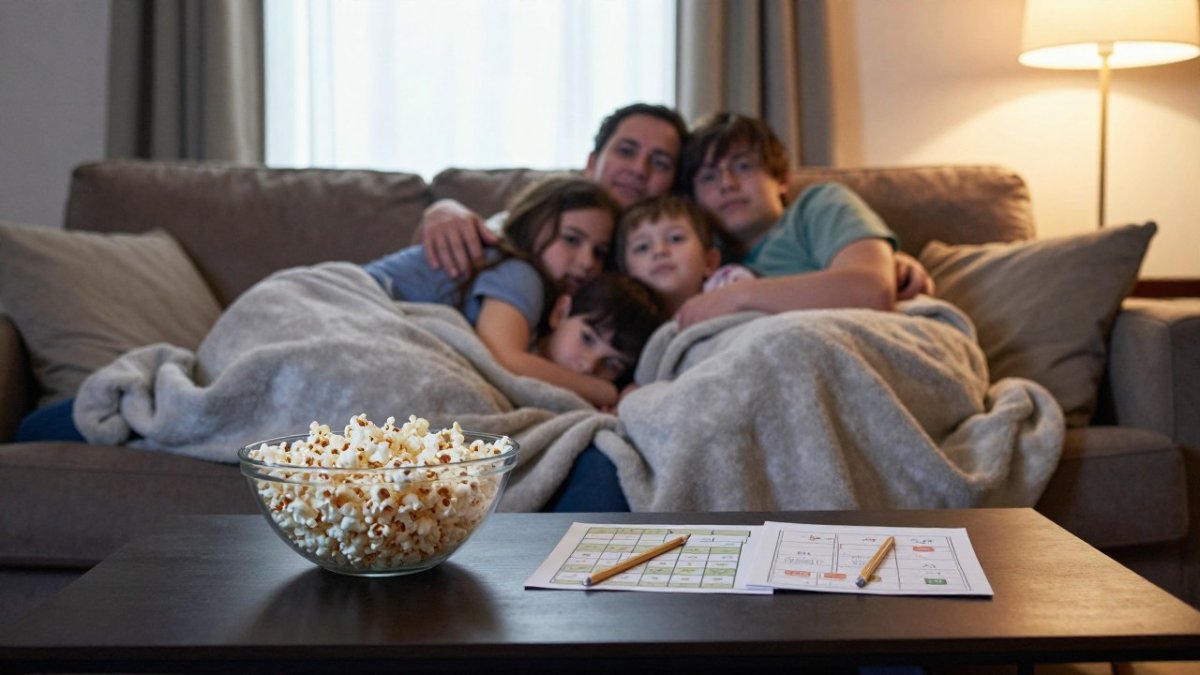
The trick is to think in three phases: before the movie, during the movie, and after the credits. Most families only do the after part, which is why movie night feels like a treat instead of a literacy routine. Spread your games across all three and the whole evening does double duty.
Step 1: Pick a Story-Rich Movie (and Plan the Three Phases)
Not every movie works equally well. Look for films with a clear beginning, middle, and end, plus characters your kids will want to talk about. Animated features, family adventures, and book-based movies are gold. Skip the ones with constant action and no real plot. You want something your kids can retell afterward.
Once you have your pick, sketch a one-page plan on an index card:
- Before: one prediction prompt and one vocabulary word to listen for
- During: one bingo card or listening job per kid
- After: one retell game and one drawing or writing task
That card is your whole plan. Tape it inside a cabinet door and reuse the format every week with a new movie.
Step 2: Prep Your Low-Cost, Portable Game Stations
You don't need fancy supplies. A few index cards, a pencil, and a printable bingo sheet do the job. Set up two or three stations around the room:
- Word bingo: kids mark words they hear in the movie
- Character sketch station: paper and crayons to draw a favorite character
- Prediction cards: write what you think happens next
Keep everything in a ziplock bag so it survives the next move. Label the bag with the movie title and the games inside, and you have a reusable kit you can pull out on a rainy night or hand to a babysitter. For more ready-to-use ideas, see these reading readiness games for home that build real skills.
Watch out: if the bingo card has too many words, younger kids give up in the first ten minutes. Cap it at five or six words for preschoolers and ten for elementary kids.
Step 3: Make It Inclusive for Every Age and Ability
Mixed ages are the norm, especially in military families. Give younger kids picture-based cards and older kids written prompts. Kids who need extra support can pair up with a sibling or an adult.
A simple way to differentiate is to assign roles instead of worksheets. The youngest draws, the middle kid writes, the oldest reads the prompts aloud, and an adult keeps time. Everyone has a job, so nobody is sitting out.
If your child is neurodivergent, adapt the games so everyone can join comfortably. These tips on how to help neurodivergent kids enjoy reading walk you through simple tweaks, like shorter rounds and quieter spaces. For multilingual families, let kids answer in whichever language feels natural, then say it once in English. Home languages strengthen English learning, which is the heart of Chapter 7, "Cultural Literacy."
Here is the whole plan on one card, spread across the three phases of the evening.
| Phase | What to prep | Example |
|---|---|---|
| Before | One prediction prompt and one vocabulary word | Prediction cards |
| During | One bingo card or listening job per kid | Word bingo |
| After | One retell game and one drawing or writing task | Three-sentence retell |
4 Family Movie Night Questions to Spark Conversation
These family movie night questions turn passive watching into real talk. Ask two or three after the credits roll, not all four at once. Keep it light.
- What did the main character want most? This builds comprehension and empathy.
- What would you have done differently? Great for critical thinking.
- Which word did you hear a lot tonight? Sneaky vocabulary practice.
- What happens next, if there's a sequel? Story prediction in action.
Kids who struggle to answer can draw their response instead. Listening counts too, and Chapter 4 of Literacy Roots calls listening the most overlooked piece of the literacy puzzle.
Storytelling Games for Kids: Retell the Movie
Story retelling is the single best post-movie activity you can do. It builds reading comprehension, sequencing, and memory, and kids think they're just playing.
Try these storytelling games for kids:
- Three-sentence retell: beginning, middle, end, three sentences total
- Puppet retell: act out one scene with socks or paper bag puppets
- Backwards retell: start with the ending and work backward
- Interview a character: one kid plays the character, others ask questions
For puppet-based fun, these puppet storytelling ideas make the game even better.
Free Family Literacy Games You Can Print Tonight
The best free family literacy games need nothing but a printer and a pencil. Here are three you can set up in minutes:
- Sight word bingo: fill a card with words from the movie's theme
- Story dominoes: match characters, settings, and events
- Letter hunt: find objects around the room that start with a movie letter
Printable activities keep prep low and fun high. If you want more phonics-based options, these free phonics games to play at home tonight are a perfect add-on to your movie night lineup.
Military Family Reading Activities for Deployment and PCS
Deployment and PCS moves throw off routines fast. Military family reading activities keep books and stories steady when everything else shifts. The goal is not a perfect routine. It's a small, repeatable ritual that survives a time zone, a move, or a long stretch apart.
Here's how to run each one so it actually works.
- Recorded read-alouds: the deployed parent records a short story or a movie recap on a phone, and the kids follow along with the book or draw what they hear. Keep clips under five minutes so they stay watchable. Kids often replay the same recording many times, and that repetition is fine.
- Movie night by video call: pick one film everyone can access, agree on a start time in both time zones, and press play together. Pause at the same moments to ask one question from the list above. If the connection is shaky, skip the live watch and send a voice note with three questions instead.
- Portable book bin: one small bin that travels with every move. Add a laminated index card with the family's movie-night game plan taped to the lid, so the ritual restarts the first night in a new house.
- Story letters: kids write or draw what happened in the movie and mail it. The deployed parent writes back with a prediction or a question. This is slow literacy, and that's the point. It gives kids a reason to write for a real audience.
For families mid-move, this guide on building a portable home library for military kids gives you a simple system that fits in a duffel bag.
Watch out: don't schedule the video-call movie night for the deployed parent's late night just to match the kids' bedtime. A short recorded recap the kids can watch on their own schedule often gets more participation than a live call nobody has energy for.
One more idea that costs nothing: a family "story circle" after the movie, where each person shares one scene they'd change. Chapter 11, "Future of Family Literacy," describes this ritual, and it works just as well over a video call as it does on the couch.
Your Next Step: Grab the Book and Plan Your First Game Night
You don't need a teaching degree or a big budget. You need one movie, a few index cards, and ten minutes of prep. That's the whole formula.
Chapter 4 of Literacy Roots walks you through the speaking, listening, and storytelling side of literacy in plain language, with family stories and reflection questions. Chapter 8, "Digital Literacy," also helps you use screens with guidance instead of guilt.
Pick a movie this weekend. Print one game sheet. Ask one question after the credits.
Ready to make literacy a natural part of your family's routine? Literacy Roots: Nurturing Your Child's Reading Journey from Birth to Brilliance gives you the tools to be your child's first and best teacher, one small moment at a time. Get the book and start your first game night this week.
Frequently Asked Questions
How can I make a family movie night educational without making it feel like school?
Keep it playful and low-pressure. Choose one or two simple literacy games, like a movie bingo card with vocabulary words or a quick storytelling prompt after the credits. The goal is connection and fun, not a quiz. In Literacy Roots, Chapter 8 on digital literacy explains that tech is a tool that needs guidance, so you can feel good about using a movie as a springboard for talking, listening, and laughing together.
What are some free family literacy games we can play during a movie?
You don't need to buy anything. Try a printable movie bingo card with sight words or character traits. Play a listening game where kids raise a hand when they hear a certain word. Use a whiteboard or paper for a word hunt. After the movie, do a story retell using a simple beginning-middle-end chart. All of these use materials you already have and build vocabulary and comprehension skills.
How can we keep reading routines going during a deployment or a PCS move?
Routine is your anchor. Try a virtual movie night where you sync the same film with a deployed parent and play a movie-themed game over video chat. Keep a small bin of books and printable games packed for moves. In Literacy Roots, Chapter 10 on community matters highlights how book access drives reading achievement, so lean on libraries and book swaps at your new location. Small, consistent moments matter more than a perfect schedule.
What are some fun military games for kids that also build literacy?
Use the movie's theme to create a mission. For example, after watching a space movie, have kids write a three-sentence 'mission report' or draw a comic strip retelling the story. You can also play a vocabulary treasure hunt where they find words from the movie around the house. These military family reading activities tie movement, imagination, and language together, which is perfect for kids who learn by doing.



