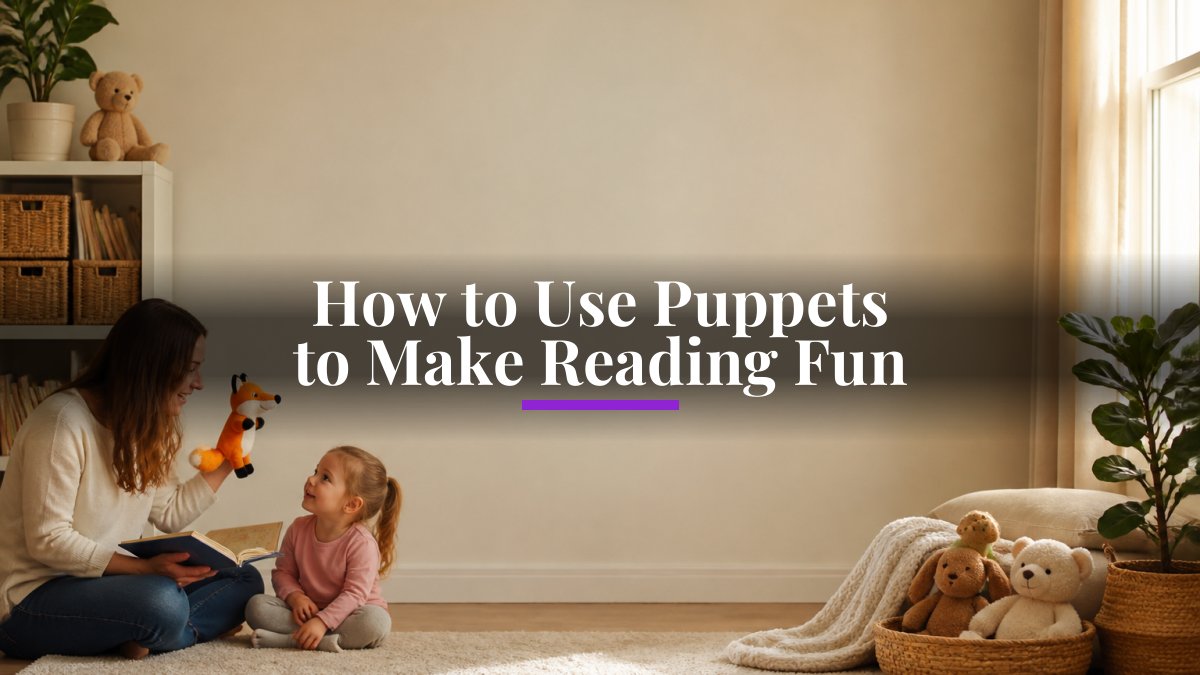
 How-to
How to Use Puppets to Make Reading Fun
Last Updated: October 23, 2026
Quick Summary
How to use puppets to make reading fun is to turn reading from a passive sit-down activity into interactive storytelling where kids participate, laugh, predict, and ask questions. You don't need store-bought puppets, fancy tools, or expensive programs, just simple strategies like a sock, stuffed animal, or wooden spoon that moves and has personality.
- Let the puppet ask questions instead of you, so your child becomes the expert explaining the story.
- Give each character a different voice to help your child hear contrast, notice how characters differ, and practice speaking naturally.
- Pause mid-story for the puppet to predict what happens next, turning your child into an active thinker and reader.
- A sock puppet takes five minutes to make with just a clean sock and markers you already have at home.
- Run a three-part routine before, during, and after reading to build a habit your child expects and enjoys.
Table of Contents
- Why Puppets Turn Reading Into Play
- Puppet Read-Aloud Ideas to Try Tonight
- Using Puppets for Language Development
- Puppet Activities for Toddlers
- How to Make a Sock Puppet in 5 Minutes
- Low-Cost Puppet Alternatives
- Keeping the Magic Going
- Frequently Asked Questions
Why Puppets Turn Reading Into Play
Your toddler is sprawled on the couch, refusing to sit still for one more page. You're tired. The book feels like a battle you're losing.
That's the magic of puppets.
Puppets turn reading from a passive sit-down activity into interactive storytelling. When children actively participate in stories, they build vocabulary, listening skills, and a genuine love of reading that sticks.
Parents don't need fancy tools or expensive programs. You need simple, warm strategies that work with your real life.
This is about how to use puppets to make reading fun, and it starts tonight.
Puppet Read-Aloud Ideas to Try Tonight
The best part? You probably have what you need already.
A puppet doesn't have to be store-bought. A sock, a stuffed animal, a wooden spoon with a face drawn on it, even your hand shaped like a bird. Anything that moves and has some personality works. It's not just you reading anymore, it's a character inviting your child into the story.
Here are three ways to bring puppets into your read-aloud sessions right now.
Let the puppet ask questions
Instead of you asking "What do you think happens next?" have the puppet ask it. "Wait, why did the bunny hop away?" Your child becomes the expert, explaining the story to the puppet. Suddenly they're talking, thinking, and teaching.
This works with any age. With toddlers, the puppet can ask simple questions: "Do you see the dog?" With older kids, the puppet can wonder aloud about plot twists or character choices.
Give each character a different voice
When the puppet speaks, give it a voice. Maybe the bunny is high and quick, the fox low and slow. Your child hears the contrast, notices how characters differ, and might start doing the voices too. That's language development happening naturally: rhythm, tone, expression, and practice speaking, all disguised as fun.
Pause for the puppet to predict what happens next
Stop mid-story. The puppet scratches its head. "Hmm, I wonder what's going to happen on this page. What do you think?" Your child guesses, the puppet reacts, and you turn the page. Now they're not just listening, they're predicting and checking. That's critical thinking. That's a reader being born.
Using Puppets for Language Development
Puppet play is one of the best ways to build vocabulary and communication skills without it feeling like work.
Puppet play looks like play but builds real language skills. The puppet gives kids permission to try new words and voices.
You can target specific words too. Learning colors? The puppet holds up objects: "Look, a red ball!
The puppet also gives shy kids a voice.
Puppet Activities for Toddlers
Toddlers are natural puppet fans. They love things that move, make noise, and respond to them. The trick is matching the puppet moment to your child's actual attention span. Shorter is better, repetition is the point, and you do most of the talking at first. Your toddler joins when they're ready. That's the warm-up.
Babies and young toddlers (birth to about 18 months)
At this stage, puppets are about surprise and connection. A puppet pops out from behind your back, your baby laughs, you do it again. That back-and-forth is the serve-and-return pattern Chapter 2 describes. Keep it to one or two minutes: one puppet, one sound, one peekaboo reveal. Narrate what the puppet does ("Bear is hiding... peekaboo!") so your baby hears words tied to action.
Toddlers around 18 months to 3 years
Now puppets become props in tiny stories. Tell a three-line story about a puppet going to the park, and your toddler follows along, touches the puppet, makes it dance. They're learning that stories have characters, actions, and a sequence. Two to five minutes is plenty. A sample exchange you can steal:
- You (puppet voice): "I want to go outside. Can I go outside?"
- You (your voice): "Hmm, what do you think? Should Bunny go outside?"
- Child: nods or says yes.
- Puppet: "Yay! Let's hop! Can you hop with me?"
Let the puppet ask, not you. Toddlers answer a puppet far more readily than a direct quiz.
Preschoolers around 3 to 5 years
Puppets become conversation partners. Your child talks to the puppet, the puppet talks back, and your child starts acting out scenes from books they love. They're no longer just listening. They're creating.
Five to ten minutes works here, and you can hand over the puppet. Expect wobbly voices and plot holes. That's the good stuff.
When your child won't participate
Some kids hang back. That's normal, and it's not a sign anything is wrong. Try these:
- Let the puppet be shy first. "Puppy is feeling quiet today. He just wants to watch." Kids often jump in once the pressure is off.
- Give a nonverbal role. Your child can clap when the puppet appears, point to the page, or hold a second puppet. Participation doesn't have to be talking.
- Watch for sensory overload. If your child covers their ears or turns away, drop the voice to a whisper or put the puppet down. A calm two minutes beats a forced ten.
- Try a quiet puppet. A small finger puppet that moves slowly can work for kids who find big voices and fast movement overwhelming.
If your child has a speech delay or uses AAC or sign, the puppet can model those too. Have the puppet sign "more" or point to a picture. The goal is connection, not performance.
This is the heart of Chapter 4's idea that literacy is a mosaic of reading, writing, speaking, and listening. Puppet play hits all four, at whatever pace your child sets.
Different ages respond to puppets in different ways, so here's what to expect and how to adapt.
| Age Range | What They Do | How Long | Your Role |
|---|---|---|---|
| Birth to 18 months | Laugh at surprise and movement | One to two minutes | Narrate actions and repeat |
| 18 months to 3 years | Follow tiny stories and touch the puppet | Two to five minutes | Let the puppet ask questions |
| 3 to 5 years | Talk to puppet and act out book scenes | Five to ten minutes | Hand over the puppet sometimes |
How to Make a Sock Puppet in 5 Minutes
You don't need to buy anything. A sock and a few household supplies become a puppet your child will love.
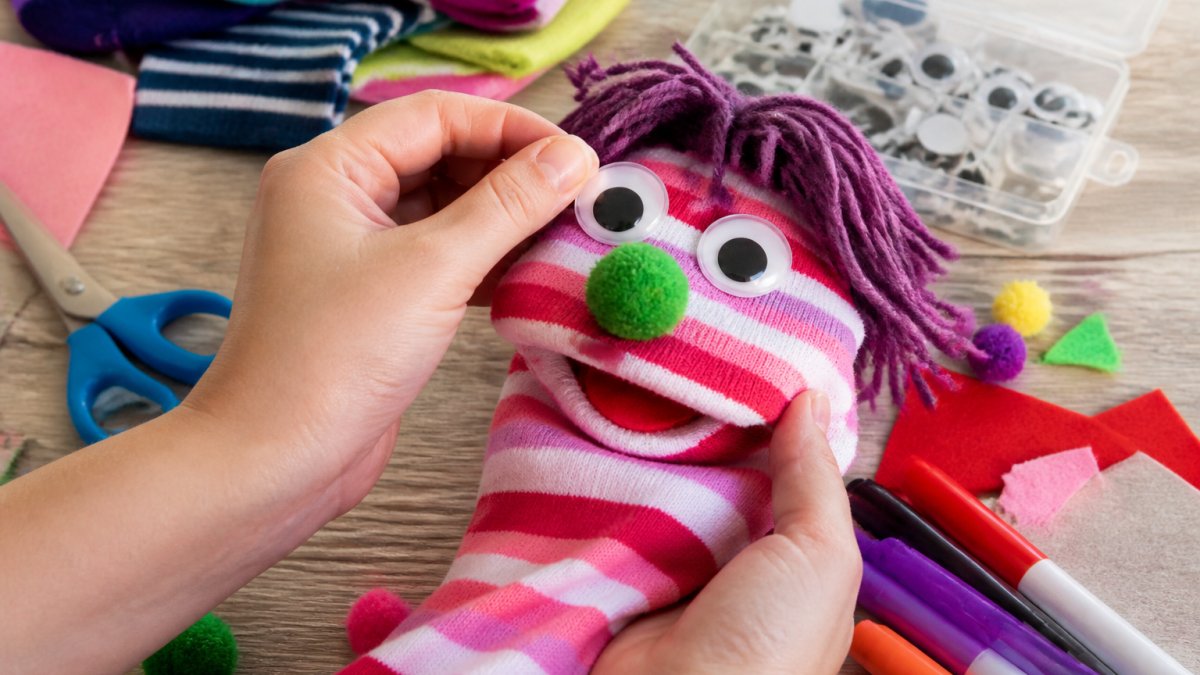
What you'll need
- One clean sock (any color)
- Markers, crayons, or colored pencils
- Googly eyes or buttons (optional but fun)
- Glue stick or tape (optional)
- Scissors (optional, for felt pieces)
That's it. You probably have all of this right now.
Step-by-step instructions
Step 1: Slip the sock on your hand. Make a fist inside the sock.
Step 2: Draw eyes on the heel. Use a marker to draw two eyes where the heel sits. Big eyes, small eyes, silly eyes. Whatever you and your child like.
Step 4: Add details (optional). Glue on googly eyes, or draw a nose, spots, or stripes.
Step 5: Let it dry for one minute. If you used glue, give it a quick moment.
That's really it. Your child now has a puppet they made themselves. That ownership matters.
Low-Cost Puppet Alternatives
Not in the mood to make a sock puppet? You have other options right now.
A stuffed animal you already own is a puppet. Pick it up, give it a voice, and it's a character.
A wooden spoon can become a puppet.
A paper plate stapled to a popsicle stick becomes a puppet.
The point is this: you don't need to buy anything. Your home is full of puppet materials.
Keeping the Magic Going
Once you start using puppets, your child will want more. The trick to keeping it fun is a simple routine you can repeat without thinking, plus a loose sense of what "working" looks like.
A repeatable before, during, and after routine
Instead of one-off activities, try a three-part rhythm you can run with any book.
Before you read: Let the puppet introduce the book. "Hi, I'm Fox.
While you read: Give the puppet one job. Maybe it's the character who keeps getting surprised.
After you read: The puppet retells the story badly on purpose.
Run this routine three or four times a week and it becomes a habit your child expects.
Signs it's working (without overthinking it)
You don't need a test. Watch for small things: your child talks to the puppet without prompting, retells part of the story at dinner, uses a new word in play, stays with the story longer, or asks for the puppet by name. Any one is a good sign. None is a requirement. Some weeks are just wiggly, and that's fine.
Let your child take the puppet
When your child wants to be the puppeteer, hand it over. The puppet gives them courage. They'll tell stories you didn't expect and connect them to books you've read together. Resist the urge to correct their plot. Let it wander.
Make a simple stage (free)
A cardboard box with the bottom cut out, or a blanket over two chairs, becomes a theater in two minutes. Your child performs for you, you perform for them. It becomes a family ritual, not a production.
Include every kid in the room
Puppet play adapts to different needs. A child with motor differences can direct while you move the puppet. A nonverbal child can choose which puppet acts next. A bilingual child can have one puppet speak the home language and another speak English, which Chapter 7 notes strengthens both. A child who needs predictability can follow the same three-part routine every time.
This is what Literacy Roots: Nurturing Your Child's Reading Journey from Birth to Brilliance keeps returning to: literacy grows in small, warm, daily moments. Chapter 4 explores how reading, writing, speaking, and listening fit together, and a puppet is one of the simplest tools for hitting all four at once. If you want the full picture, learn more today.
Frequently Asked Questions
How can I use a puppet during a read-aloud?
Have the puppet sit beside you and interact with the story. Let it ask questions, make funny voices for characters, or act out what's happening in the book. Your child will stay more engaged because there's a character responding to the story alongside them. Puppets turn passive listening into active participation, which builds listening and comprehension skills.
What do toddlers learn from playing with puppets?
Puppet play builds vocabulary, communication skills, and listening abilities. When toddlers see puppets act out words and actions, they connect language to meaning. They also practice turn-taking, expression, and storytelling. Puppets make abstract ideas concrete, which is exactly how young brains learn best.
What can I use as a puppet if I don't have one?
Socks, paper bags, cardboard tubes, or even your hand with a drawn-on face work great. Stuffed animals count too. You don't need to buy anything. The magic isn't in the puppet itself, it's in the interaction and the stories you tell together. Free or homemade puppets are just as effective as store-bought ones.
Can I use puppets with babies under 12 months?
Yes, absolutely. Babies love watching puppets move and listening to different voices. A puppet can narrate peek-a-boo, introduce new sounds, or simply move gently while you read. Even infants benefit from the extra engagement and the varied sensory input puppets provide during reading time.
Learn more today. Get Literacy Roots and discover how to build your child's reading confidence in the moments you already have. Order the book on Amazon and start tonight with Chapter 4: Beyond Reading.



