 How-to
Building a Portable Home Library for Military Kids
Table of Contents
- Building a Portable Home Library for Military Kids: Start With What You Have
- Step 1: Pick a Portable Children's Book Storage Setup That Fits Your Moves
- Step 2: Choose Books That Travel Well and Grow With Your Child
- Step 3: Plan PCS Move Reading Activities for Kids Before the Boxes Close
- Step 4: Build a Military Family Reading Routine That Survives Every Address
- Step 5: Add Digital Library Books for Kids as Your Backup Shelf
- Common Mistakes When Building a Portable Home Library
- Conclusion
- Frequently Asked Questions
Last Updated: October 20, 2026
Building a Portable Home Library for Military Kids: Start With What You Have
The moving truck pulls away, and your seven-year-old asks the question you've heard at every address: "Where are my books?" Building a portable home library for military kids starts with one simple truth: the books don't need a room. They need a system that packs, travels, and unpacks fast.
Lauren Daugherty, a military spouse and mom of five, wrote Literacy Roots after seeing kids thrive or struggle based on book access, not ability. Her Chapter 3, on the home literacy environment, is the backbone of everything below.
Here's the plan: five steps, one weekend of setup, and a shelf that survives every set of orders.
Step 1: Pick a Portable Children's Book Storage Setup That Fits Your Moves
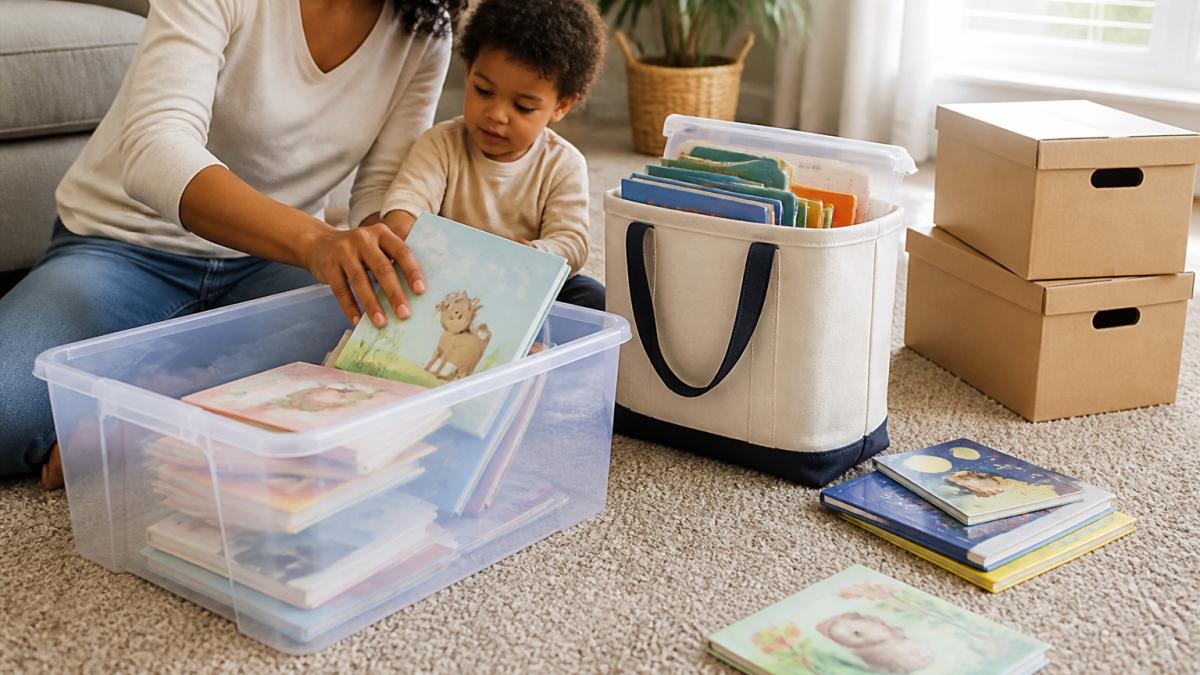
Portable children's book storage is any container your child can reach, you can carry, and a moving truck can't crush. The best pick is a lidded plastic bin for the main collection and a canvas tote for the current favorites.
Bins, Baskets, and Bags That Survive a Move
- Lidded plastic bins (medium size): stack in any truck, keep out moisture, and double as a nightstand in a new place.
- Canvas tote or book bag: the "carry-on" shelf your child keeps during the move itself.
- Soft baskets: light enough for a toddler to pull down alone.
- Recycled materials: sturdy diaper boxes wrapped in packing tape work fine for a season. Free beats fancy.
Size, Weight, and Capacity: The Numbers That Matter
A medium lidded bin (roughly 15 to 20 gallons) holds about 30 to 40 picture books or 20 to 25 chapter books. Keep each filled bin under about 30 pounds so you, not just the movers, can lift it on a bad day. A canvas tote holds 8 to 12 books, which is the right size for a carry-on shelf.
A simple capacity plan for a family with two kids:
- One main bin per child for the core collection (20 to 30 books each).
- One shared tote for current bedtime favorites.
- One small basket by the couch for library books on loan.
That's three containers, not thirty. The rest of the collection lives in labeled storage bins that get rotated in later.
A Labeling System That Survives the Movers
Movers read sides, not tops. Label every bin on all four sides with three things: your child's name, the word "BOOKS," and a room word like "BEDROOM" or "PLAYROOM." Add a colored dot sticker per child so a pre-reader can spot their own bin in a stack.
How Many Books Should Travel With You?
A common mistake is hauling the whole collection. Instead, pack a core shelf of 20 to 30 books that covers ages and moods: board books, picture books, one chapter book series, and a favorite repeat-read. Store the rest. Rotating books back in later feels like a shopping trip.
Step 2: Choose Books That Travel Well and Grow With Your Child
Books that travel well are sturdy, emotionally useful, and slightly above your child's current level. Mix three kinds: comfort reads, growth reads, and move reads. The comfort read is the one your child has heard 40 times. The growth read stretches them a little. The move read names what they're feeling.
Age-Appropriate Books About Military Life and Transitions
You don't need a specialty store. You need a short list per age band and a librarian who knows the deployment shelf.
- Ages 0 to 3: board books about families, homes, and bedtime. Durable pages survive truck rides, and the repetition is the point. Look for board books that show different kinds of families and houses.
- Ages 4 to 7: picture books about moving, new friends, and a parent deploying. Ask your installation librarian for the deployment and transition shelf. Many keep one ready, and they'll hand you three titles in two minutes.
- Ages 8 and up: chapter books with kids who move, plus nonfiction about bases, maps, and the places you're heading. A map book doubles as a PCS activity.
Pair each move book with a map or photo album so the story connects to your child's own life. After you read a book about saying goodbye to a house, pull out the goodbye-shelf photo from Step 3 and let your child tell the story back to you.
A Selection Rule That Beats a Long List
When you're standing in front of the shelf, use this filter: one comfort, one stretch, one feeling. One book your child already loves. One book that's a little harder. One book that names a big feeling like moving, missing someone, or making a new friend. That's a balanced carry-on tote in three picks.
If your child is struggling with reading, keep the stretch book gentle. Chapter 6 of Literacy Roots covers early signs and why early support works best, and it treats warning signs as reasons to talk with a teacher or pediatrician, not a diagnosis.
Where to Find Military-Life Books for Free
- Installation libraries: most keep a transition and deployment shelf. Ask at the front desk.
- Public libraries: request titles through interlibrary loan before you move, and note the new town's library before you arrive.
- Book swaps and Little Free Libraries: Chapter 10 of Literacy Roots makes the case that book access drives reading achievement, and swaps are the cheapest way to refresh a shelf after a move.
- School librarians: email the new school's librarian before you arrive and ask for two or three titles about moving.
Step 3: Plan PCS Move Reading Activities for Kids Before the Boxes Close
PCS move reading activities for kids work best in the messy middle: after orders arrive, before the truck loads. The goal is to make books the one thing that feels steady.
- Box-labeling game: your child writes (or scribbles) labels for the book bins.
- Goodbye shelf photo: snap a picture of the old reading corner to unpack in the new home.
- Map reading: trace the route on a paper map and read one book set in each state you cross.
- Countdown chain: one paper link per day, each with a book title to read that night.
Step 4: Build a Military Family Reading Routine That Survives Every Address
A military family reading routine is a short, repeatable ritual that doesn't depend on the house. Same time, same order, same voice. The address changes; the routine doesn't.
Pick a 15-minute window: bedtime, after breakfast, or right after school pickup. Read one book together, then let your child "read" it back in their own words. That retelling builds listening and speaking skills, which Chapter 4 covers as part of the literacy mosaic.
When a parent deploys, record video or voice readings before they leave. A recorded bedtime story keeps the voice in the room.
Step 5: Add Digital Library Books for Kids as Your Backup Shelf
Digital library books for kids are your backup when the bins are on a truck. They are not a replacement for paper, just a bridge.
- Installation and public libraries: most offer free ebook and audiobook apps with a library card.
- Audiobooks in the car: great for long PCS drives.
- Offline downloads: download titles before travel days when Wi-Fi disappears.
Chapter 8 of Literacy Roots treats screens as a tool that needs guidance, not a villain. Set the app, then put the device away and talk about the story.
Common Mistakes When Building a Portable Home Library
The biggest mistake is overbuilding. Families create a beautiful custom shelf, then leave it behind because it won't fit the next house.
Other pitfalls we see:
- Too many books, too little rotation. Keep the shelf small and swap seasonally.
- No weather protection. A roof and lid matter in storage; damp garages ruin paper.
- Skipping the child's input. Let your kid pick five books for the carry-on bag.
- Waiting for the perfect space. A basket by the couch beats a dream library you never build.
Conclusion
Every move asks your child to start over, and books are one thing that never has to. Start tonight: pick one bin, choose 20 books, and read one together before bed.
Literacy Roots: Nurturing Your Child's Reading Journey from Birth to Brilliance walks through the home literacy environment in Chapter 3 and community book access in Chapter 10, with research, family stories, and reflection questions in every chapter. It's endorsed by Dr. Susan Neuman of NYU and available for $14.99 on Amazon.
Get the book and give your family a shelf that travels. If you're overwhelmed or your child is struggling with reading, book a free 1:1 chat with Lauren for a calm, no-pressure conversation.
Frequently Asked Questions
How do you build a portable home library for military kids without spending much?
Start with what you already own. Sort your child's books into one sturdy bin or canvas bag, then add a library tote for library day. Clear plastic bins and zippered bags often cost less than a specialty shelf and survive moves better. Free books from base libraries, book swaps, and donation piles stretch the collection. The goal is a small, loved shelf your child can unpack first in every new home, not a big one. Chapter 3 of Literacy Roots covers building a home literacy environment on any budget.
How can military families keep a reading routine during a PCS move?
Keep one bag of books out of the moving boxes and read from it every night, even in an empty house or a hotel room. A military family reading routine works best when it is tied to something that never changes, like bedtime, rather than a specific room. Let your child pick the same three books on repeat; repetition is comfort during transitions. Add a short PCS move reading activity, like reading a moving-day picture book together, so the move itself becomes part of the story.
How many books should a child have in a home library?
There is no magic number, and a small collection can absolutely support literacy. What matters is access and variety: a mix of favorites for comfort and a few new titles for stretch. For a portable library, aim for one bin of about 20 to 30 books per child, plus a rotating stack from the library. Swap books out at each move or season so the collection stays fresh without getting heavy. Chapter 10 of Literacy Roots explains why book access, not book volume, drives reading achievement.
What are easy ways to find digital library books for kids?
Your public library card is the easiest starting point. Most U.S. library systems offer free ebook and audiobook apps for kids, and many military installations have their own library with digital access. Download a few titles before a move so your child has something to read during travel and the first week in a new home. Pair digital library books for kids with print books rather than replacing them, and let your child choose. Chapter 8 of Literacy Roots covers guiding screen time without the guilt.


