 How-to
How Do You Encourage a Reluctant Reader at Home?
Quick Summary
To encourage reluctant readers at home, shrink the ask to one page or one comic panel, offer two real choices, and read aloud together without quizzes or rewards. Praise effort, let them quit boring books, and keep comics, magazines, and series within arm's reach so reading feels like an invitation, not a test.
- Name the feeling, drop the demand, then ask for just one page.
- Offer two options, like comic or animal book, instead of a command.
- Read the first page aloud and stop at the good part.
- Skip rewards and quizzes; praise effort and let the story be the reward.
- Use the five-finger rule: two to three fingers means just right.
Table of Contents
- Start With the Book, Not the Battle
- How to Get a Child to Read When They Refuse
- Reluctant Readers Books: What Actually Gets Picked Up
- The Five-Finger Rule for Reading: A Two-Minute Check
- How to Support Reluctant Readers Without Adding Pressure
- Is It Reluctance or a Reading Difficulty?
- Build a Reading Routine That Fits Your Real Week
- Try One Chapter of Literacy Roots Tonight
- Frequently Asked Questions
Start With the Book, Not the Battle
Your kid groans when you say "reading time." Maybe they flop on the floor. Maybe they suddenly need water, a snack, and a bathroom break, all in the same minute.
Here's the good news: that reaction usually isn't about books. It's about pressure. At Lauren's Literacy Lounge, we've learned that the fastest way to help reluctant readers is to stop treating reading like a fight and start treating it like an invitation.
So before you try a single tip in this guide, change one thing: your goal. Don't aim for twenty minutes. Aim for one page, one laugh, one moment where your child forgets they were resisting.
That shift sounds small. It changes everything.
How to Get a Child to Read When They Refuse
Your child crosses their arms and says no. Now what? Most reading advice stops at "make it fun," which is not much help in the moment.
Here is a step-by-step response you can run tonight, in order.
Step 1: Name the feeling and drop the demand. Say, "You really don't want to read right now." Then wait.
Step 3: Hand over a real choice. Offer two options, not a command. "Comic or animal book?" beats "Go read." "Couch or blanket fort?" works too. Choice restores the control your child was fighting for.
Step 4: Take the reading off your child for a minute. Read the first page aloud and stop at the good part. Or read the same book side by side, taking turns by paragraph.
Step 5: Let it end. When the page or the timer is done, you are done. No quiz, no summary, no "see, that wasn't so bad." That last line turns a win back into a lecture.
Watch out: rewards can backfire here. A sticker for every page teaches a child that reading is a chore worth paying for.
If your child is younger and flat-out refuses storytime, playful tactics work better than logic. Our guide on making reading fun for reluctant toddlers has low-pressure ideas that fit the toddler attention span.
A few more moves for the days when nothing works:
- Let them quit a book. Life is too short for boring books, and quitting a bad book keeps them open to a good one.
- Read in odd places. Under a blanket fort counts. So does the car, the bathtub (with a plastic bag), or the backyard.
- Try a different format. Audiobooks, graphic novels, and magazines are all reading. A child who refuses a chapter book may devour a comic.
- Skip the quiz. No summary required, no comprehension questions. The goal is a reading habit, not a reading test.
Literacy Roots Chapter 6, "Navigating the Challenges," is the chapter to read if refusal has become a pattern. It walks through what avoidance can signal and how to respond without pressure.
Reluctant Readers Books: What Actually Gets Picked Up
Reluctant readers books share one trait: they don't feel like school. Kids pick up books that match their interests, their reading level, and their idea of fun, not the books adults think they should love.
In Literacy Roots, Chapter 3 makes the case that access drives reading. Kids read more when great books sit within arm's reach. So stock low shelves, car bins, and bathroom baskets with options.
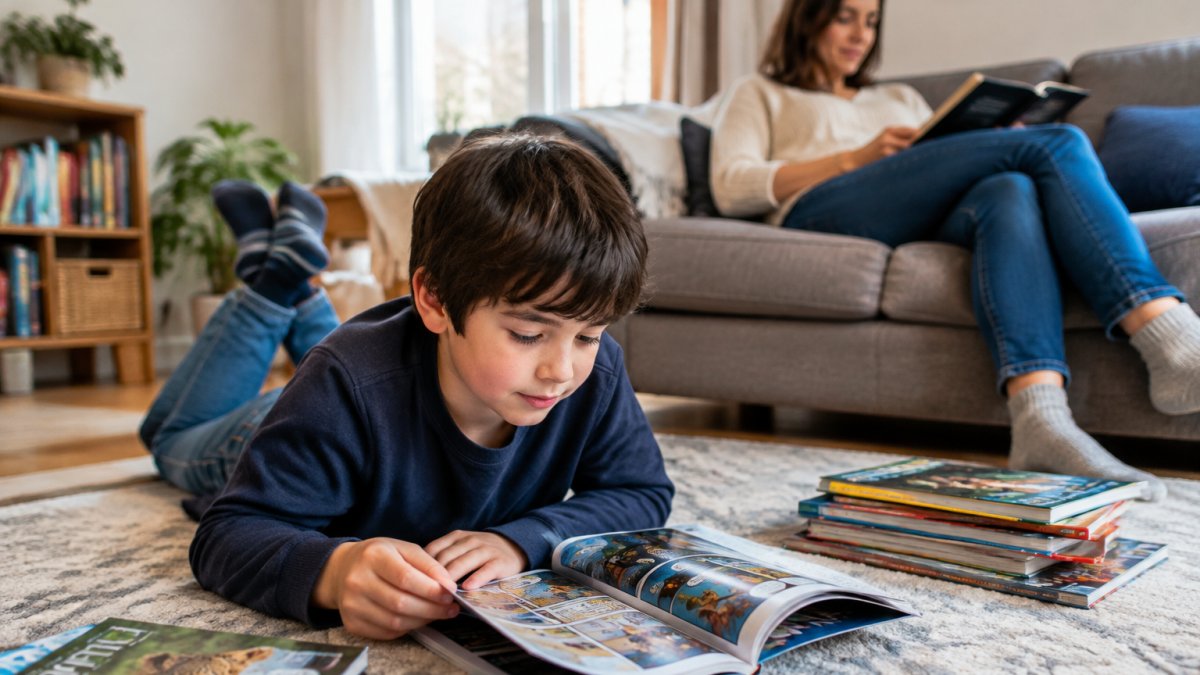
What gets picked up most often:
- Comics and graphic novels. Pictures carry the story, so decoding feels lighter.
- Nonfiction with bite. Shark attacks, volcanoes, gross science, real rescues.
- Magazines. Short pieces, big photos, natural stopping points.
- Instructions. Lego manuals and recipe cards are reading.
- Series books. Familiar characters make the next book an easy yes.
If your child is still building phonics skills, our roundup of phonics resources for reluctant readers points to materials that support decoding without feeling like homework.
The Five-Finger Rule for Reading: A Two-Minute Check
The five-finger rule for reading is a quick way to check whether a book fits your child's reading level. Ask your child to read one page aloud and hold up a finger for each word they can't figure out.
Here's how to read the result:
| Fingers on One Page | What It Means | What to Do |
|---|---|---|
| 0-1 | Easy and comfortable | Great for fluency and confidence |
| 2-3 | Just right | Ideal for independent reading |
| 4 | Getting hard | Try shared reading instead |
| 5+ | Too hard for now | Save it, pick another |
One catch: the five-finger rule only works for books your child reads alone. A book you read aloud together can be far above their level, and that's healthy. Listening to harder text builds vocabulary and comprehension.
How to Support Reluctant Readers Without Adding Pressure
Supporting reluctant readers comes down to praise and patience, not performance. Kids who feel watched and graded stop reading for fun. Kids who feel trusted keep coming back.
Try these moves:
- Praise effort, not level. "You stuck with that tricky word" lands better than "You're so smart."
- Let them reread the same book. Repetition builds fluency and comfort.
- Read the same book they're reading. It gives you something to talk about.
- Keep screens in the mix. Audiobooks and reading apps count as reading.
- Let them see you read. A parent with a book in hand is a walking advertisement.
A common mistake is turning every reading moment into a lesson. If you catch yourself quizzing, stop. The goal is a reading habit, not a reading test.
Is It Reluctance or a Reading Difficulty?
Sometimes reluctance is just preference. Sometimes it's a signal. The difference matters, and it's worth paying attention to, because a child who is struggling quietly will avoid reading for a very good reason.
Here is a simple way to tell them apart. Ask yourself three questions.
Does the avoidance follow the book or the child? A reluctant reader who will happily read a comic, a magazine, or a Lego manual is probably making a preference call. A child who avoids reading across every format, even favorite topics, may be hitting a wall.
Is the struggle about effort or about the code? Preference looks like boredom or a shrug. Difficulty looks like effort: slow, labored reading that wears them out, guessing at words instead of sounding them out, or trouble rhyming and hearing sounds in words.
Does it show up outside reading? Reversing letters or words past age seven, or a child who is bright and verbal but flat on the page, is worth a closer look.
Signs that point to a possible reading difficulty include:
- Trouble rhyming or hearing sounds in words
- Reversing letters or words past age seven
- Slow, labored reading that wears them out
- Strong avoidance of reading, even favorite topics
- Guessing at words instead of sounding them out
- Frustration that shows up as tears, anger, or stomachaches before reading time
Literacy Roots Chapter 6 covers this gently. Dyslexia is not about intelligence, and early support helps. If several signs show up, talk with your child's teacher or pediatrician. That's a conversation, not a diagnosis.
While you wait for that conversation, keep reading together. Read aloud above your child's level and let them follow along with a finger.
If your child is neurodivergent, our article on helping neurodivergent kids enjoy reading offers ways to support them without pressure. And if you suspect dyslexia, this guide on helping a child with dyslexia read at home goes deeper.
Build a Reading Routine That Fits Your Real Week
A reading routine works best when it's short and repeatable. Ten minutes daily beats a heroic Sunday session every time. Kids thrive on predictable, low-stakes reading time.
Here's a simple plan:
- Pick a anchor moment. Bedtime, breakfast, or the after-school snack.
- Set a timer for ten minutes. When it dings, you're done. No extras.
- Keep books where the routine happens. A basket by the couch works.
- Let your child choose. Choice and autonomy keep motivation alive.
- Skip the guilt on busy days. A single page still counts.
Military families, this one's for you. When you move, keep the routine itself steady even when everything else changes. Same time, same basket, new house.
Our guide on daily reading routines explains why little and often wins for kids.
Try One Chapter of Literacy Roots Tonight
You don't need a teaching background to raise a reader. You need small, warm moments, repeated often. That's the whole message of Literacy Roots: Nurturing Your Child's Reading Journey from Birth to Brilliance.
Chapter 3, "Home Literacy Environment," covers book access and why parents reading for fun matters. Chapter 6 helps you tell reluctance from a real difficulty.
Pick one idea from this article. Try it tonight. One page, one comic, one silly voice. That's enough.
If reading time has turned into a battle at your house, you're not alone, and you're not failing. Lauren's Literacy Lounge is here to help you rebuild the habit with small, doable steps. Literacy Roots gives you the research, real family stories, and simple exercises to make reading feel good again. The book is endorsed by Dr. Susan Neuman of NYU and is available on Amazon. You can also book a free one-on-one chat with Lauren if you want help figuring out where to start. Get the book and give your child one calm, curious reading moment tonight.
Frequently Asked Questions
How do I motivate a reluctant reader without bribing them?
Skip the sticker charts for pages finished and aim at the conditions that make reading feel good instead. Let your child pick the book, even if it looks below their level. Read the first chapter aloud so the story hooks them before they take over. Keep sessions short, around ten minutes. Praise the effort you see ("you stuck with that tricky word") rather than the result. In Literacy Roots, Chapter 3 points out that kids who see parents reading for fun are more likely to read for fun themselves, so let them catch you with a book too.
What is the five-finger rule for reading?
Have your child open to any page and read it aloud. Hold up one finger for each word they can't decode or don't know. Zero or one finger means the book is easy and fine for cozy, confident reading. Two or three fingers is a good fit for practice. Four or five fingers means the book is frustrating right now, so save it for later or read it together. The five-finger rule for reading is a quick gut check, not a test, so keep it light and let your child try a different page or book.
What kinds of books work well for reluctant readers?
Reluctant readers books tend to share a few traits: short chapters, lots of white space, funny or gross humor, and characters who feel like them. Graphic novels, comics, magazines, and nonfiction about sharks, space, or video games all count as real reading. Series help too, because your child already knows the characters and doesn't have to start over. In Literacy Roots, Chapter 4 makes the case that literacy is a mosaic, and listening to an audiobook or reading a magazine still builds vocabulary, fluency, and comprehension.
How can I tell if my child is reluctant or actually struggling to read?
Reluctance usually shows up as avoidance: "reading is boring," "I'll do it later." A difficulty looks different. Watch for trouble rhyming, reversals that continue past age seven, slow and choppy reading, or strong avoidance of anything with text. If you notice these, talk with your child's teacher or pediatrician. Literacy Roots, Chapter 6, draws on Dr. Sally Shaywitz's work to explain that dyslexia is unrelated to intelligence and that early intervention works best, so a conversation now is worth more than waiting.



