 How-to
Choosing Age Appropriate Books: A Parent's Step-by-Step Guide
Last Updated: November 12, 2026
Quick Summary
Choosing age appropriate books starts with your child's stage, interests, and skills, not the age label on the cover. Preview a book together using the five-finger rule, then match it to their reading level and let their interests lead the way.
- A book is age appropriate when it fits your child's stage, interests, and skills, not just their birthday.
- In the five-finger rule, two to three fingers means the book is just right.
- Let your child's reading fluency, not their grade level, tell you when to move up to chapter books.
- Pair decodable books for sounding-out practice with rich read-alouds for vocabulary and pleasure.
- If a book is too hard, read it aloud together or try again later.
Table of Contents
- Start With Your Child, Not the Age Label
- How to Select Books for Different Ages and Stages
- The Five-Finger Rule for Choosing Books
- Books for Beginning Readers: Decodable Texts and Read-Alouds
- Match the Book to Reading Level, Not Just Grade Level
- Follow Their Interests, Then Stretch Them
- When a Book Flops: Fixes for Too Hard, Too Easy, or Rejected
- Build Your Book-Picking Routine at the Library
- Frequently Asked Questions
Start With Your Child, Not the Age Label
You're standing in the library, holding two books. One says "ages 4 to 8" on the back. Your kid is five. So it's perfect, right? Maybe. Maybe not.
Here's the thing: the age range on a book cover is a guess, not a rule.
A book is age appropriate when it fits your child's stage, interests, and skills, not just their birthday.
How to Select Books for Different Ages and Stages
Picking books by stage is about matching what a child can do with what a book asks of them. The age bands below are starting points, not gates.
Board Books and Picture Books (Birth to Age 5)
Babies and toddlers need books they can grab, chew, and study. Board books with high-contrast pictures and familiar objects do the heavy lifting here.
Around 12 to 18 months, shift toward books with simple labels: a picture of a dog with the word "dog" underneath.
For preschoolers, picture books with a simple storyline and repetition build vocabulary and comprehension.
A few concrete things to check on a picture book before you commit:
- Illustrations that match the words. A young child uses pictures to decode meaning. If the art tells a different story than the text, the book asks too much.
- One clear plot line. Books with a single problem and a single solution are easier to follow than books with subplots.
- Familiar routines. Bedtime, bath, meals, and going to the store let a child predict what comes next, and prediction is comprehension.
- Songs and repetition. Books you can sing or chant invite a child to join in, which builds memory for language patterns.
If you want a closer look at picking picture books for this stage, our guide on choosing age-appropriate picture books for preschoolers walks through it step by step.
Easy Readers and Chapter Books (Ages 5 to 9)
Beginning readers need short sentences, simple language, and lots of picture support.
When you preview an easy reader, flip to a middle page and count the words your child would need to sound out.
Chapter books come next, once independent reading feels steadier. Look for bigger type, short chapters, and characters worth following.
The jump from easy readers to chapter books trips up a lot of families.
Watch out: don't retire picture books the moment chapter books appear.
Books for Older Children (Ages 9 and Up)
Once kids read independently, the selection job changes. Now you're matching themes and content as much as reading level.
A simple check: read the first chapter yourself. Ask whether the characters face problems your child has language for.
Series matter at this age too. A series gives a reader a known world, known characters, and a predictable rhythm, which lowers the effort of starting a new book.
Matching Format to the Reader
Format is part of age appropriateness, and it's easy to overlook. A graphic novel, an audiobook, and a traditional chapter book can all build reading skill, and they ask different things of a child.
- Graphic novels pair text with sequential art. They're strong for visual learners and reluctant readers, and they still require inference, because the reader fills gaps between panels.
- Audiobooks build vocabulary and listening comprehension. Chapter 4 makes the case that listening is real literacy work, not a shortcut.
- Poetry and short story collections suit kids who like to finish something in one sitting.
- Nonfiction with diagrams and captions hooks kids who prefer facts to stories.
None of these is a lesser choice. The goal is a child who reads widely, and format variety keeps reading from feeling like one narrow task.
The Five-Finger Rule for Choosing Books
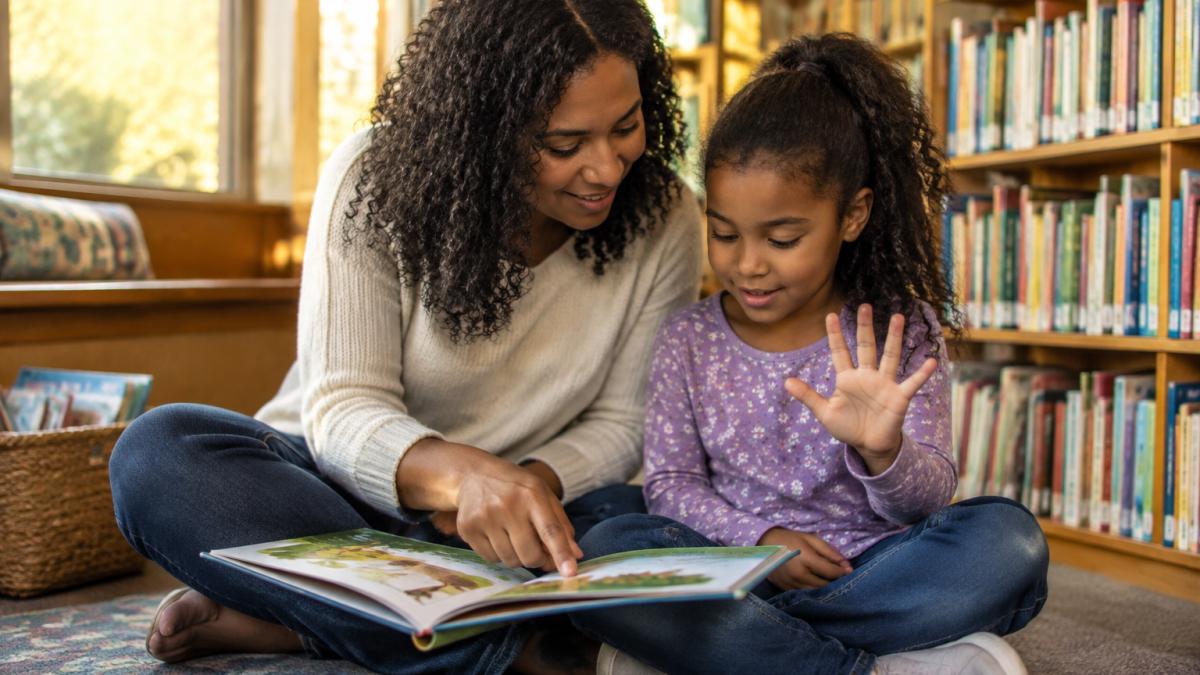
The five-finger rule for choosing books is a quick way to check if a book fits your child's reading level.
Here's how to read the result:
- Zero to one finger: too easy. Fine for confidence, not for growth.
- Two to three fingers: just right. This is the sweet spot.
- Four fingers: a stretch. Save it for shared reading.
- Five or more: too hard for now. Try again in a few months.
One catch: don't count the same word twice. And if your child is tired or distracted, try again later. The rule works best on a fresh, willing reader.
Books for Beginning Readers: Decodable Texts and Read-Alouds
Decodable books are short texts built around phonics patterns your child has already learned.
But decodable books alone aren't enough. Pair them with rich read-alouds, the stories you read to your child, full of vocabulary and ideas above their reading level.
If you're unsure how to pick decodables, our article on how to choose decodable books for beginners breaks down what to look for.
Match the Book to Reading Level, Not Just Grade Level
Grade level tells you what a classroom covers. It doesn't tell you what your child can read today.
Reading level is really three skills stacked together: decoding (sounding out words), fluency (reading smoothly at a talking pace), and comprehension (understanding what was read). A book can be right on one and wrong on another. That's why a single number on a cover never tells the whole story.
Here's a practical method for assessing reading level at home. It takes about five minutes and needs nothing but a book.
Step 1: Pick a book your child hasn't seen. A familiar book hides problems, because memory fills in the hard words.
Step 2: Have your child read one page aloud. Listen for three things at once:
- Accuracy. How many words did they miss? A few stumbles are normal. A pattern of misses on the same kind of word (long vowels, blends, two-syllable words) tells you what to practice.
- Pace. Do they read at a speed that sounds like talking, or do they stop to sound out nearly every word? Slow, choppy reading means the book is a stretch for solo reading.
- Expression. Do they pause at periods and lift their voice at question marks? Flat, word-by-word reading usually means all their effort is going into decoding, with none left for meaning.
Step 3: Ask two questions about what they read. Not a quiz, just talk. "What happened on that page?" and "What do you think happens next?" If your child can retell the page and make a guess, comprehension is keeping up. If they read the words but can't say what happened, the book is too hard right now, even if the decoding sounded fine.
Step 4: Match the result to a next step.
- Reads smoothly, answers easily, looks bored: move up a level or add a richer read-aloud.
- Reads with a few stumbles, answers correctly: this is the sweet spot for solo reading.
- Reads slowly, answers with help: keep it as a shared read-aloud, not a solo book.
- Can't decode the page at all: drop back to a simpler text and build from there.
Watch out: don't use this check on a tired, hungry, or distracted kid.
Why Decodables and Read-Alouds Do Different Jobs
This is the part most book lists skip. Beginning readers need two kinds of reading at the same time, and they serve opposite purposes.
Decodable books are short texts built around phonics patterns your child has already learned.
Rich read-alouds are the stories you read to your child, full of vocabulary and ideas above their reading level.
If you only give a new reader decodables, reading can start to feel like drills.
If you're unsure how to pick decodables, our article on how to choose decodable books for beginners breaks down what to look for. And for the full step-by-step version of the check above, our guide on assessing early reading levels at home walks through it with examples.
Follow Their Interests, Then Stretch Them
A kid who loves sharks will read about sharks. A kid who loves trucks will read about trucks. Reading interests are the engine here, so start there.
Once you've found a topic they love, stretch it gently:
- Same topic, harder book
- Same author, new series
- Same format, new subject
Personal preferences and personality traits matter more than any reading list. A shy kid may love quiet stories. A wild one may want silliness. Use that.
When a Book Flops: Fixes for Too Hard, Too Easy, or Rejected
A rejected book isn't a failure. It's information. Here's how to fix the three most common problems:
| Problem | What It Looks Like | Fix |
|---|---|---|
| Too hard | Stumbling, frustration, quitting | Read it aloud together, or try again later |
| Too easy | Boredom, rushing, no challenge | Move up a level or add a harder read-aloud |
| Rejected | "This is boring" | Swap topics, try a series, or let them pick |
If your child keeps rejecting books, phonics-based resources can help. Our guide on phonics resources for reluctant readers covers what actually clicks.
Build Your Book-Picking Routine at the Library
A repeatable routine takes the stress out of book selection. Try this on your next library trip:
- Preview five books before you go, using the five-finger rule
- Let your child pick two on their own
- Grab one read-aloud for the whole family
- Keep a running list of what worked
Short, frequent reading routines beat marathon sessions. Our article on daily reading routines explains why little and often wins.
Picking books doesn't have to feel like a test you might fail. Start with your child, use the five-finger rule, and let their interests lead. You'll get it wrong sometimes. That's fine.
Literacy Roots walks through all of this, chapter by chapter, with research, real family stories, and simple exercises you can try tonight. It's endorsed by Dr.
Frequently Asked Questions
What is the five-finger rule for choosing books?
Open the book to a full page of text and have your child read it aloud. Hold up one finger for each word they can't decode or don't know. Zero to one fingers means the book is easy and great for building fluency. Two to three fingers is a solid fit for growing readers. Four or five fingers means the book is too hard to read alone right now, so save it for a shared read-aloud instead.
How do I choose age appropriate books when my child reads above or below grade level?
Let reading ability lead and age guide the content. A second grader reading at a fourth-grade level still wants characters and themes that feel right for a seven-year-old, so look for books with older vocabulary but younger storylines. The reverse works too: an older child who is still building fluency can enjoy simpler text with topics that respect their maturity. Chapter 6 of Literacy Roots covers what to do when skills and age don't line up.
Are age-range labels on children's books reliable?
Treat them as a starting point, not a verdict. Publishers set age ranges for marketing, and they rarely account for a specific child's fluency, background knowledge, or interests. Use the label to narrow the shelf, then check the five-finger rule and flip through the first few pages together. Your child's reaction on page one tells you more than the back cover ever will.
What should I do if a book is too difficult for my child to read alone?
Don't shelve it. Read it aloud together and let your child follow along, or take turns with a paragraph each. Shared reading keeps the story enjoyable while exposing them to richer vocabulary and sentence structure than they could handle solo. Then keep a few easier books nearby for independent reading so practice stays frustration-free. Chapter 4 of Literacy Roots explains why listening to harder books still builds comprehension.



