 Listicle
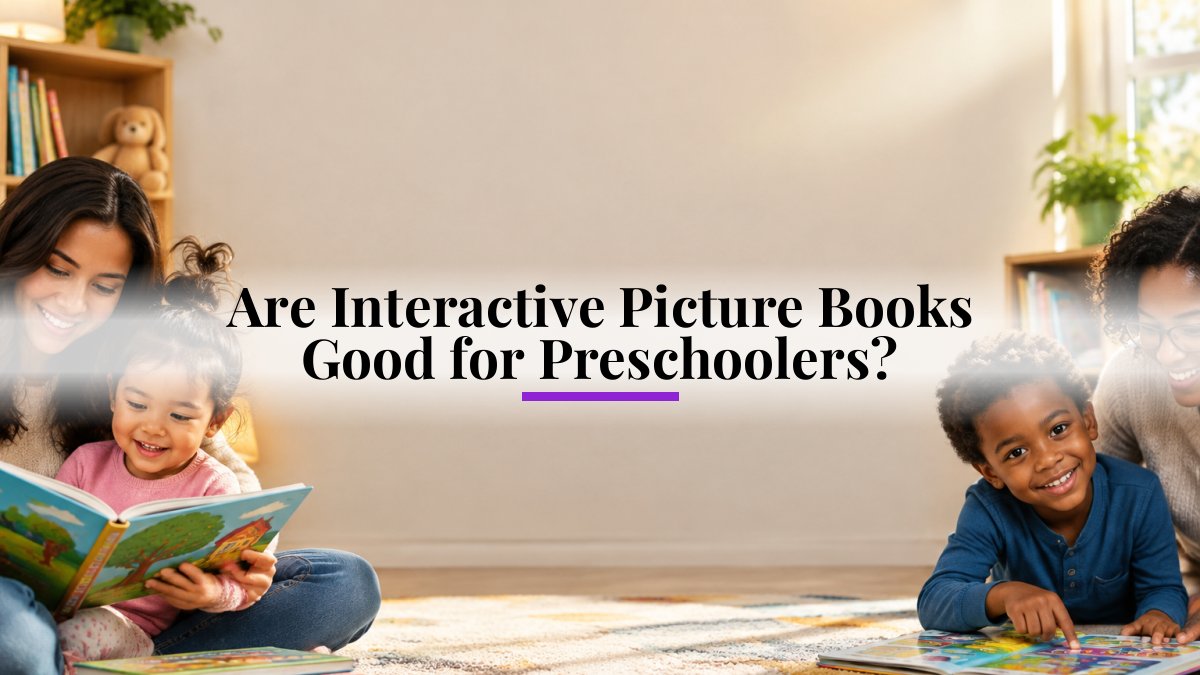
Are Interactive Picture Books Good for Preschoolers?
Last Updated: November 7, 2026
Quick Summary
Interactive picture books are good for preschoolers because they turn storytime from listening into doing. They ask your child to tap, shake, clap, or call out, which builds language, motor skills, and comprehension. Match the book's prompts to what your child can already do.
- Interactive picture books are serve-and-return in book form: your child acts, you respond.
- Match the interaction type to your child's energy that day, such as movement books after school.
- Clear, single-action prompts like press here work better than vague directions.
- Borrow two or three titles from the library first, then buy the ones your child asks for again.
- Younger preschoolers around 3 do best with one simple cause-and-effect prompt per page.
Table of Contents
- Why Interactive Picture Books Work for Preschoolers
- How to Pick an Interactive Picture Book (What Actually Matters)
- Interactive Books for 4 Year Olds: Titles That Hold Up to Repeat Reads
- Books Like Press Here: What to Read Next
- Free Interactive Picture Books for Preschoolers (No Purchase Needed)
- Preschool Storytime Questions That Get Kids Talking
- Build Your Read-Aloud Habit With One Chapter
- Frequently Asked Questions
Why Interactive Picture Books Work for Preschoolers
You know the scene. You sit down with a picture book, open to page one, and your preschooler is already wiggling off your lap.
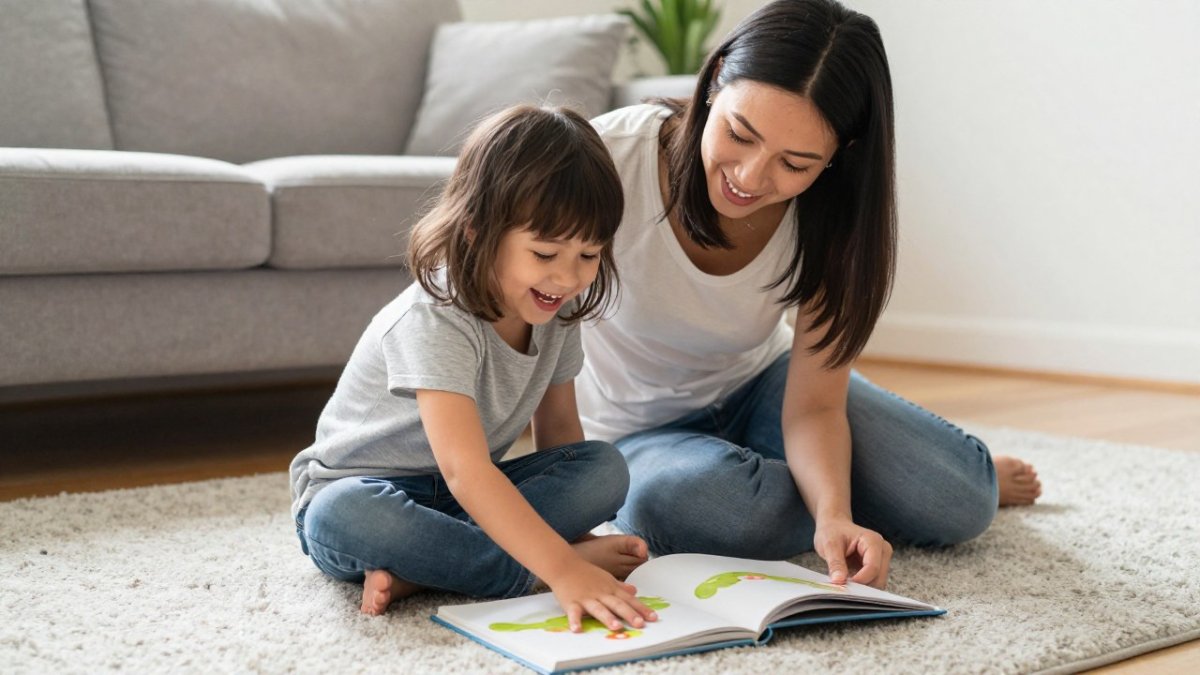
The book that gets requested forty times is almost never the one they sit still for. It's the one they get to touch.
The research lines up with what parents see at home.
How to Pick an Interactive Picture Book (What Actually Matters)
The best interactive picture book for your child is the one whose prompts match what they can already do. A book that asks a 3-year-old to follow three-step directions will frustrate them. A book that asks a 5-year-old to just tap a dot may bore them.
Here's a method you can use to judge any book on the shelf.
Start with the interaction type
Ask what the book wants your child to do. Most fall into one of four buckets:
- Touch and page movement: tap, press, shake, tilt, trace. Builds fine motor control and cause-and-effect thinking.
- Sound and verbal response: repeat a word, make an animal noise, shout a phrase. Builds listening and oral language.
- Movement: wiggle, clap, stand up, act it out. Builds gross motor skills and helps kids who need to move to focus.
- Prediction: guess what's behind the page, spot the hidden character. Builds early comprehension and story sense.
Match the bucket to your child's energy that day. A kid bouncing off the walls after school may do better with a movement book than a quiet tap-and-count one.
Check prompt clarity
Clear, single-action prompts ("press here," "shake the book") work better than vague ones. Flip through a few pages before you commit. If you can't tell what the book is asking you to do, your child won't either.
Judge repeat-read value
Preschoolers reread favorites many times over, so look for books with variety built in. A one-trick book gets old fast, and you're the one who has to read it forty times.
Weigh durability against format
Board book editions survive enthusiastic tapping better than paper pages. If your child is rough on books, board is worth the trade-off, and library copies are often already reinforced.
Think about sensory needs
This is the part most lists skip. If your child is sensitive to noise, a shout-it-out book may backfire, and a quiet tap-and-trace title is the safer pick. If your child seeks movement, a wiggle book gives them an outlet. If visual clutter is distracting, choose simple, high-contrast pages. None of this is a diagnosis, just a way to match the book to the kid in front of you.
Consider group versus one-on-one
A book that's perfect on your lap can fall flat with a room of twelve kids. Call-and-response titles work well in groups because everyone can answer at once, while small, detailed prompts work better one-on-one.
A quick side-by-side test
When you're deciding between two books, run this short comparison:
| What to compare | Why it matters |
|---|---|
| Interaction type | Tells you which skills it supports |
| Prompt clarity | Predicts whether your child can follow along |
| Repeat-read variety | Decides how long it stays in rotation |
| Format and durability | Affects how long it survives |
| Sensory fit | Matches the book to your child's needs |
| Group suitability | Tells you if it works for storytime or just lap time |
Watch out: Don't buy a whole stack at once. Borrow two or three from the library, see which ones your child asks for again, then buy the keepers.
If you want a deeper walkthrough on matching books to your child's stage, our guide on how to choose age-appropriate picture books for preschoolers goes further.
Interactive Books for 4 Year Olds: Titles That Hold Up to Repeat Reads
Four-year-olds are a tough audience. They've seen the trick before, so the book has to earn its place on the shelf. The titles below are popular picks from interactive picture book lists. We've sorted them by what they ask your child to do, because that decides whether a book lands on a given day.
Books that ask for touch and page movement
Press Here by Hervé Tullet asks kids to tap, shake, and tilt the page, and the dots respond. Check your library or local shop for current availability.
Tap the Magic Tree by Christie Matheson walks through seasonal change with taps and counting.
There's a Unicorn in Your Book is a playful title built for participation.
Books that ask for sound and verbal response
Say Zoop! by Hervé Tullet turns reading into a sound game. Kids make noises on cue, which builds listening skills along with the fun.
I Say Ooh You Say Aah by John Kane is a call-and-response book. Your child says the words back, and the story reacts. Great for group reading.
Books that ask for prediction and suspense
Watch Out for the Lion!, Hey, Bruce!, and There Are No Dragons in This Book build anticipation into every page turn, which is prediction practice dressed up as a game.
How to read each one aloud
The book does half the work, but a little setup makes the participation smoother:
- Press Here: Do the first tap yourself, slowly, and let your child see the page change. Then hand it over. If your child taps too hard, that's fine. Board book editions take it better than paper pages.
- Tap the Magic Tree: Pause before each page turn and ask, "What do you think the tree will do next?" Count out loud together.
- Say Zoop!: Warm up with one silly sound before you open the book. Kids who feel shy about noise often join in once you go first.
- I Say Ooh You Say Aah: Practice the call-and-response once before the story starts. In a group, have everyone answer together so no one feels put on the spot.
Watch out: If your child gets so excited they start flipping ahead, don't correct them. Let them lead, then circle back to the pages you skipped.
Matching the book to your child's age
Within the preschool years, attention span and motor control vary a lot. A few guideposts:
- Younger preschoolers (around 3): Simple cause-and-effect prompts work best, like tapping a dot or pressing a page. One action per page is plenty.
- Older preschoolers (4 to 5): Counting, prediction, and humor land better. These kids can hold a two-step prompt and wait for a page turn.
- Mixed-age groups: Call-and-response books like I Say Ooh You Say Aah let a 3-year-old join in without needing to follow complex directions.
| Title | Main Interaction | Best Age Fit | Read-Aloud Note |
|---|---|---|---|
| Press Here | Tap, shake, tilt | 3 to 5 | Model the first tap, then hand it over |
| Tap the Magic Tree | Tap, count, seasonal talk | 3 to 5 | Count out loud together |
| Say Zoop! | Make sounds | 4 to 5 | You go first with a silly sound |
| I Say Ooh You Say Aah | Call and response | 3 to 5 | Practice the response once before starting |
| There's a Unicorn in Your Book | Physical and mental prompts | 4 to 5 | Let your child lead the actions |
| Watch Out for the Lion! | Prediction and suspense | 4 to 5 | Pause before the page turn |
Best Age Fit
Want more titles in the toddler and preschool range? Our list of interactive board books for toddlers is a good next stop.
Books Like Press Here: What to Read Next
If Press Here is the favorite, there's a whole shelf of books that scratch the same itch.
Start with the other Tullet titles. Say Zoop! is the natural follow-up because it swaps tapping for sound, which keeps things fresh.
For kids who like a little suspense, Watch Out for the Lion! and There Are No Dragons in This Book build anticipation into every page turn.
One insider tip: rotate these books rather than keeping them all out at once.
Free Interactive Picture Books for Preschoolers (No Purchase Needed)
You don't have to buy a thing to get the benefits. Your local library is the best free source of interactive picture books, and most systems let you request titles online and pick them up curbside.
Here's where to look:
- Your library catalog. Search "interactive picture books" or ask a children's librarian. They build lists exactly like the ones cited above.
- Little Free Library boxes. Neighborhood book-sharing boxes often have well-loved picture books. Take one, leave one.
- Book swaps. A neighborhood swap is a free way to rotate titles. Chapter 10 of Literacy Roots covers the community value of book access.
- Read-aloud videos. Many libraries post free storytime recordings. They're a supplement, not a replacement for lap time.
- Homemade interactive books. Fold paper, draw a dot, and write "tap here" on each page. Your child helps make it, which doubles the fun.
For the broader case on why daily read-aloud time pays off, see why reading aloud to toddlers every day is worth it.
Preschool Storytime Questions That Get Kids Talking
The book is the start of the conversation, not the end. A few well-placed questions turn a five-minute read into ten minutes of language practice, and they cost nothing.
Try these during and after the story:
- "What do you think will happen when we turn the page?"
- "Can you show me with your hand what the book wants us to do?"
- "How do you think the character feels right now?"
- "What sound does that animal make?"
- "If you could add one page to this book, what would happen on it?"
Notice these are open questions, not quizzes. There's no wrong answer, which is the point. Chapter 4 of Literacy Roots calls literacy a mosaic of reading, writing, speaking, and listening, and storytime questions hit all four at once.
Build Your Read-Aloud Habit With One Chapter
Here's the part that matters more than any single title: consistency. For a closer look at why short, frequent sessions beat marathon storytimes, see daily reading routines.
Start smaller than you think you should. One book at bedtime. One interactive book after breakfast. That's it.
Parenting advice can pile up and feel like one more chore. This isn't that.
If you're ready to go deeper, Literacy Roots: Nurturing Your Child's Reading Journey from Birth to Brilliance is available on Amazon for $14.99.
Your child doesn't need a perfect reading routine. They need you, a book they can touch, and a few minutes tonight.
Frequently Asked Questions
What makes a picture book interactive?
An interactive picture book asks the child to do something, not just listen. That might mean tapping a dot, shaking the page, blowing on a character, or answering a question out loud. The book is built so the child's action seems to cause what happens next. That cause-and-effect loop is what keeps a preschooler's attention on the page instead of the ceiling.
Are interactive picture books good for preschoolers?
Yes, and for reasons beyond entertainment. Interactive picture books for preschoolers build attention span, vocabulary, and fine motor skills because kids are pressing, pointing, and turning pages while they listen. They also invite social interaction: your child makes sounds, follows directions, and waits for your reaction. Chapter 4 of Literacy Roots calls this the literacy mosaic, where listening and speaking count as much as reading.
Can I find free interactive picture books for preschoolers?
You can. Your local library is the easiest place to start, and many library storytime programs build participation right into the session. Ask a children's librarian for titles that invite touch and movement. Little Free Library boxes, neighborhood book swaps, and library book sales are other low-cost routes. Chapter 10 of Literacy Roots makes the case that access, not ability, is what shapes young readers.
How long should a preschool storytime last?
Follow your child, not the clock. Many preschoolers stay engaged for 10 to 15 minutes with an interactive book, then want to move. If your child wiggles away, that is not a failure. Try a shorter book, read at bedtime when they are calmer, or let them act out the pages. Chapter 2 of Literacy Roots points out that repetition and warm back-and-forth talk matter more than session length.