 How-to
Simple Reading Routines for Busy Parents: A 2026 Guide
Table of Contents
- Why 10 Minutes a Day Beats an Hour on Sunday
- Build Early Literacy Activities at Home Into Your Existing Day
- The Reading Routine for Toddlers That Survives Real Life
- How to Fit Reading Into a Hectic Schedule
- Literacy Tips for Working Parents: Routines That Hold Up on Hard Days
- Audiobooks and Reading Aloud: Two Tools, Not Rivals
- Keeping Simple Reading Routines Going Through Moves and Change
- Frequently Asked Questions
Last Updated: September 16, 2026
Why 10 Minutes a Day Beats an Hour on Sunday
A simple reading routine for busy parents is a short, repeatable block of shared reading built into an existing daily habit, usually 5 to 15 minutes at the same time each day. Consistency beats duration: ten minutes nightly builds more early literacy than one long weekend session, because language development grows through repetition, not volume.
Build Early Literacy Activities at Home Into Your Existing Day
Early literacy activities at home work best when they attach to something you already do. You are not adding a task; you are labeling an existing moment as a reading moment. Breakfast, bath, and the drive to daycare are the highest-yield slots because they happen daily without negotiation.
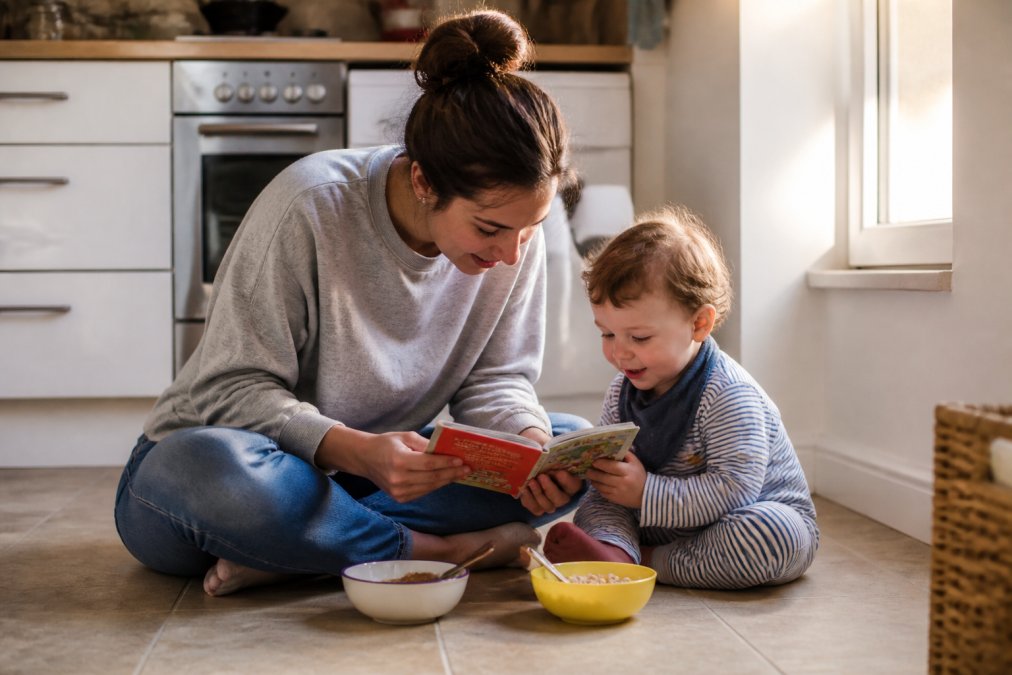
Micro-Routines for Breakfast, Bath, and the Commute
A micro-routine is a reading habit under five minutes, tied to a fixed trigger. Try one per slot:
- Breakfast: One board book propped against the cereal box. Point at pictures between bites.
- Bath: Two waterproof books in the tub caddy. Let your child turn the pages.
- Commute: One audiobook or a sing-along CD in the car. Talk about what you heard at the next red light.
Turn Screen Time Into Storytime
Screen time reduction starts with substitution, not restriction. Replace one 10-minute video block with a read-along video or animated storybook, and sit with your child while it plays, the goal is shared attention, not a solo screen. Over a few weeks, move that block to a physical book at the same time of day. The trigger stays; the medium changes.
Model the Habit: A Digital-to-Analog Plan for Parents
Most advice tells you to put your phone down; almost none tells you how. Children copy what they see long before they follow what they are told, so if your child watches you scroll through dinner and then gets handed a book, the book reads as punishment. The fix is a behavioral plan, not willpower.
What to Do When the Screen Wins
Some days the screen wins. That is not a failure of the routine; it is a data point. Note the time of day it happened, a pattern usually emerges within a week. Screens tend to win when the child is overtired, a parent is on deadline, or the routine has drifted past the child's attention span. Adjust the trigger, not the goal: move reading 20 minutes earlier, shorten it to two pages, or swap in an audiobook.
The Reading Routine for Toddlers That Survives Real Life
A reading routine for toddlers should be short, predictable, and led by your child's attention span, not a page count. Most toddlers sustain 3 to 7 minutes of shared reading. Fighting for 20 minutes produces resistance; stopping at 5 while your child is still interested produces requests for more.
Reading Aloud Techniques That Hold a Toddler's Attention
Interactive reading beats straight narration. Use these techniques:
- Point and name. Touch each picture and say the word.
- Pause and wait. Stop mid-sentence and let your child fill the gap.
- Repeat phrases. Repeated phrases in rhyming books invite your child to join in.
- Ask one question per page. "Where's the duck?" beats "What do you think happens next?"
- Follow the wriggle. If your child stands up, keep reading. Movement and listening can happen together.
Choosing Books by Age and Attention Span
Book selection should match attention span, not reading level. A 12-month-old needs high-contrast pictures and one word per page. A 2-year-old needs rhythm and repetition. A 3-year-old can follow a simple story with a beginning and an end.
| Age | Attention Span | Best Book Type | What to Avoid |
|---|---|---|---|
| 0-9 months | 1-3 minutes | High-contrast board books | Long text blocks |
| 9-18 months | 2-5 minutes | Lift-the-flap, touch-and-feel | Abstract illustrations |
| 18 months-2 years | 3-7 minutes | Rhyming, repeated phrases | Busy pages |
| 2-3 years | 5-10 minutes | Simple plot, familiar routines | Scary themes |
How to Fit Reading Into a Hectic Schedule
Reading fits into a hectic schedule when it borrows time from transitions you already have, not tasks you would have to cancel. The realistic slots are the 4 minutes waiting for pasta to boil, the 6 minutes in the pickup line, and the 3 minutes after teeth are brushed. None require new time; they require a book within arm's reach.
Three moves that make this stick:
- Keep a basket of books in every room your child spends time in.
- Keep one book in the car and one in your bag.
- Set a phone reminder for the same time each day for the first two weeks.
Literacy Tips for Working Parents: Routines That Hold Up on Hard Days
Literacy tips for working parents have to survive the 6 p.m. meltdown, the late meeting, and the sick day. The routine that works on a hard day is smaller than the one that works on a good day, and that is fine. Two pages counts. One audiobook chapter in the car counts. A single repeated phrase counts.
When Your Child Resists: Troubleshooting Without a Power Struggle
Resistance is normal and rarely about the book. Work through this list before assuming your child dislikes reading:
- Check the time. A tired child resists everything. Move reading earlier.
- Check the book. Offer three choices and let your child pick.
- Check the pressure. If you are asking questions on every page, back off and just read.
- Check the format. Try an audiobook, a wordless picture book, or a magazine.
- Check yourself. If you are tense, your child will be too. Read one page and stop.
Neurodivergent-Friendly Adjustments
Children with ADHD, autism, or sensory processing differences often need a different structure, not less reading. Shorten sessions to 2 to 4 minutes and increase frequency, allow movement or fidget toys, and repeat the same book if that is what your child wants, repetition is regulation for many neurodivergent kids. If your child covers their ears, lower your voice and slow down rather than stopping.
Audiobooks and Reading Aloud: Two Tools, Not Rivals
Audiobooks and reading aloud serve different purposes and both build literacy. Reading aloud builds bonding, print awareness, and phonics as your child watches words while hearing them. Audiobooks build vocabulary and listening comprehension during car rides, chores, and waiting rooms, when a physical book is not practical.
How to Use Audiobooks as a Real Literacy Tool
Treating audiobooks as background noise wastes them. Used deliberately, they do three things a physical book cannot: expose your child to vocabulary above their reading level, model fluent phrasing and prosody, and let a tired parent deliver a story without reading a page.
- Car rides (5-20 minutes): Short picture-book audio or a single chapter. Avoid long novels here, the ride ends mid-scene and the thread is lost.
- Chores and cooking (10-30 minutes): Chapter books or story collections. Your child can move around while listening, which suits kids who will not sit still for a physical book.
- Waiting rooms and pickup lines (2-10 minutes): Single poems, short fables, or one song. These slots are too short for plot.
- Bedtime: Keep this slot for a physical book. Audio at bedtime competes with sleep and often winds a child up rather than down.
What Audiobooks Do Not Replace
Audiobooks do not teach print awareness. A child who only listens never learns that words run left to right, that a sentence ends with a period, or that the same word looks the same every time it appears, that comes from seeing print. Keep at least one physical book in the daily rotation, even if it is the same book for a month.
Keeping Simple Reading Routines Going Through Moves and Change
Simple reading routines are portable, which is why they matter during a move, a deployment, or a school change. When everything else is new, the same three books at the same time of day give your child a fixed point. Pack the bedtime books in the car, not the moving truck, keep the audiobook loaded before the drive, and read in the hotel room, temporary housing, and new bedroom on the first night.
Frequently Asked Questions
How long should a daily reading session be for toddlers?
Ten minutes is plenty. Toddler attention spans are short, and a consistent ten-minute routine beats a 45-minute session once a week. If your child is engaged, keep going; if they squirm after four minutes, stop while it's still fun. The goal is a daily rhythm your child associates with warmth, not a timer. Two or three short sessions, at breakfast and bedtime, work well for wiggly kids.
What are some simple literacy activities for busy parents?
Narrate your day while you cook or drive. Point out letters on cereal boxes, street signs, and storefronts. Sing songs with repeated phrases, which build phonics skills and vocabulary acquisition. Keep a basket of board books in the car and near the bathtub. Let your child turn pages and finish familiar lines. None of these require planning, and each one adds minutes of shared reading to a day that is already full.
How do I keep a reading routine going when I'm exhausted?
Lower the bar instead of skipping the routine. On hard days, play an audiobook during the bedtime routine and let a narrator do the reading while you both listen. Keep two or three books by the bed so you do not have to choose. A tired parent reading one short book still counts. Consistency matters more than enthusiasm, and a scaled-down routine protects the habit.
My child resists books. What should I try?
Follow their interest rather than the book list. A child who loves trucks will sit through a truck book. Try wordless picture books so there is no pressure to read, and let your child hold the book and turn pages. Read during movement, like on a swing or before a bath, when resistance is lower. If reading aloud feels like a battle, switch to an audiobook for a week and return to books later.


