 How-to
How Toddlers Learn to Recognize Letters, Step by Step
Last Updated: November 6, 2026
Quick Summary
Toddlers start to recognize letters through everyday exposure, not flashcards. Reading together, pointing out letters on signs and packages, and singing the alphabet song all help. Most children begin recognizing some letters, especially those in their own name, around ages 3 to 4.
- Around age 2, toddlers may point to a favorite letter or the first letter of their name.
- Ages 3 to 4: many children recognize some letters, especially those in their own name.
- Ages 4 to 5: many start telling uppercase from lowercase and naming more letters.
- Keep it low-pressure; quizzing turns cozy moments into tests, so point and name instead.
- Singing the alphabet song is a warm-up, not the same skill as recognizing letters.
Table of Contents
- Why Letter Recognition Starts Long Before the Alphabet Song
- Letter Recognition by Age: What's Typical From Toddlerhood to Preschool
- Recognition, Naming, Sounds, and Writing: How They Differ
- Letter Recognition Activities for Toddlers You Can Start Tonight
- What Order to Teach Letters to Preschoolers
- How Many Letters Should a 2-Year-Old Know?
- Your Next Step: Notice Progress and Know When to Ask for Help
- Frequently Asked Questions
Why Letter Recognition Starts Long Before the Alphabet Song
Letter recognition doesn't begin with flashcards. If you want to see how to set up a print-rich space for babies, check out a print-rich home for babies. It begins with the bedtime stories, peek-a-boo games, and nursery rhymes you share long before your child can point to an "A" and learn to recognize letters on their own. Literacy grows in small, warm, daily moments.
Think about the grocery store. That running commentary you give while you shop? "Look, that's a big S on the cereal box. Stop sign starts with S too!" It counts. Your child is noticing that letters are everywhere and that they mean something.
Try this tonight: When you read, run your finger under the title and say it out loud. Your child learns that print carries meaning, even before they can name a single letter.
Lauren describes this kind of everyday exposure in Literacy Roots (Ch. 2 and Ch. 3). Nothing you do has to be perfect.
Letter Recognition by Age: What's Typical From Toddlerhood to Preschool
Every child moves at a different pace, and that's normal. What helps most is knowing what you're actually watching for at each stage, so you can notice progress without turning it into a test.
Here's a loose picture, with some small behaviors that many children show along the way:
- Under age 2: Turns pages, pats pictures, and may fix on one letter on a favorite board book. At this stage, interest in the book matters more than the letter.
- Around age 2: Might point to a letter they like, often the first letter of their own name, or hand you a letter-shaped toy.
- Ages 3 to 4: Often recognizes some letters, especially the ones in their name, and may sing parts of the alphabet song.
- Ages 4 to 5: Many children start to tell uppercase and lowercase letters apart and name more of them. Some begin matching a letter to its sound, especially the first sound in their name.
A word on the alphabet song: singing it is a lovely ritual, and it is not the same skill as recognizing letters. A child can belt out the whole tune and still not pick an "M" out of a lineup. It just means the song is a warm-up, not the finish line.
Watch out: If you find yourself quizzing ("What letter is this? What about this one?"), pull back. Recognition grows from lots of low-pressure exposure, and a quiz turns a cozy moment into a test. Point and name instead, and let your child jump in when they're ready.
If your child is a little behind this list, that's not a crisis. Variation is part of how children develop. If you have concerns that last longer, talk with your child's teacher or pediatrician. Lauren covers the everyday-talk side of early language in Ch. 2 of Literacy Roots, where repetition and back-and-forth conversation are central.
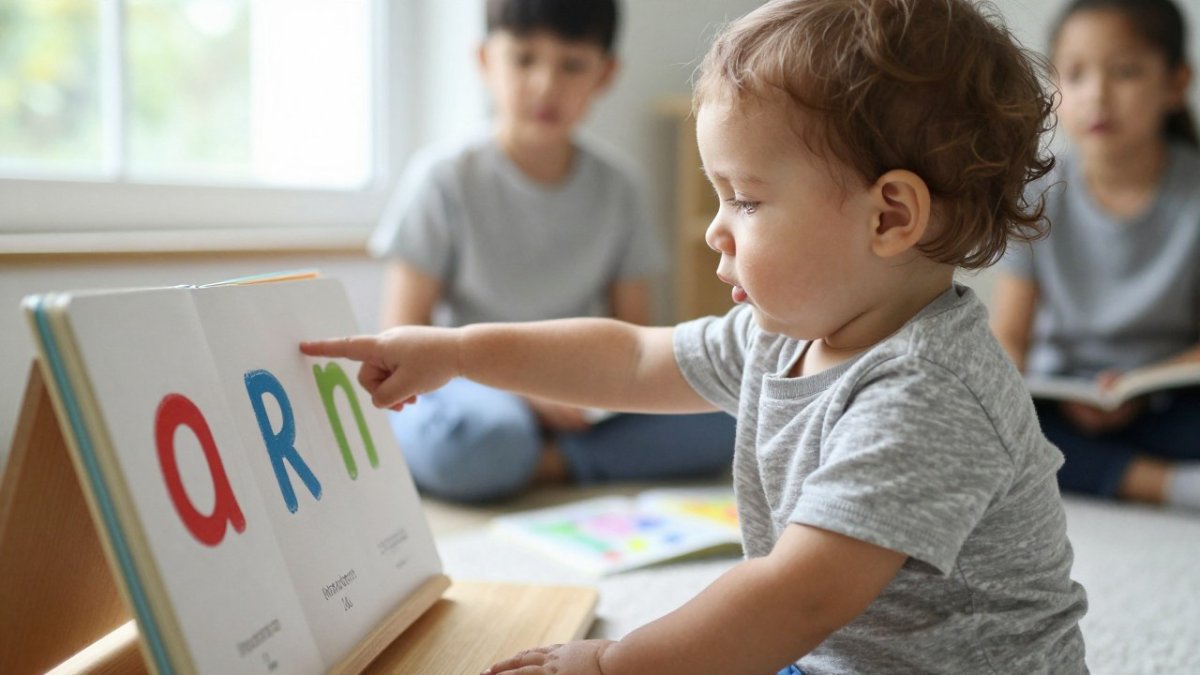
Every child moves at their own pace, but here is a loose picture of what many children show from toddlerhood through preschool.
| Age | What you might see | Note |
|---|---|---|
| Under 2 | Turns pages, pats pictures, fixes on one letter | Interest in books matters most |
| Around 2 | Points to a favorite letter or first letter of name | Letter-shaped toys can help |
| Ages 3 to 4 | Recognizes some letters, sings parts of the alphabet song | Letters in own name come first |
| Ages 4 to 5 | Tells uppercase from lowercase, names more letters | Some match letters to sounds |
Recognition, Naming, Sounds, and Writing: How They Differ
These four skills get mixed up a lot, so here's a quick breakdown:
- Recognition: Seeing a letter and knowing it's an "M" when you spot it.
- Naming: Saying the letter's name out loud.
- Sounds: Knowing that "M" makes the /m/ sound.
- Writing: Forming the letter with a pencil, crayon, or finger.
A child can recognize letters well before they can write them, and naming often comes before sounds. Keep these separate in your mind so you don't expect everything at once.
Letter Recognition Activities for Toddlers You Can Start Tonight
You don't need a shopping list. These ideas fit into normal routines, and most cost nothing. Pick one, try it for a few minutes, and stop while it's still fun. For a full walkthrough of home reading steps, see step-by-step home reading activities. That last part matters more than the activity itself.
For younger toddlers (roughly 18 months to 2 and a half):
- Name hunt: Walk through the house and point out letters on packages, mail, and signs. Keep it to two or three letters per walk, and name them out loud without asking your child to repeat. "There's the M on the mail."
- Sing the song, then pause: Sing the alphabet song and stop before a letter. If your child fills in the blank, great. If not, sing it yourself and move on.
- Letter shapes in the bath: Trace a letter on a foggy mirror or draw in bath foam together. The big motion is the point, not a perfect shape.
- Alphabet books, read again: Lauren's research point in Ch. 2 is that reading the same book many times builds familiarity. Repetition is the goal, so let your child pick the same one for the tenth night.
For older toddlers and preschoolers (roughly 3 to 5):
- Name-building: Write your child's name on a sticky note and cut the letters apart. Let them rebuild it. This works on a table, a tray, or a hotel nightstand.
- Pair the letter with a feeling or object: "B is for bear, and bear rhymes with chair." Link the letter to something your child already loves.
- Letter hunt in environmental print: On a walk or a store run, look for one letter together. "Can you find another S like the one on the stop sign?" This fits the everyday-print idea in Ch. 3 of Literacy Roots, where environmental print around the home and neighborhood supports literacy.
Multisensory and accessibility adaptations:
- Tactile: Trace letters in sand, salt on a tray, or shaving cream. Letter-shaped blocks and movable letters let a child feel the shape while naming it.
- Visual: Use high-contrast letters, larger print, and one letter at a time on a plain background. Too many letters at once can be visual clutter.
- Movement: Make a letter with your whole body, or hop from one letter taped on the floor to the next. Movement helps kids who learn by doing.
- Speech and language support: If your child is working on speech sounds, name the letter and let them point or nod. You don't need a spoken answer for the exposure to count.
Watch out: If your child wanders off or says no, that's information, not failure. Stop, and try again another day. A five-minute session that ends happily beats a twenty-minute one that ends in tears.
Military and budget-friendly tip: These activities travel with you. A sticky note with the child's name and a marker works in any hotel room or new base housing, and you don't need to pack a single flashcard.
What Order to Teach Letters to Preschoolers
There's no single correct order, so start with what matters to your child, such as letters from their name or favorite words. Introduce a few at a time, rather than all 26 at once.
Common groupings you might try:
- Letters in your child's name
- Letters that look different from each other (like O, S, and X)
- Letters with easy sounds (like M, S, and T)
Keep it playful. If your child loses interest, switch to something else and come back later.
How Many Letters Should a 2-Year-Old Know?
Some 2-year-olds recognize one or two letters, often the first letter of their name, while others don't yet. Focus on interest and exposure rather than a number. A child who loves books and hears language every day is building the skills that matter most.
Your Next Step: Notice Progress and Know When to Ask for Help
Watch for progress in how your child engages: pointing at letters, singing parts of the alphabet song, or saying "that's an S!" at a sign. Those small moments add up.
If you notice ongoing concerns, such as trouble with rhyming, a lack of interest in letters or books over a long period, or difficulty with speech, bring them to your child's teacher or pediatrician. You can also learn how to spot reading gaps before they become struggles. Those conversations are about support, not labels.
If you want more ideas for building early reading at home, Literacy Roots by Lauren Daugherty walks through each stage with research and everyday family routines. You can find it on Amazon for $14.99.
Frequently Asked Questions
Is it normal for a 2-year-old to recognize letters?
Some 2-year-olds recognize a few letters, often the ones in their own name or on familiar signs, and many don't yet. Recognition grows with exposure, and children move at their own pace. Keep reading aloud, point out letters in everyday places, and let your child lead. If you have concerns about your child's progress, a conversation with your pediatrician or your child's teacher is a good next step.
Should a 3-year-old recognize letters?
Some 3-year-olds start noticing letters, especially the first letter of their name. Try playing with letter blocks or spotting letters on cereal boxes and street signs. Keep it light and playful so learning still feels like fun.
What letters should I teach my toddler first?
Many parents start with the letters in their child's name, since those hold personal meaning. Letters your child sees often, like the first letter of a favorite food or a family member's name, also work well. Follow your child's interest rather than a fixed list.
My 5-year-old isn't recognizing letters. Is this normal?
Children develop at different rates, so some five-year-olds are still building letter recognition. If progress seems slow or your child seems frustrated, it's worth sharing your observations with their teacher or pediatrician.



