 How-to
How to Create a Print-Rich Environment for Babies at Home
Table of Contents
- What a Print-Rich Environment Looks Like for Babies
- Literacy-Rich Activities for Infants That Fit Your Daily Routine
- How to Read to a Baby Effectively (Even When They Won't Sit Still)
- Your Home Literacy Environment Checklist: Room-by-Room Setup
- Developmental Milestones for Print Interaction: What to Expect at Each Stage
- Digital vs. Physical Print Balance: What the Research Says
- Budget-Friendly DIY Print Materials You Can Make Today
- Conclusion: Building Your Baby's First Library of Experiences
- Frequently Asked Questions
Last Updated: September 29, 2026
What a Print-Rich Environment Looks Like for Babies
A print-rich environment is a space where your baby sees, touches, and hears written language every day. It is not a classroom or a shelf full of expensive books. It is your home, set up so words are part of normal life.
Everyday Examples You Already Have at Home
Most homes are closer to a literacy-rich environment than parents realize. Look around and you likely already have:
- A cereal box with big letters on the front
- Mail, catalogs, and grocery lists on the counter
- A phone book or recipe card in a drawer
- Board books stacked near the crib
Literacy-Rich Activities for Infants That Fit Your Daily Routine
The best literacy-rich activities for infants are the ones you can do while feeding, changing, or folding laundry. No extra time needed. Just talk, point, and name.
- Name what you see. "That's a B. B for banana."
- Point at labels. Say the word on the jar out loud.
- Sing while you point. Use a book or a chart as you sing.
- Talk through chores. "I'm writing eggs on the list."
Simple Activities for Different Ages and Stages
Match the activity to what your baby can do right now:
- 0-3 months: Hold a high-contrast board book and talk about the shapes.
- 3-6 months: Let them bat at soft cloth books during tummy time.
- 6-9 months: Offer sturdy board books to chew and grab.
- 9-12 months: Point at pictures and ask, "Where's the dog?"
How to Read to a Baby Effectively (Even When They Won't Sit Still)
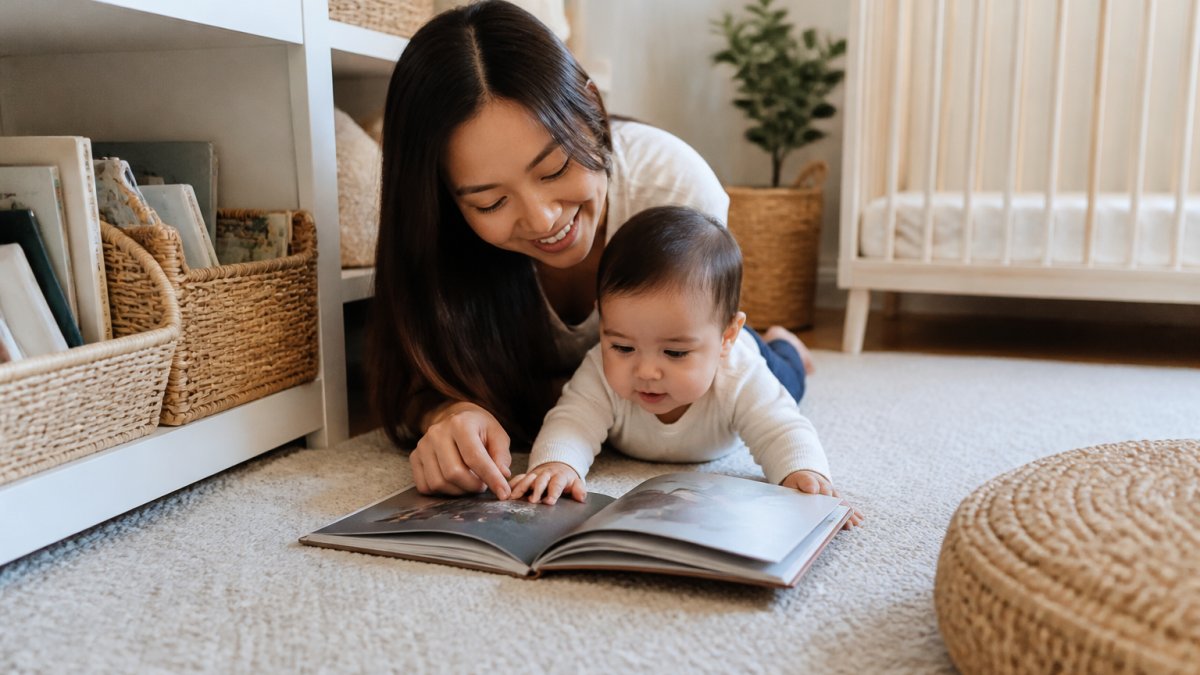
Reading to a baby does not require a still, quiet child. It requires you to follow their lead. If they grab the book, that is book handling skills in action, not misbehavior.
Interactive Reading Techniques That Build Book Handling Skills
Try these methods during story time:
- Pause and wait. Give your baby a chance to coo or point.
- Follow their gaze. Talk about whatever they look at.
- Use a sing-song voice. This supports phonological awareness.
- Let them turn pages. Even if they skip ahead.
Your Home Literacy Environment Checklist: Room-by-Room Setup
A strong home literacy environment checklist covers five rooms, not one. You do not need a full library in each. You need a few words within reach, everywhere your baby spends time. The difference between a checklist that works and one that collects dust is specificity: where to put the item, how high, and how often to change it.
| Room | What to Add | Where to Place It | Why It Works |
|---|---|---|---|
| Nursery | 5-8 board books in a low basket | On the floor beside the crib or glider, within your baby's reach once crawling starts | Easy grab-and-go access during diaper changes and wind-down |
| Kitchen | Magnetic letters on the fridge, a grocery list at eye level | Lower third of the fridge door; list taped at your baby's seated eye level in a high chair | Daily exposure while you cook; you narrate the list out loud |
| Living room | Basket of 4-6 board books by the couch | On the floor, not a high shelf, babies need to reach books themselves | Turns idle couch time into book time |
| Bathroom | 1-2 waterproof or vinyl books | In a small bin beside the tub, out of standing water | Builds routine and makes bath time language-rich |
| Car | 1-2 board books in the seat pocket or a back-seat bin | Within arm's reach of the car seat, softcover to avoid injury in a sudden stop | Fills idle minutes in line or at pickup |
- Anchor heavy items. A bookshelf taller than about 30 inches should be strapped to the wall. Once your baby pulls to stand, unsecured furniture is the main hazard in a reading corner.
- Skip the top shelf. Anything above your baby's reach is decoration, not print exposure. If they cannot grab it, it does not count.
- Rotate every 1-2 weeks. Keep 4-6 books out and store the rest. A common pattern is that babies re-engage with a book that reappears after a week away.
- Keep one book per bag. Diaper bag, stroller basket, and car each get one. That way you never arrive somewhere empty-handed.
Creating a Dedicated Reading Corner or Nook
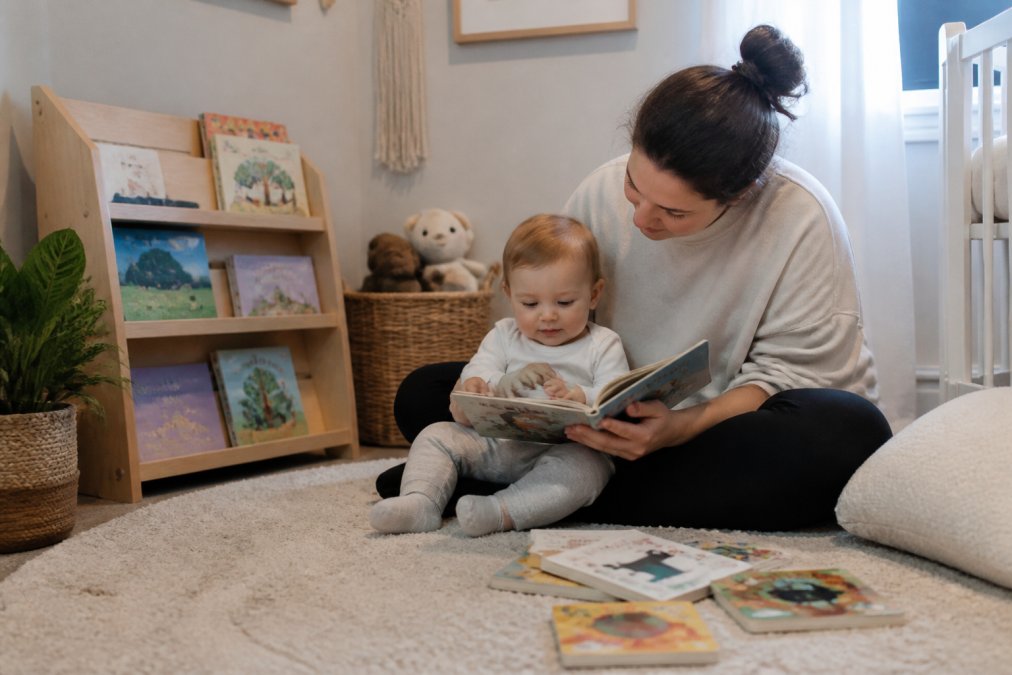
A reading corner does not need a whole room. A soft rug, a low basket of books, and a cushion will do. Keep it near a window for natural light, but avoid direct sun on the books, UV fades covers and warps board pages over time.
- Face-out display beats spine-out. Babies are drawn to covers, not titles. A simple wall ledge or a basket with the front cover showing gets more grabs than a traditional shelf.
- One soft landing spot. A rug or mat signals "this is where we sit." It also protects a wobbly sitter.
- No screens in sight. Keep the nook away from the TV and any tablet charging station. The point is to make paper the easiest choice in that spot.
Developmental Milestones for Print Interaction: What to Expect at Each Stage
Print knowledge grows in steps, and every baby moves at their own pace. Use these as a rough map, not a test. If you are ever concerned about your child's development, talk with your pediatrician.
0-6 Months: Looking and Listening
- What you may see: Your baby tracks high-contrast images, calms to your voice, and starts to bat at objects around 3-4 months.
- What to do: Hold a high-contrast board book about 10-12 inches from their face during tummy time. Name one picture per page, not the whole story.
- Why it works: At this stage, print exposure is really sound exposure. Hearing you name the same object repeatedly builds the vocabulary foundation that reading comprehension will later sit on.
- Try this: A black-and-white or high-contrast cloth book during tummy time; a soft vinyl book in the bath.
6-12 Months: Grabbing, Mouthing, and Turning
- What you may see: Reaching for books, mouthing corners, turning pages with help around 9 months, and pointing at named pictures around 12 months.
- What to do: Offer sturdy board books they can chew. Let them turn pages, even backward. When they point, name what they point at.
- Why it works: Mouthing and page-turning are book handling skills, not misbehavior. They are how a baby learns that a book is an object with a front, a back, and pages that move.
- Try this: A board book with one clear image per page; a touch-and-feel book; a small basket of 4-6 books on the floor.
12-18 Months: Bringing, Pointing, and Naming
- What you may see: Bringing a book to you to read, pointing at familiar pictures, and saying a few words or word-like sounds.
- What to do: Follow their lead. If they bring the same book for the fifth time, read it again, repetition is the point. Pause and wait after a page to let them respond.
- Why it works: This is where print awareness becomes interactive. Your baby is learning that books are a way to get a response from you, which is the social engine behind early literacy.
- Try this: A book with a repeated phrase they can anticipate; a photo album with family names written under each picture.
18-24 Months: Choosing and "Reading"
- What you may see: Choosing a specific book, pretending to read, and turning pages one at a time.
- What to do: Let them pick. Ask simple questions, "Where's the dog?", and wait. Keep a few books in every room so the choice is always available.
- Why it works: Choice builds ownership. A toddler who picks their own book is practicing the same decision-making that later makes independent reading feel natural.
Tracking these moments helps you match activities to your baby's stage instead of rushing ahead. If you want a one-page version to keep on the fridge, write the four age bands down the side and jot one activity next to each.
Digital vs. Physical Print Balance: What the Research Says
Physical books still matter most in the first year. Screens can support language acquisition, but they cannot replace the back-and-forth of a real conversation. The American Academy of Pediatrics recommends avoiding screen media other than video chatting for children under 18 months (AAP media use guidelines).
Budget-Friendly DIY Print Materials You Can Make Today
You can build a print-rich home for almost nothing. Many families find these free options work as well as store-bought kits. Try these today:
- Photo labels. Write "MOM" and "DAD" on index cards and tape them up.
- Grocery list art. Let your baby hold a list while you shop.
- Homemade book. Staple paper and glue in family photos with names.
- Name cards. Put your baby's name on their bedroom door.
- Magazine cutouts. Cut big letters and tape them at eye level.
Conclusion: Building Your Baby's First Library of Experiences
Every home can become a place where words are everywhere. Start small: one book in the diaper bag, one label on the fridge, one song during a diaper change. Those tiny moments add up fast.
Frequently Asked Questions
What is an example of a print-rich environment for a baby?
A print-rich environment for a baby includes board books within reach, labeled household items like 'door' and 'light,' magnetic letters on the fridge, and functional print such as grocery lists or mail your baby sees you use. It also means having a cozy reading corner with a few books rotated regularly. The goal is exposing your baby to print awareness through everyday items and routines, not creating a classroom at home.
At what age should I start creating a print-rich environment?
You can start from birth. Newborns benefit from hearing your voice during interactive reading and seeing high-contrast books. By 4 to 6 months, babies begin reaching for board books and exploring them with their mouths, which builds book handling skills. By 9 to 12 months, they may turn pages with help and point at pictures. Starting early supports language acquisition and early literacy development before your baby says their first word.
How do I read to a baby who won't sit still?
Follow your baby's lead. Short sessions of 2 to 3 minutes are fine. Let them hold a book, chew on it, or turn pages while you narrate what they're doing. Try interactive reading techniques like pointing at pictures and naming objects, making animal sounds, or asking 'Where's the ball?' even if they can't answer yet. Keep books in multiple rooms so you can grab one during calm moments like diaper changes or before naps.
Do labels and signs around the house actually help babies learn to read?
Yes, labels build environmental print awareness, which is the understanding that print carries meaning. When you label the crib, the door, or the light switch and point to the words as you say them, your baby starts connecting spoken words with written symbols. This is a foundation for alphabet recognition and reading readiness. Simple index cards or printed labels work fine, and you can rotate them as your baby grows.


