 How-to
7 Signs Your Child Is Ready for Phonics Instruction
Last Updated: October 26, 2026
Quick Summary
Most children are ready for phonics instruction somewhere between ages four and six, and readiness depends on skills and interest rather than a birthday. Watch for signs like rhyming, letter curiosity, and first-sound awareness before starting short, formal lessons.
- Keep playful sound exposure casual from toddlerhood, with no lesson plan or pressure.
- Formal letter-sound lessons usually click in the preschool to kindergarten window.
- Preschool practice should run 5 to 10 minutes and stay play-based.
- Start with common consonants and short vowels like m, s, a, and t.
- If your child isn't ready, wait and play or ask a teacher for a closer look.
Table of Contents
- The Best Age to Start Phonics Instruction (It's Not a Birthday)
- Signs a Child Is Ready to Read (and Ready for Letter Sounds)
- Phonics Activities for Preschoolers That Feel Like Play
- How to Teach Phonics at Home Without a Teaching Degree
- How Long to Practice Phonics (Short Beats Beat Long Sessions)
- When Your Child Isn't Ready: Multilingual Homes and Learning Differences
- Your Next Step: Build a Family Phonics Plan
- Frequently Asked Questions
The Best Age to Start Phonics Instruction (It's Not a Birthday)
Your four-year-old hands you a cereal box and asks what the big letters say. You freeze. Is this the moment? Are you supposed to start teaching letter sounds now, or are you already behind?
Take a breath. There is no single birthday that flips the switch on reading.
Most children are ready for phonics instruction somewhere between ages four and six, and readiness has far more to do with skills and interest than with a number on a cake. At Lauren's Literacy Lounge, we tell parents the same thing Lauren Daugherty writes in Literacy Roots: watch your child, not the calendar.
Below, we'll walk through the signs to watch for, games to try tonight, and what to do if your child isn't there yet.
Playful Exposure vs. Formal Lessons
Here's the distinction most guides skip. Exposure and instruction are two different things.
Exposure is casual. It's you saying "look, a B, buh-buh-ball" at the grocery store.
Formal phonics teaching is structured. You sit down, introduce a letter sound, practice it, and blend it into words.
Most kids soak up exposure from birth. Formal lessons tend to click somewhere in the preschool to kindergarten window.
Signs a Child Is Ready to Read (and Ready for Letter Sounds)
Your child might be ready for something new and you can't tell if it's a real milestone or wishful thinking. Here's the good news: readiness shows up in small, observable behaviors, not in a birthday.
Most children are ready for playful sound exposure from toddlerhood on. Most are ready for short, formal letter-sound lessons somewhere between ages four and six, often in the preschool to kindergarten window.
Readiness for Playful Exposure (Ages 2 to 4)
This stage is about ears, not worksheets. Look for:
- Enjoying songs and rhymes. Your child bounces to a rhythm or finishes a line of a nursery rhyme.
- Noticing sounds. They laugh at a silly word or repeat a sound for fun.
- Pointing at print. They tap a logo on a box or a sign at the store.
If you see these, keep doing what you're doing. Chapter 2 of Literacy Roots calls everyday talk "language nutrition," and that's the soil phonics grows in later.
Readiness for Formal Letter-Sound Lessons (Ages 4 to 6)
Formal instruction asks a child to focus, remember, and blend. That's a bigger ask. Watch for:
- Rhyming and sound play. They giggle at "cat" and "hat" or notice that "Sam" and "ham" sound alike.
- Letter curiosity. They point at letters and ask what they are.
- Name recognition. They spot the first letter of their own name.
- First-sound awareness. They can hear the opening sound in a word, like the "sss" in snake.
That sound-awareness piece is called phonemic awareness, and it's the groundwork for decoding.
A Quick Age-by-Age Snapshot
- Age 2 to 3: songs, rhymes, naming objects, pointing at print. No lessons.
- Age 3 to 4: sound games, letter spotting, name recognition. Still no formal lessons unless your child pulls you there.
- Age 4 to 5: short letter-sound introductions, blending two sounds, five-minute sessions.
- Age 5 to 6: more structured practice, blending and simple words, ten to fifteen minutes.
Use this as a map, not a scorecard. Some kids sprint ahead. Some need more time. Both are normal.
No checklist score is a diagnosis. If several boxes stay empty, that's information, not a verdict. Chapter 2 of Literacy Roots is the place to start if you want the research behind why everyday talk matters so much before lessons begin.
Phonics Activities for Preschoolers That Feel Like Play
The best phonics activities for preschoolers don't look like school at all. They look like a game on the living room floor.
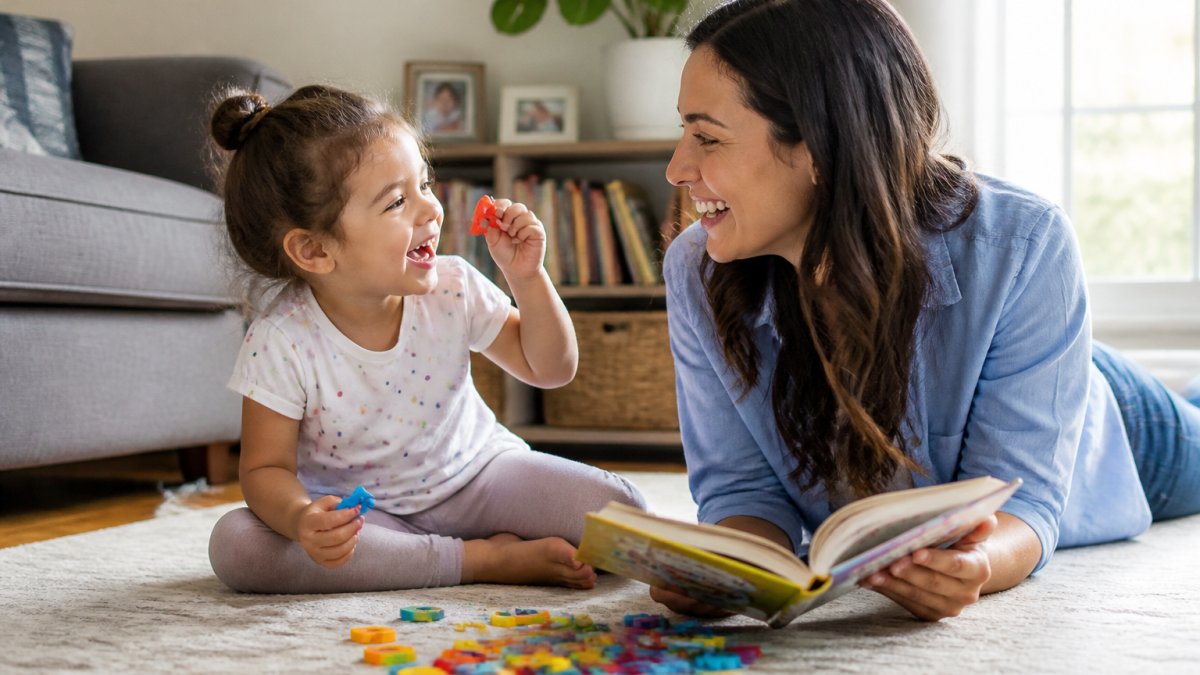
Keep sessions short and silly. If your child wanders off after two minutes, that's normal. Try again tomorrow. For more phonics games to play at home, there are plenty of quick options.
Sound Games to Try Tonight
- I Spy sounds. "I spy something that starts with /m/." (Say the sound, not the letter name.)
- Sound hunt. Walk the room and find three things that start with the same sound.
- Name clap. Clap the syllables in family names: "El-iz-a-beth."
- Mystery bag. Fill a bag with small objects and pull one out, stretching its first sound.
How to Teach Phonics at Home Without a Teaching Degree
You don't need a credential to teach letter sounds. If you want a step-by-step guide to teaching phonics at home, it walks you through the whole sequence.
Here's the honest part: most parents overthink this. A common mistake is jumping straight to flashcards and worksheets. Kids tune out fast. Start with sounds they can hear and letters they can touch.
A Simple Starter Sequence
- Hear sounds first. Play rhyming and sound games before any letters appear.
- Introduce a few letters. Start with common consonants and short vowels, like m, s, a, t.
- Say the sound, not the name. "Mmm," not "em."
- Blend two sounds. Push /a/ and /t/ together: "at."
- Add a letter. Turn "at" into "cat," "bat," "sat."
- Practice a little daily. Five minutes beats a long weekend session.
How Long to Practice Phonics (Short Beats Beat Long Sessions)
Ten to fifteen minutes a day is plenty for most young children.
Think about how long to practice phonics in terms of attention, not ambition.
Try this rhythm:
- Preschool: 5 to 10 minutes, play-based.
- Kindergarten: 10 to 15 minutes, with a quick review.
- Early elementary: 15 to 20 minutes, plus reading together.
Stop while it's still fun. If you worry about pushing too hard, these strategies for avoiding reading burnout can help.
Here is how long to practice phonics at each stage, based on attention rather than ambition.
| Stage | Practice time | Note |
|---|---|---|
| Preschool | 5 to 10 minutes | Play-based |
| Kindergarten | 10 to 15 minutes | With a quick review |
| Early elementary | 15 to 20 minutes | Plus reading together |
| Most young children | 10 to 15 minutes a day | Short, frequent practice beats one long session |
When Your Child Isn't Ready: Multilingual Homes and Learning Differences
Your child's teacher mentions that letter sounds aren't clicking yet, and your stomach drops. Take a breath. A child who starts later isn't behind for life, and "not yet" is not the same as "never."
Readiness isn't a race. Some kids need a few more months of sound play before formal lessons make sense. Others need a different approach or a closer look. The trick is knowing which is which.
When Waiting Is the Right Move
Waiting is smart when your child is still building the foundation. Signs that more time and play are the answer:
- They're young for the ask. A just-turned-four-year-old asked to blend sounds may simply need another season of rhyming games.
- They're still warming up to books. If sitting for a story is hard, formal lessons will be harder.
- They're new to the language. A child learning English alongside a home language needs time to build listening skills in both.
- They show no frustration. A child who shrugs and moves on is often just not there yet. If you're wondering whether phonics works for all children, including multilingual and neurodivergent kids, that's worth a read.
In those cases, keep the pressure low and the sound play high. Five minutes of I Spy sounds beats a tearful worksheet every time.
When to Seek Extra Support
Some patterns are worth a conversation with a teacher or pediatrician. These are reasons to check in, never a diagnosis:
- Rhyming trouble that persists. If rhymes stay invisible well past age five, mention it.
- Letter reversals past age seven. Occasional flips are normal early on. Ongoing reversals past seven are worth flagging.
- Slow, effortful reading. A child who reads every word like it's a puzzle may need a closer look.
- Avoidance. A child who hides from books or melts down at reading time is telling you something.
Chapter 6 of Literacy Roots covers early intervention and why it works best when it's early. Dr. Sally Shaywitz's work on dyslexia is a helpful starting point, and the book is clear that dyslexia is unrelated to intelligence. ADHD and Visual Processing Disorder can also shape how a child learns to read, and a teacher or pediatrician can help you sort out what you're seeing.
Multilingual Homes: Keep the Home Language Strong
If your child is growing up in a multilingual home, keep speaking your home language. Research summarized in Chapter 7 of Literacy Roots shows that a strong first language supports English learning rather than holding it back.
Sound play works in any language. Clap syllables in Grandma's language. Rhyme in the language you use at the dinner table. Those listening skills transfer.
Your Next Step: Build a Family Phonics Plan
You don't have to guess your way through this. A simple plan takes the pressure off and keeps the joy in.
Start with what you already have: your voice, your daily routines, and a few minutes together. Add sound games this week.
If you're not sure where to begin, the free 1:1 chat with Lauren is a warm place to ask your questions.
Frequently Asked Questions
What is the best age to start phonics instruction?
Most children are ready for playful phonics exposure around ages 3 to 4, and formal phonics instruction usually fits best around ages 5 to 6, when a child can recognize some letters and hear the sounds inside words. Watch for readiness signs rather than a birthday. If your child is 4 and loves rhyming games, start there. If your 6-year-old is still working on letter recognition, that's fine too. The goal is matching the instruction to the child, not the calendar.
Should toddlers learn phonics?
Toddlers can enjoy the early building blocks of phonics, like singing songs, clapping syllables, and playing with letter sounds, without any formal lessons. Think of it as exposure, not instruction. A 2-year-old who hears you say 'mmm, mmm, moon' is already tuning into sounds. Keep it light and play-based. Chapter 2 of Literacy Roots explains how everyday talk acts as language nutrition for growing brains, and that same idea applies to early sound play.
How long should phonics practice last for young children?
Short and frequent beats long and tiring. For preschoolers, aim for 5 to 10 minutes of playful sound games a few times a week. For kindergarten and early elementary kids, 10 to 15 minutes of focused practice most days works well. Stop while it's still fun. If your child loses interest or gets frustrated, that's your cue to wrap up and try again another day. Consistency over weeks matters more than the length of any single session.
What if my child is not interested in phonics?
Follow your child's interest instead of pushing. Try weaving sounds into what they already love: animal noises during bath time, letter hunts in the grocery store, or rhyming songs in the car. Some kids need more movement, so try hopping for each sound in a word. If your child consistently avoids letters and sounds, or you notice rhyming trouble or slow letter learning, talk with a teacher or pediatrician. Chapter 6 of Literacy Roots covers gentle next steps for reading support.
Ready to stop guessing and start building? Get your copy of Literacy Roots on Amazon for $14.99 and give your child the small, daily moments that grow into a love of reading.



