 Comparison
Does Phonics Work for All Children? What Parents Should Know
Table of Contents
- Does Phonics Work for All Children? The Honest Answer
- Phonics vs. Whole-Word Approaches: What the Research Actually Shows
- Phonemic Awareness vs. Phonics: Two Different Skills Parents Often Mix Up
- Phonics for Struggling Readers: When It Works and When to Add More
- Signs a Child Needs Reading Support (And What to Do Next)
- How to Teach Phonics at Home Without a Teaching Degree
- Building a Complete Reading Program: Where Phonics Fits
- You Are Your Child's First Teacher
- Frequently Asked Questions
Last Updated: October 14, 2026
Does Phonics Work for All Children? The Honest Answer
Your four-year-old points at a cereal box and says "K-k-kix!" You feel a thrill.
Here's the short answer: does phonics work for most children? Yes, and the research is solid.
Phonics teaches how letters map to the sounds of spoken language, helping a child decode unfamiliar words instead of guessing from pictures or memory.
At Lauren's Literacy Lounge, parents often worry their child is "behind" because phonics drills aren't clicking like a cousin's did.
Phonics vs. Whole-Word Approaches: What the Research Actually Shows
Phonics and whole-word instruction answer two different questions.
Most reading researchers now agree that explicit, systematic phonics gives beginners a stronger start than a meaning-first approach alone.
That doesn't mean sight words are useless. English is full of words that break phonetic rules (think "said," "was," "one").
The practical takeaway: phonics builds the engine, and word recognition keeps it running smoothly.
| Approach | What It Teaches | Strength | Watch Out For |
|---|---|---|---|
| Systematic phonics | Letter-sound relationships, blending, segmenting | Decoding unfamiliar words | Needs a comprehension piece too |
| Whole-word / sight-word | Recognizing common words on sight | Quick fluency on high-frequency words | Weak on new or rare words |
| Balanced approach | Phonics plus vocabulary, fluency, comprehension | Covers more ground | Requires consistency to work |
Phonemic Awareness vs. Phonics: Two Different Skills Parents Often Mix Up
Phonemic awareness is the ability to hear and play with individual sounds in spoken words. Phonics connects those sounds to written letters.
A child with strong phonemic awareness can tell you that "cat" becomes "hat" if you swap the first sound.
Phonics comes next. Once a child can hear the sounds, they can match them to graphemes (the written letters that represent those sounds).
This is why a phonics worksheet can flop for a child still developing phonemic awareness.
Phonics for Struggling Readers: When It Works and When to Add More
Phonics for struggling readers works best when instruction is explicit, systematic, and early. "Explicit" means someone says the silent-e rule out loud rather than having a child infer it.
So does phonics work for all children? Here's the honest answer most guides skip: phonics is necessary for nearly every reader, but not sufficient for every reader. Think of it as the engine, not the whole car.
When phonics alone tends to be enough
A child with solid oral language, typical hearing, and no attention or processing differences often takes off with explicit, systematic phonics plus decodable text. Blending clicks within weeks, then automatic word recognition builds over months. If that's your child, keep going. Consistency is the whole game.
When phonics needs a partner
A few profiles commonly need more than a standard phonics block:
- Dyslexia. Dr. Sally Shaywitz's work shows dyslexia is unrelated to intelligence, and it typically needs more intensive, structured instruction than a general classroom provides: more repetitions, smaller sound units, and a multisensory approach tying letters to movement and speech.
- ADHD. Attention challenges can make it hard to hold a sound long enough to blend it, even when the child understands the concept. Shorter sessions, more movement, and a predictable routine often help more than a longer lesson.
- Speech and language needs. If a child can't yet say or hear a sound clearly, mapping it to a letter is shaky ground. Speech-language support runs alongside phonics, not instead of it.
A phonics program is a tool, not a diagnosis. If your child gets solid phonics instruction and still struggles, the answer isn't more of the same. It's a conversation with their teacher or pediatrician about what else might be going on.
Lauren writes about this in Chapter 6, "Navigating the Challenges," where she walks through what early intervention looks like and how to talk with a school without feeling like you're labeling your child.
Signs a Child Needs Reading Support (And What to Do Next)
Signs a child needs reading support show up as patterns, not single moments. Every kid flips a "b" and "d" sometimes.
Watch for these:
- Trouble rhyming. Nursery rhymes and silly songs don't stick, even with repetition.
- Reversals past age seven. Mixing up b/d or p/q well into early elementary.
- Slow, effortful reading. Decoding every word from scratch, with no words becoming automatic.
- Avoidance. Sudden excuses at story time, or anger when reading comes up.
- Guessing from pictures. Relying on illustrations instead of sounding words out.
If two or more sound familiar, start with your child's teacher. Ask what phonics instruction looks like in the classroom and whether your child gets enough repetition.
No diagnosis belongs in a blog post, and no parent should feel pressured to label a child.
How to Teach Phonics at Home Without a Teaching Degree
You don't need a teaching degree to teach phonics at home. You need a routine, a few minutes a day, and the willingness to be a little silly.
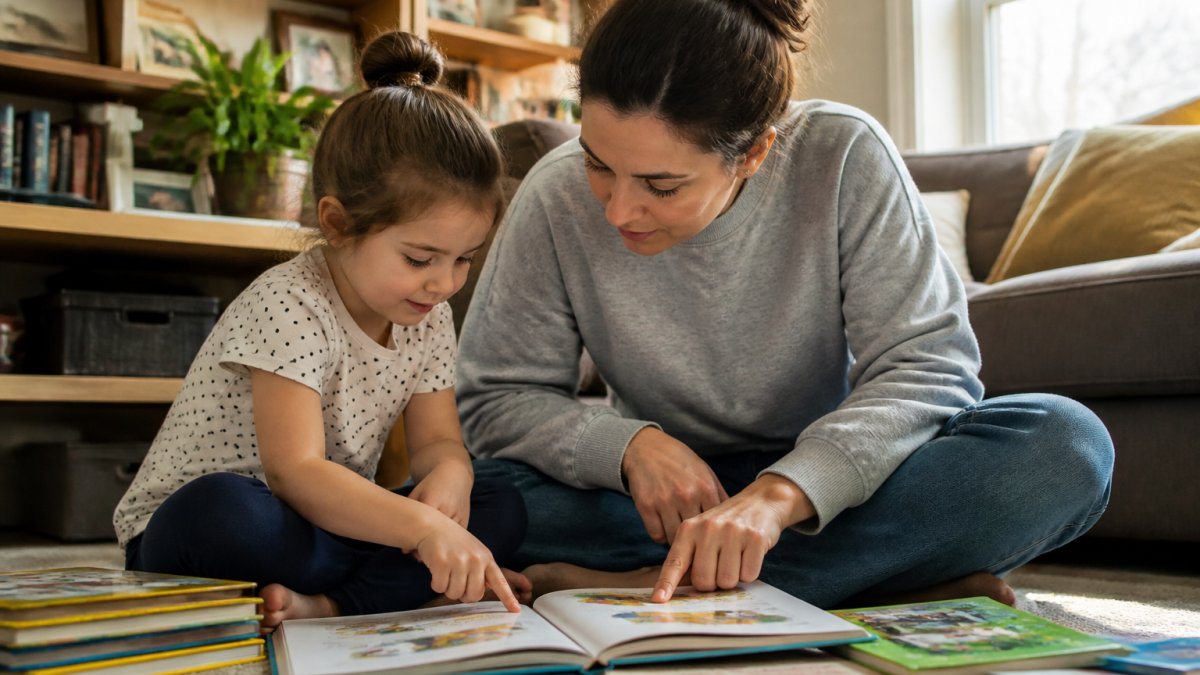
Here's a simple sequence that works for most families:
- Start with sounds, not letters. Play with beginning sounds in everyday words: "Milk starts with /m/. What else starts with /m/?"
- Introduce a few letter-sound pairs at a time. Two or three is plenty. Add more only when the first ones are automatic.
- Practice blending. Say the sounds slowly (/s/ /u/ /n/) and have your child push them together into a word.
- Practice segmenting. Say a word and ask your child to break it into sounds. This is the reverse skill, and it matters just as much.
- Read real text together. Decodable books give kids a chance to use what they've learned. So does the back of a cereal box.
- Keep it short. Five to ten minutes daily beats a thirty-minute session once a week.
- Follow your child's lead. If they're done, stop. Joy and consistency beat perfection.
If you want a structured program to lean on, options like Hooked on Phonics' program overview combine phonics instruction with digital and print materials, and the company describes a 30-day improvement guarantee when children use it for 15 to 20 minutes a day.
Building a Complete Reading Program: Where Phonics Fits
A complete reading program has five working parts, and phonics is one of them. The others are phonemic awareness, fluency, vocabulary, and comprehension. The useful part is seeing how they feed each other, and what happens when one is missing.
How the five pieces actually connect
Phonemic awareness is ear work: hearing that "cat" and "hat" differ by one sound. Phonics is page work: matching those sounds to letters. Fluency is speed and smoothness, which frees up brain space for meaning.
Here's the chain in plain English. A child hears sounds (phonemic awareness), maps them to letters (phonics), reads words without sounding out every one (fluency), recognizes what the words mean (vocabulary), and understands the story (comprehension).
That's why "does phonics work" is the wrong question on its own.
What the balance looks like by age
- Babies and toddlers. Almost all ear work and vocabulary. Talk, sing, rhyme, name everything. No phonics needed yet.
- Preschool. Phonemic awareness games plus a light introduction to a few letter sounds. Keep it playful.
- Kindergarten and first grade. Explicit, systematic phonics takes center stage, paired with decodable books and daily read-alouds for vocabulary and comprehension.
- Second grade and up. Phonics continues for new patterns, but fluency, vocabulary, and comprehension get more of the time. Kids still need to read real books, not just worksheets.
What multilingual families should know
If your family speaks more than one language at home, the five pieces still apply, but the balance shifts. A child may decode English words accurately and still not know what they mean, because the meaning lives in a language they're still learning. Extra oral language support (talking through a story, naming things in both languages, asking "what does that word mean?") does more for reading than extra phonics drills.
How to tell which piece is missing
You don't need a formal test to spot a gap. Listen for the pattern:
- Sounds out every word slowly and never speeds up? Fluency needs work.
- Reads smoothly but can't tell you what happened? Comprehension or vocabulary.
- Guesses at words that look similar? Phonics or phonemic awareness.
- Avoids reading aloud but understands everything you read to them? Could be fluency or confidence.
Lauren lays out this whole picture in Chapter 4, "Beyond Reading," and Chapter 12, "Empowered Parents," where she helps you build a simple family literacy plan around all five pieces.
You Are Your Child's First Teacher
Every child learns to read on their own timeline. Some pick up letter sounds in a week. Others need months of the same game before it clicks.
What matters is that you keep showing up. Five minutes of sound play in the car. A running commentary at the grocery store.
If you want a roadmap, Literacy Roots: Nurturing Your Child's Reading Journey from Birth to Brilliance walks through all of this chapter by chapter, from phonemic awareness to building a family literacy plan.
Frequently Asked Questions
Does phonics work for all children?
Phonics works well for most children, but not every child learns to read through phonics alone. Research supports explicit, systematic phonics as the most effective approach for teaching decoding to the majority of kids. Some children, including those with dyslexia or language processing differences, need phonics plus additional support like multisensory instruction. Others may need more vocabulary and comprehension work alongside decoding practice. The key is watching your child's progress and adjusting if something is not clicking.
Is phonics the same as phonemic awareness?
No, they are related but different. Phonemic awareness is the ability to hear and manipulate individual sounds in spoken words, like knowing that 'cat' has three sounds. Phonics is about connecting those sounds to written letters. Phonemic awareness comes first and is purely oral. Phonics builds on it by teaching letter-sound relationships. Your child needs both, but you can practice phonemic awareness anywhere, even in the car, with no materials at all.
What should I try if my child struggles with phonics?
First, talk with your child's teacher about what specific skills are hard. Then try breaking practice into shorter, more frequent sessions, maybe five minutes twice a day. Use multisensory methods: trace letters in sand, build words with magnetic tiles, or clap out sounds. If progress stays slow after a few weeks of consistent practice, ask your pediatrician or school about a reading evaluation. Early support makes a real difference, and struggling does not mean your child cannot learn to read.
Can children learn to read without phonics?
Some children figure out reading with very little phonics instruction, especially kids who have strong language skills and lots of book exposure. But research consistently shows that explicit phonics helps more children become stronger readers faster. A whole-word approach alone leaves many kids guessing at unfamiliar words. The most effective reading programs combine phonics with vocabulary building, comprehension practice, and plenty of time reading real books together.
How can parents support reading at home alongside phonics instruction?
Read aloud together every day, even after kids can read on their own. Point out letter sounds in everyday places: cereal boxes, street signs, grocery lists. Keep practice short and playful. Let your child pick books that interest them, even if they seem easy. And talk about what you read together. In Literacy Roots, Chapter 3 covers how a home literacy environment, including access to books and a cozy reading spot, supports everything else.
If you've been quietly worrying about your child's reading and aren't sure where to start, you don't have to figure it out alone. Lauren's Literacy Lounge exists to help parents feel capable instead of overwhelmed, and Literacy Roots gives you the research, the family stories, and the practical exercises to build a reading routine that fits your real life. Grab your copy and start with one chapter tonight.