 How-to
Teaching Reading Without a Teaching Background
Table of Contents
- You Don't Need a Teaching Degree to Teach Reading
- Understanding the Science of Reading for Parents
- Recognizing Early Literacy Milestones
- Simple Phonics Activities for Home
- How to Teach Sight Words Effectively
- Common Misconceptions About Teaching Reading at Home
- Building Your Confidence as a Reading Guide
- Frequently Asked Questions
Last Updated: August 31, 2026
You Don't Need a Teaching Degree to Teach Reading
The most common barrier parents face when thinking about teaching reading without teaching background isn't ability, it's confidence. Many parents assume they need formal training, a curriculum, or years of education experience to guide their child toward literacy. The truth is simpler and more helping: you already have the most important qualification. You're your child's first and most influential teacher.
At Lauren's Literacy Lounge, we empower parents to be the best first teachers. What we've learned is that teaching reading without teaching background is entirely achievable when you understand a few core principles. This guide walks you through exactly what you need to know, without the jargon or the overwhelming theory.
The science of reading has evolved significantly over the past two decades. What educators now understand about how children learn to read is clearer and more evidence-based than ever. That research has a direct application to your home, and it doesn't require a teaching certificate to put it into practice.
Understanding the Science of Reading for Parents
The science of reading explains how brains process written language. It's built on decades of cognitive science research, and the findings are remarkably consistent: children learn to read through a combination of phonemic awareness, phonological processing, and explicit instruction in how letters connect to sounds (peer-reviewed research).
You don't need to memorize the neuroscience. What matters is understanding the pathway: children move from hearing sounds in words, to recognizing that letters represent those sounds, to blending those sounds together to decode words, and finally to reading with fluency and comprehension. Each step builds on the previous one.
This progression is why random exposure to books, while valuable, isn't always enough. Some children pick up reading naturally through immersion. Many others need explicit, systematic instruction to understand the connection between letters and sounds. That's not a failure on anyone's part. It's how literacy development works.
Decoding vs. Guessing: The Critical Distinction
Decoding is the process of using phonics knowledge to sound out words. Guessing is looking at a picture, recognizing the first letter, or relying on context to predict what a word might be. These feel similar to an untrained observer, but they're fundamentally different.
A child who decodes is using the orthographic mapping system in their brain, they're learning how written words are constructed (peer-reviewed research). A child who guesses is bypassing that system entirely. Over time, this matters enormously. Decoders build a growing sight word vocabulary through repeated exposure and practice. Guessers hit a ceiling because they never develop the foundational skill of phonological processing that unlocks more complex texts.
When you're teaching reading without teaching background, recognizing this distinction changes how you respond to your child's attempts. If your child guesses at a word, the helpful response is to guide them back to the letters: "Let's look at the sounds in this word. What sound does this letter make?" This small shift, away from accepting guesses and toward supporting decoding, is one of the most powerful moves a parent can make.
Phonemic Awareness and Phonological Processing
Phonemic awareness is the ability to hear, identify, and manipulate individual sounds in words. Phonological processing is the broader skill of working with the sounds of language. These aren't the same as knowing letter names. They're about sound.
A child with strong phonemic awareness can tell you that the word "cat" has three sounds: /k/ /æ/ /t/. They can remove the first sound and tell you what's left (/æ/ /t/). They can blend sounds together to form words. These skills develop naturally for some children through conversation and language play. Other children need explicit practice.
The good news: you can build these skills at home through simple games and activities. Rhyming, sound play, clapping syllables, these are all phonological processing activities. They're also fun and require nothing but your attention and a few minutes of time.
Recognizing Early Literacy Milestones
Literacy development doesn't start when a child learns to read. It starts in infancy. Understanding what's typical at each stage helps you recognize where your child is and what comes next.
The key is knowing that there's many normal. Some children show early interest in books at 6 months (the NIH). Others don't engage with print until age 2 or 3. Both paths are fine. What matters is consistent exposure and interaction.
Birth to 12 Months: Foundational Skills
In the first year, your child is building the auditory and language foundations for reading. They're learning that sounds have meaning, that voices carry emotion, and that language is a tool for connection.
What to watch for: Does your baby respond to your voice? Do they babble and experiment with sounds? Are they beginning to understand simple words like "mama" or "no"? These are the early signs that language processing is developing normally.
What you can do: Talk constantly. Narrate what you're doing ("I'm changing your diaper now"). Sing songs and nursery rhymes. Read aloud, even if your baby seems more interested in chewing the book than listening. The exposure matters more than comprehension at this stage.
By 12 months, many children speak their first words, though some don't. Both are normal. The foundation is being built whether or not you see obvious evidence yet.
12 to 36 Months: Building Awareness
Between 12 and 36 months, language explodes. Your toddler moves from a few words to simple sentences. They begin to understand that symbols represent things, that a picture of a dog means the actual dog.
This is when you'll start to see early literacy behaviors. Your child might point to pictures in books. They might try to turn pages. They might recognize familiar words. Some children start recognizing letters.
What to watch for: Is your child interested in books? Do they point to pictures and ask "what's that?" Are they beginning to recognize familiar words or letters? Are they playing with sounds and rhyming?
What you can do: Read daily, multiple times if possible. Keep books accessible. Let your child choose books. Ask questions about pictures ("Where's the dog?"). Play rhyming games. Sing songs repeatedly, repetition builds language. Point out letters and words in your environment ("Look, that says 'STOP'").
By age 3, many children show interest in letter names or sounds, though many don't yet. Again, the range is wide. Some children aren't ready for explicit phonics instruction until age 4 or 5. That's developmentally normal.
Simple Phonics Activities for Home
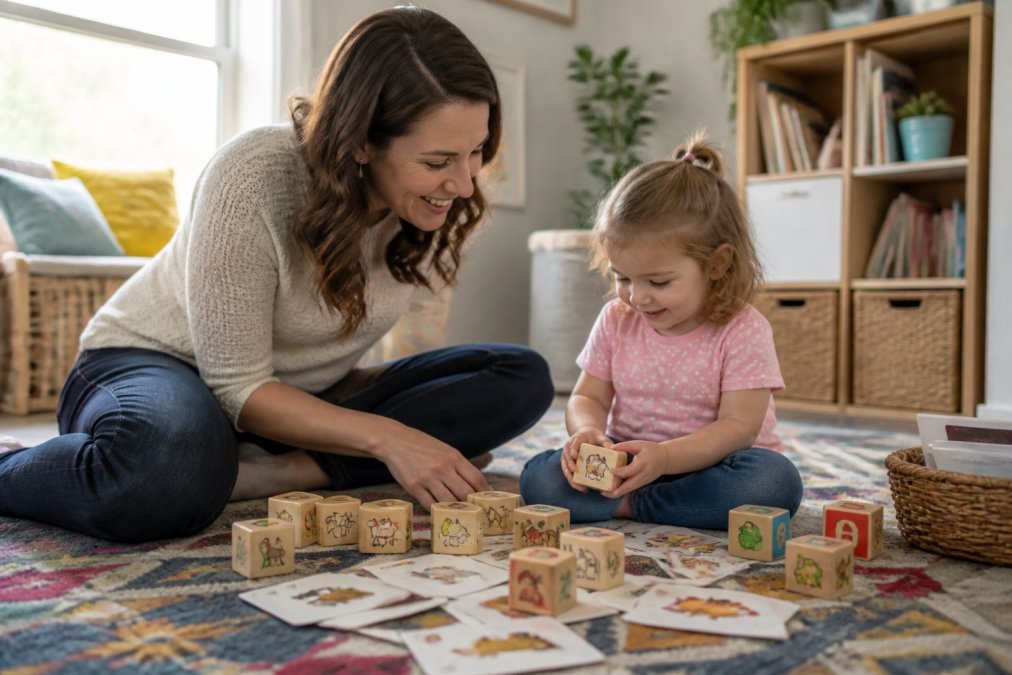
Phonics instruction doesn't require worksheets or formal lessons. It works best when it's integrated into play and daily life. The activities below are designed to be simple, short, and enjoyable, things you can do while cooking, during car rides, or before bed. reading instruction guide.
Sound Play and Letter Recognition
Start with sounds, not letter names. Many parents begin by teaching "A says /æ/, B says /b/," but that approach can confuse children. It's more effective to teach the sound a letter makes in isolation, then show how that sound appears in words.
A simple activity: Pick one letter sound per week. Find objects around your house that start with that sound. Say the sound repeatedly. Play with it. "Sssssnake. Ssssun. Ssssand. Ssssock." Make it silly. Exaggerate the sound.
Another activity: Sound hunts. Walk around your home and find things that start with a specific sound. "Let's find all the things that start with /m/." Point them out. Say the sound. This builds the connection between sounds and objects without any pressure.
Letter recognition follows naturally. Once your child is comfortable with sounds, introduce the letter that makes that sound. Point it out in books, on signs, in your home. "That's the letter S. It makes the /s/ sound."
Blending and Word Building Games
Once your child understands individual sounds, blending, combining sounds to make words, is the next step. This is where decoding actually happens.
A simple blending game: Say three sounds slowly, with a pause between each. "C-a-t." Then say the word normally. "Cat." Do this repeatedly with simple three-letter words. Let your child try it.
Word building: Use letter tiles, magnetic letters, or even written letters on index cards. Build a simple word like "cat." Point to each letter, say the sound, then blend them together. Change one letter and build a new word. "Now it says 'bat.'" This concrete, visual approach helps children understand how words are constructed.
These activities should be brief, 5 to 10 minutes, and should feel like play, not work. If your child is frustrated or resistant, stop and try again another day. Pressure works against learning.
How to Teach Sight Words Effectively
Sight words are words that don't follow regular phonics patterns or are used so frequently that instant recognition is useful. Words like "the," "said," "of," and "you" fall into this category.
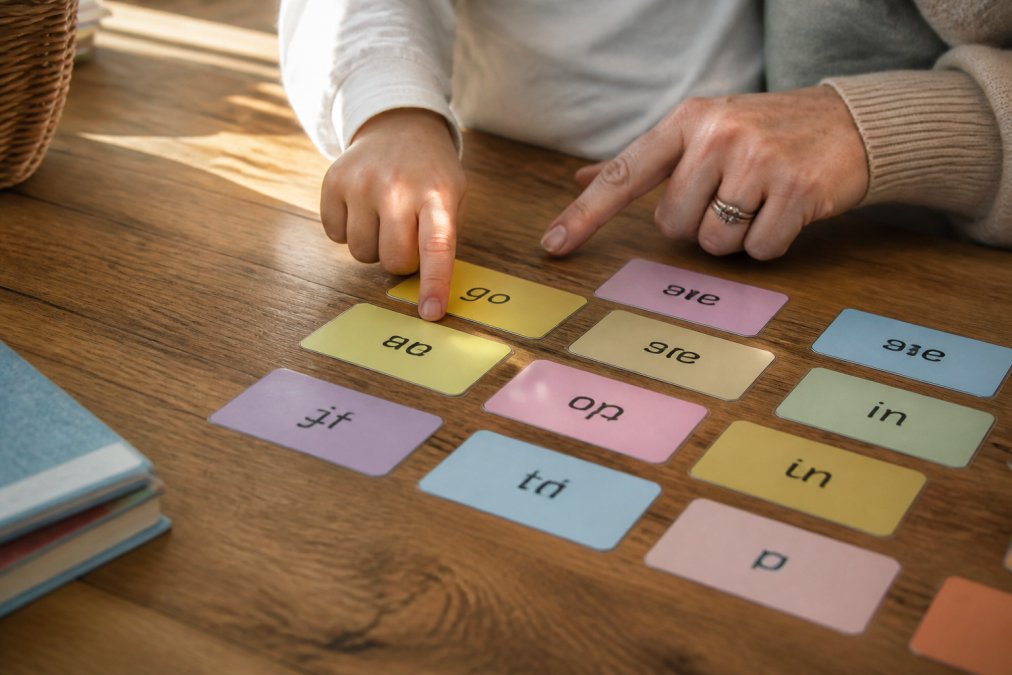
The most effective way to teach sight words is through repeated exposure in context, not flashcard drills. Read books that contain these words. Point them out. "Look, there's 'the' again." Over time, your child will recognize them automatically.
If you do use flashcards, keep sessions short, just a few minutes. Show a word, say it, use it in a sentence. "This says 'said.' She said hello." Mix review of familiar words with new ones. Celebrate recognition. Make it positive.
The key insight: sight words are learned through reading, not through memorization drills. The more your child reads, the more sight words they'll internalize. Flashcards can supplement reading, but they shouldn't replace it.
Common Misconceptions About Teaching Reading at Home
Several beliefs about literacy development can actually slow progress if they go unchallenged.
Misconception 1: Reading will happen naturally if you just read aloud. Some children do learn to read primarily through exposure. Many don't. Immersion in books is necessary but often not sufficient. Most children benefit from explicit instruction in phonics and phonemic awareness alongside read-alouds.
Misconception 2: If your child isn't reading by age 5, something is wrong. Reading readiness varies widely. Some children are ready at 4. Others aren't ready until 6 or 7. Late readers who receive appropriate instruction catch up quickly. Pushing too early often creates anxiety without accelerating progress.
Misconception 3: You need a structured curriculum to teach reading at home. Structured curricula can be helpful, but they're not required. Many children learn to read through systematic, intentional play and daily reading with a parent who understands the fundamentals of phonics and phonemic awareness.
Misconception 4: Teaching reading without teaching background means you'll teach it wrong. This is the fear that stops many parents from trying. The truth: consistency and intention matter more than expertise. If you're focusing on phonemic awareness, phonics, and regular reading, you're on the right track.
Building Your Confidence as a Reading Guide
The final piece, and often the most important, is your own confidence. Teaching reading without teaching background is entirely possible when you trust the process and yourself.
Start small. Pick one activity. Do it for a week. Notice what your child responds to. Adjust. There's no single right way to do this. What works for one child might not work for another. Your job is to observe, respond, and keep going.
Remember that you're not replacing teachers or formal education. You're supporting your child's natural development and filling in gaps where explicit instruction helps. This is within reach.
Many parents worry they'll "mess up" their child's reading development. The research is reassuring: children are resilient learners. Mistakes in approach rarely cause lasting problems. Consistency, warmth, and a willingness to learn alongside your child are what matter most.
If you're looking for structured guidance, Lauren's Literacy Lounge offers Literacy Roots Nurturing Your Child's Reading Journey from Birth to Brilliance to empower parents to be the best first teachers. This program can provide the confidence boost and systematic approach that makes the process feel manageable.
Frequently Asked Questions
Q: Can I effectively teach my child to read without a teaching background?
A: Yes. Research in cognitive science and the science of reading shows that parents can teach reading effectively using explicit instruction focused on phonemic awareness, phonics, and decoding. You don't need formal training, you need to understand how children's brains process written language and apply evidence-based strategies consistently. Many parents successfully guide their children's reading development by learning foundational concepts and practicing simple, structured activities at home.
Q: What is the difference between phonics and whole language approaches?
A: Phonics teaches children to decode words by understanding the relationship between letters and sounds through systematic, explicit instruction. Whole language assumes children learn to read naturally through exposure to books and context clues. Evidence-based research supports phonics combined with balanced literacy practices, explicit phonics instruction paired with meaningful reading experiences. This combination addresses both decoding skills and comprehension, which are essential for literacy development.
Q: How do I know if my child is ready to start reading?
A: Early literacy milestones guide readiness. Before formal reading, children typically show phonemic awareness (recognizing that words are made of sounds), letter recognition, and interest in books. Between ages 2 and 4, many children begin showing these signs. However, readiness varies widely. Look for your child's ability to follow stories, recognize letters, and engage with rhyming activities. Starting with phonemic awareness games and read-alouds works at any age, formal decoding instruction typically follows around age 4 to 5.
Q: What simple tools can I use to support literacy development at home?
A: You need minimal materials: picture books, alphabet blocks, index cards for flashcards, and household items for sound games. Effective tools include read-alouds (daily), rhyming activities, letter-sound matching games, and word-building with magnetic letters. Many parents create DIY flashcards or use printable resources. The most valuable tool is consistent, intentional practice, 15 to 20 minutes daily of structured phonics activities combined with recreational reading builds strong foundational skills without expensive programs.
Teaching reading without teaching background is not a luxury reserved for educators. It's a skill any parent can develop. The science of reading is accessible. The activities are simple. What remains is your commitment to showing up, reading together, and supporting your child's journey toward literacy. You have everything you need to be your child's most effective reading teacher.
This article was written using GrandRanker


