 Ultimate guide
Pre-Reading Skills for 18 Month Olds: What to Know
Table of Contents
- What Pre-Reading Skills Look Like at 18 Months
- Early Literacy Activities for 18-Month-Olds You Can Do Today
- How to Read to a Toddler: Responsive Shared Reading in Practice
- Books for 18-Month-Olds: What to Look For
- A Daily Routine for Busy Caregivers (Even During Moves)
- When to Seek Advice About Hearing, Language, or Development
- Conclusion: Building Pre-Reading Skills One Page at a Time
- Frequently Asked Questions
Last Updated: October 9, 2026
What Pre-Reading Skills Look Like at 18 Months
At 18 months, pre reading skills are not about recognizing letters or sounding out words.
Pre-reading skills are the early literacy behaviors and understandings that children develop before formal reading instruction begins.
Most parents expect something more dramatic at 18 months.
What matters more than the exact word count is whether your child:
- Responds to their name
- Follows simple directions like "bring me your cup"
- Uses gestures to communicate
If several of these are missing, that is worth a conversation with your pediatrician.
Early Literacy Activities for 18-Month-Olds You Can Do Today
The most effective early literacy activities for 18-month-olds take five minutes or less and fit into routines you already have. You do not need a curriculum, a subscription, or a dedicated "learning time."
Sound Play, Songs, and Nursery Rhymes
Songs and rhymes teach rhythm, rhyme, and syllable awareness, which are core components of phonological awareness. They also require zero preparation.
Try these throughout the day:
- Sing a cleanup song while putting toys away
- Clap out the syllables in your child's name ("El-a-nor")
- Pause during a familiar rhyme and let your toddler fill in the last word
The repetition is not boring to your toddler. It is how their brain locks in sound patterns.
Print Awareness and Book Handling
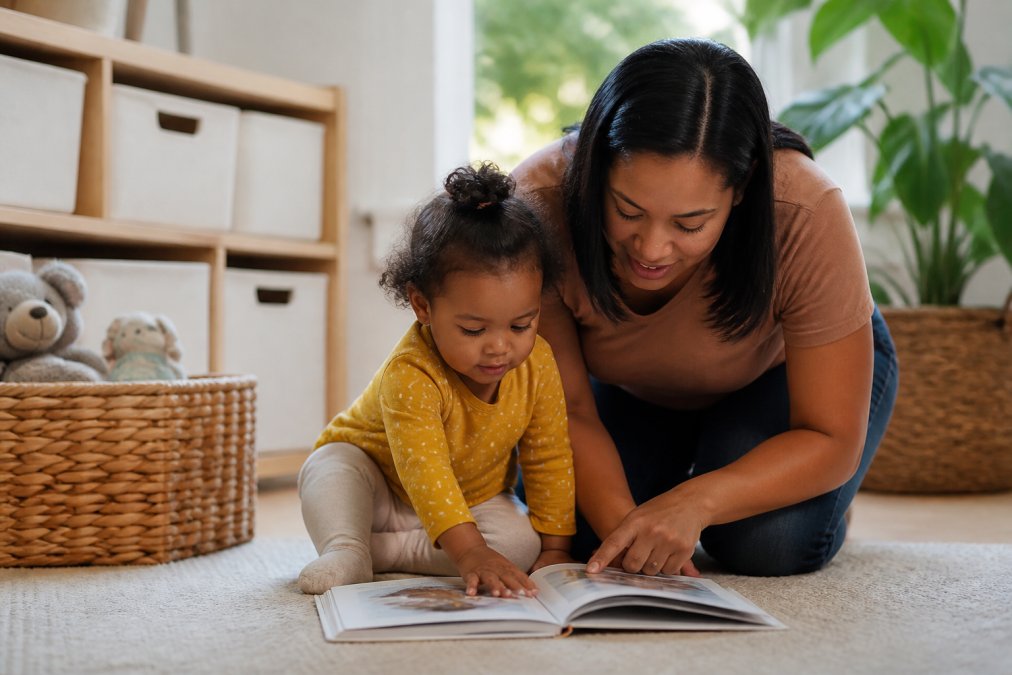
Let your toddler hold the book. Let them turn the pages, even if they skip three at once or go backward. Book handling is a pre-reading skill.
Point to the front cover and say "front cover." Trace your finger under the title. When your child grabs at the pages, that is engagement, not misbehavior. Board books exist precisely for this stage.
How to Read to a Toddler: Responsive Shared Reading in Practice
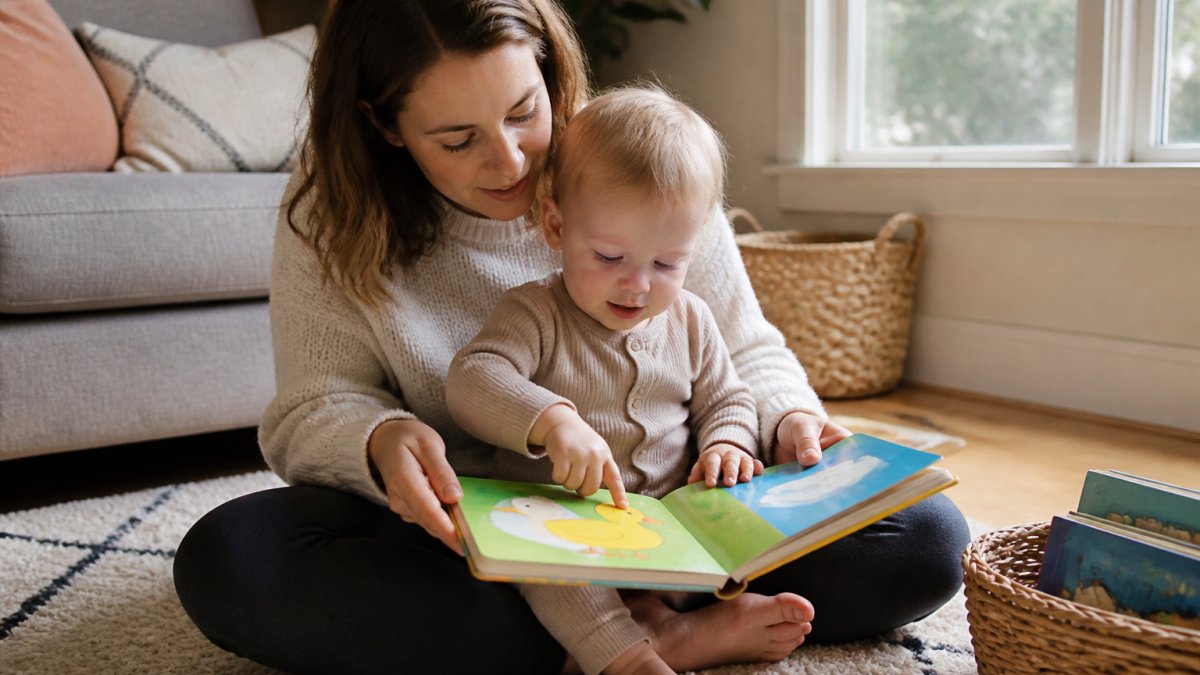
Responsive shared reading means following your child's lead instead of reading every word on the page. If your toddler points at a dog and says "dog," you stop and talk about the dog. The text can wait.
Here is what that looks like in practice:
- Let your child choose the book. Even if it is the same one for the tenth time.
- Name what they point at. "Yes, that's a ball. A big red ball."
- Ask simple questions. "Where's the cat?" Pause. Give them time to point.
- Repeat their sounds back. If they say "ba," say "ba, ball, yes."
- Follow their attention. If they lose interest after two pages, that is fine. Two pages today, three tomorrow.
A common mistake is treating reading time as a performance where the adult reads and the child listens. The National Association for the Education of Young Children's guidance on early literacy emphasizes that back-and-forth interaction, not passive listening, drives language growth.
Books for 18-Month-Olds: What to Look For
The best books for 18-month-olds have thick board pages, simple pictures on white backgrounds, and one or two words per page. Look for books that invite touch, pointing, and repetition.
| Feature | Why It Works | Examples |
|---|---|---|
| Board pages | Survive chewing and grabbing | Any sturdy board book |
| Real photographs | Easier to recognize than illustrations | Books of animals, foods, faces |
| Single objects per page | Focuses attention and naming | First-words style books |
| Repetitive text | Builds prediction and rhythm | Books with repeating phrases |
| Lift-the-flap or touch elements | Engages senses and motor skills | Tactile and interactive board books |
Avoid books with long paragraphs, abstract art, or thin paper pages. Those work later. Right now, simplicity wins.
Match the Book to the Pre-Reading Skill You Want to Build
Most book lists for toddlers are organized by age. A more useful approach is to organize by the pre-reading behavior you want to encourage. At 18 months, different books do different jobs:
- For print awareness: Choose a book with a clear front cover, a title you can point to, and pages that turn one at a time. Naming "front cover," "back cover," and "page" while you handle the book teaches how books work.
- For vocabulary: Pick books with one clear object per page and real photographs rather than stylized illustrations. A photograph of a real banana is easier to map to the banana on your counter than a cartoon banana.
- For phonological awareness: Choose rhyming or repetitive text. Books that repeat a phrase let your toddler anticipate and eventually join in, which is sound play in disguise.
A Note on Real Titles
You do not need a specific brand or series. The features above matter more than the logo on the spine. That said, the books that tend to work well at this age share a few traits: they are short enough to finish in two or three minutes, they have pictures large enough to point at from across a lap, and they survive being dropped, chewed, and thrown.
When you are choosing at a store or library, open to a random page and ask three questions:
- Can my toddler point to one clear thing on this page?
- Is there a word or phrase I can repeat?
- Would this survive a trip to the floor?
If the answer to all three is yes, the book is a good fit.
Books in Multilingual Homes
If your family speaks more than one language, look for board books in the language you are most comfortable reading aloud.
Bilingual board books, where the same simple text appears in two languages, can also work well at this age, especially if you read the page in the language you know best and let another caregiver read the other. The goal is not to teach two languages at once.
What to Skip for Now
- Alphabet books with one letter per page. Letter knowledge is a later pre-reading skill. At 18 months, the pictures and sounds matter more than the letters.
- Long picture books with paragraphs. Your toddler's attention span is measured in minutes, not pages.
- Digital books on a tablet. The American Academy of Pediatrics media use guidelines recommend avoiding solo screen use for children under two because it does not provide the responsive back-and-forth interaction that builds language.
A Daily Routine for Busy Caregivers (Even During Moves)
You do not need a 30-minute block. You need three or four small moments woven into what you are already doing.
- Morning: Name three things while getting dressed ("shirt, socks, shoes")
- Mealtime: Sing one song or say one rhyme while food is warming
- Afternoon: Two minutes with a board book, following your child's lead
- Bedtime: One story, with pointing and naming
For families who move frequently, consistency matters more than materials. The same three books and the same bedtime routine travel anywhere. A familiar rhyme in an unfamiliar house gives a toddler something stable to hold onto.
When to Seek Advice About Hearing, Language, or Development
Talk to your pediatrician if your 18-month-old does not respond to their name, has not started using any words, does not point or gesture to communicate, or loses skills they previously had.
Hearing issues are the most common underlying cause of delayed language, and they are easy to test.
You are not overreacting by asking. You are being your child's best advocate.
Conclusion: Building Pre-Reading Skills One Page at a Time
Building pre-reading skills at 18 months does not require a program, a schedule, or a teaching degree. It requires talking, singing, pointing, and reading the same book twelve times in a row because that is what your toddler wants.
If you want a structured, evidence-based path that fits into real life, including moves and unpredictable schedules, Lauren's Literacy Roots program gives you simple daily routines, age-specific book lists, and responsive reading scripts you can use from birth through early elementary.
Frequently Asked Questions
What pre-reading skills should an 18-month-old have?
Most 18-month-olds show early pre-reading skills like turning pages (sometimes roughly), pointing at pictures, bringing books to a caregiver, and understanding simple one-step directions like 'bring me the book.' They may say 10 to 20 words, though some say fewer and some say more. These behaviors build the foundation for later reading. If your toddler shows only a few of these, keep offering books and talk about what you see together.
What words should my 18-month-old know?
A typical 18-month-old uses around 10 to 20 words, often including 'mama,' 'dada,' 'no,' 'more,' 'bye-bye,' and names of familiar objects or foods. Many toddlers also use gestures and point to body parts when named. Receptive vocabulary, what they understand, is usually much larger than what they say. If your child isn't using any words or gestures by 18 months, talk with your pediatrician about a hearing and speech evaluation.
How often should I read to my toddler?
Aim for at least one short shared reading session daily, even if it lasts only two to three minutes. Toddlers have short attention spans, so multiple brief sessions work better than one long one. Let your child hold the book, turn pages, and point at pictures. The goal isn't finishing the story; it's building positive associations with books and language. Consistency matters more than duration.
What books are best for an 18-month-old?
Choose sturdy board books with simple, high-contrast pictures and few words per page. Look for books featuring familiar objects, animals, daily routines, and repetitive text your toddler can anticipate. Touch-and-feel books and lift-the-flap books encourage hands-on engagement. Avoid long stories or books with too much text. Your local library and children's bookstores are good places to test which formats your child gravitates toward.
When should I be concerned about my toddler's language development?
Talk with your pediatrician if your 18-month-old doesn't use any words, doesn't point or gesture to communicate, doesn't respond to their name, or seems to lose skills they previously had. Also seek advice if your child doesn't seem to hear you consistently or doesn't follow simple directions. Early intervention services are available in every state and often free. Acting early gives your child the best support.
Can I teach my toddler to read at 18 months?
Formal reading instruction isn't appropriate at 18 months. What you can do is build pre-reading skills through talking, singing, reading aloud, and playing with sounds. These experiences develop vocabulary, print awareness, and phonological awareness, which are the building blocks for reading later. Most children aren't ready for formal phonics instruction until age 5 or 6. Your role now is creating rich language experiences.