 How-to
Literacy Strategies for Military Families
Table of Contents
- Why Early Literacy Matters for Military Children
- Establishing a Daily Reading Routine That Survives PCS Moves
- Maintaining Literacy Routines During Deployment
- Digital Reading Tools for Long-Distance Parenting
- Reading Activities for Military Children at Every Stage
- Supporting Neurodivergent and Multilingual Military Learners
- Navigating School Systems and Educational Advocacy Across Moves
- Frequently Asked Questions
Last Updated: September 20, 2026
Why Early Literacy Matters for Military Children
Early literacy builds emotional connection during seasons of uncertainty, and literacy strategies for military families help children develop resilience through frequent moves and deployments. When military families prioritize reading together from birth, they're doing far more than teaching letters and sounds.
Military children face unique challenges: frequent moves disrupt school routines, and deployments separate parents from children for months. Yet consistent literacy engagement, even during chaos, helps children develop resilience and emotional stability.
Shared reading time strengthens the parent-child bond and creates predictable moments when everything else feels uncertain, especially critical for military families.
Establishing a Daily Reading Routine That Survives PCS Moves
Don't wait for stability to establish a reading routine. Build one so portable and flexible that it moves with you.
A sustainable reading routine requires one non-negotiable commitment: reading happens every single day, no matter what.
Creating a Portable Reading Environment
Pack a small bag of books that travel with you: board books that survive moves, picture books your child loves, and one or two new titles. These familiar books become comfort objects at new duty stations.
Create a reading corner wherever you land, a cushion, couch spot, or chair. The location changes; the ritual stays the same.
Use library apps like Libby to borrow e-books and audiobooks instantly, no physical card or waiting required.
Building Consistency Across School Transitions
Anchor your reading routine to something that doesn't change: bedtime, breakfast, or a specific time after school pickup.
Read at the same time every day. Your child's brain learns to expect this. It becomes non-negotiable, like brushing teeth.
Visit the library immediately at your new school and let your child pick books. This gives them agency during transition and connects them to their new community.
Keep a simple record of books read together on your phone or notebook. Your child sees continuity across moves and feels proud of the growing collection.
Maintaining Literacy Routines During Deployment
Deployment tests every routine you've built. This is where literacy strategies for military families become emotional lifelines.
Video calls with books work well: the deployed parent reads while the child sees their face and hears their voice, with the book providing focus beyond the distance.
Create a "deployment reading box" filled with wrapped books to open weekly or monthly. This gives the child something tangible to anticipate and extends the deployed parent's presence.
Record yourself reading books aloud for your child to listen to. Hearing a parent's voice while looking at pictures creates powerful emotional connection, and repetition is healing.
Digital reading tools help maintain routines across time zones. The experience isn't identical to reading side-by-side, but it's far better than nothing.
Digital Reading Tools for Long-Distance Parenting
For military families, digital tools must work across time zones, avoid complicated logins, and protect privacy.
Video Call Platforms for Shared Reading
Google Meet and Zoom allow screen sharing for picture books, but you're limited to books you physically have and image quality depends on internet connection.
Marco Polo allows asynchronous video messages, eliminating time-zone friction but sacrificing real-time interaction.
Shared Reading Apps with Synchronized Features
Epic! offers a free tier with 40,000+ books and audiobooks, works offline, and lets parents track progress from anywhere, ideal for deployments with unreliable connectivity.
Libby lets you borrow e-books and audiobooks instantly through your library system for free across all 50 states, no shipping delays or lost books during moves.
These apps work best for children ages 3+; for infants and toddlers, video calls with physical books are more effective.
Audiobook Platforms for Older Children and Family Bonding
Audiobook subscriptions let deployed parents and children listen independently, then discuss during a call, shared experience without simultaneous screen time.
Libro.fm supports independent bookstores, letting families support their home community while stationed away.
Audiobooks work well for children 6+, but lack visual components needed for sight-word recognition and writing awareness.
Military-Specific Digital Resources
Military OneSource offers free access to counselors and educators who recommend literacy strategies tailored to deployment and transition stress.
The Military Child Education Coalition maintains a database of military-friendly schools and their literacy programs, helping families research new duty stations.
Choosing the Right Tool for Your Situation
Choose based on your child's age and internet reliability: video calls with physical books for young children, Epic!/Libby for older children, audiobooks for asynchronous bonding.
Start with free options: Libby, Epic!'s free tier, and video calls. Paid subscriptions make sense only if used consistently across multiple children.
Reading Activities for Military Children at Every Stage
Reading looks different at every age. Matching activities to your child's development makes literacy feel natural, not forced.
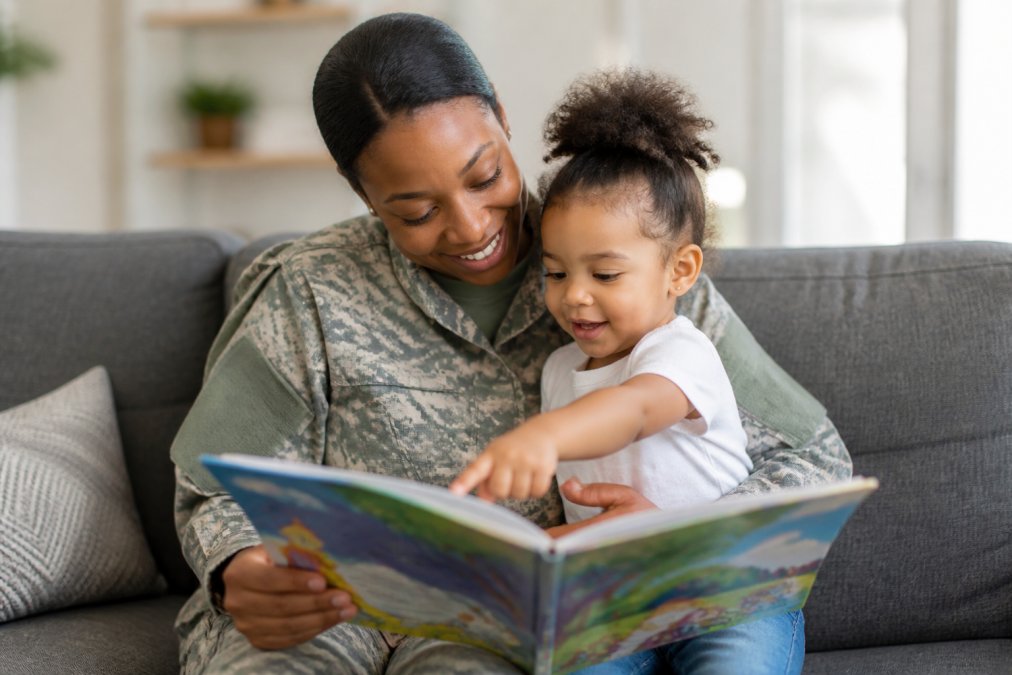
Birth to 12 Months: Building Foundations with Shared Experience
Read board books with high contrast images; your voice creates safety and bonding.
Touch-and-feel books engage multiple senses and teach that books are interactive.
Nursery rhymes and rhythmic stories help your baby's brain develop language patterns.
The goal is connection, building the foundation that makes reading feel like comfort and togetherness.
12 to 24 Months: Expanding Vocabulary and Engagement
Name objects in books with simple, repetitive language to build vocabulary naturally.
Let your toddler turn pages to give them control and make reading feel like play.
Read the same books repeatedly; toddlers learn through repetition and love predictability.
Ask simple questions like "Where's the dog?" to engage your toddler with the story.
2 to 3 Years: Developing Early Literacy Skills
Point out letters in everyday life to make literacy feel present beyond books.
Ask questions about stories to develop prediction skills and show reading is interactive.
Let your child choose books; agency increases engagement and completion.
Act out stories with toys or movements; this multi-sensory approach builds literacy skills faster than sitting still.
Supporting Neurodivergent and Multilingual Military Learners
Military families experience higher rates of neurodivergence and multilingualism. Children with ADHD, autism, dyslexia, and other learning differences struggle with frequent moves, school transitions, and deployment stress. Standard literacy strategies don't work, these families need adaptations built for instability.
Literacy Strategies for ADHD and Autism in a Mobile Lifestyle
Children with ADHD thrive with movement-integrated literacy. Break reading into 5-10 minute chunks during transitions: car rides, waiting for dinner, or while bouncing. Movement helps ADHD brains process language better.
For children with autism, establish a consistent reading routine at the same time and place. When moving, recreate it immediately and photograph the reading corner to show your child before arrival, reducing anxiety.
Audiobooks remove decoding demands for children with dyslexia or visual processing differences.
Navigating Special Education Services Across School Moves
Military children with IEPs face a challenge: each school district interprets them differently, and accommodations may not transfer.
Heritage Language Maintenance During Frequent Moves
Maintaining a heritage language strengthens cognitive development, cultural identity, and academic achievement, challenging during frequent moves when children are immersed in English at school.
Multilingual Children and Special Education
When a multilingual child struggles with reading, request evaluations in both languages to distinguish language difference from disorder. Ask for a speech-language pathologist specializing in multilingual assessment if your school can't provide this.
Navigating School Systems and Educational Advocacy Across Moves
Military families move frequently, and each move brings a new school system. Educational advocacy becomes essential.
Frequently Asked Questions
How can I maintain a reading routine when a parent is deployed?
Create a consistent time each day for reading, even if it's just 10 minutes. Use video calls to include the deployed parent in storytime when possible. Keep a special book or reading corner that feels stable and familiar. Letter writing and sending audio recordings of you reading stories can maintain connection. The routine itself, not the location or who's present, becomes the anchor that provides emotional resilience and continuity for your child during separation.
What digital reading tools work best for long-distance parenting with military children?
Video call apps allow real-time shared reading experiences. Audiobook platforms let deployed parents record themselves reading stories for their children to listen to anytime. Digital library apps provide access to thousands of books without physical shipping between locations. Screen-based reading should supplement, not replace, physical books. The best tools are ones your family will actually use consistently, test a few free options before committing to paid subscriptions.
How do reading activities help military children cope with separation and frequent moves?
Shared reading creates predictable, calm moments that reduce stress during transitions. Books provide language for discussing feelings about deployment and moving. Reading together strengthens parent-child interaction and emotional connection, especially during distance parenting. Stories normalize military experiences and help children process change. Research shows that consistent literacy promotion supports child development and builds the emotional resilience military families need to adapt to frequent school transitions and relocations.
What should I do if my child isn't interested in books yet, or if we're struggling with special education needs?
Start with board books, touch-and-feel books, or books with sounds, engagement matters more than traditional reading. For neurodivergent learners, shorter sessions, visual supports, and books matching your child's interests work better. Special education resources through your school's student support services can guide literacy intervention strategies. Every child's timeline is different. Consult your pediatrician during well-child visits if you have concerns about language development. The goal is building positive associations with books, not hitting milestones on schedule.


