 How-to
Why Infant Communication Milestones Matter
Table of Contents
- Why Infant Communication Milestones Matter More Than You Think
- Infant Communication Milestones by Age: What to Expect
- Baby Language Development Activities You Can Try Tonight
- How to Encourage Baby to Talk During Everyday Routines
- Reading to Babies Benefits: More Than Just Cuddle Time
- When to Talk With Your Pediatrician About Communication Concerns
- Milestone Variability, Hearing, and Multilingual Homes
- A Simple Tracking Tool for Caregivers
- Conclusion: Small Moments Build Big Talkers
- Frequently Asked Questions
Last Updated: October 15, 2026
Why Infant Communication Milestones Matter More Than You Think
Your baby locks eyes with you and lets out a long, wobbly "aaaah." You say it right back.
Here's the part most milestone charts skip: the skills on those lists are the same ones that later turn into reading.
Below, we'll walk through what to expect at each age, simple activities you can try tonight, and when it's worth a call to your pediatrician.
Infant Communication Milestones by Age: What to Expect
Infant communication milestones by age give you a general sense of how babies learn to understand and express themselves. They're ranges, not deadlines.
The two big buckets to watch are receptive language, what your baby understands, and expressive language, what they show you. Receptive skills come first, so a baby who turns toward your voice knows more than they can yet say.
Birth to 6 Months: Coos, Giggles, and Eye Contact
In the first six months, your baby is learning that people are worth paying attention to. Watch for these signs:
- Quiets or calms at the sound of a familiar voice
- Makes eye contact during feedings and diaper changes
- Coos and makes soft vowel sounds like "ooh" and "aah"
One of the most important early sounds is babbling. Before real words, you'll hear strings like "ba-ba" and "da-da." That's your baby playing with their voice.
6 to 12 Months: Babbling, Pointing, and Responding to Name
Between 6 and 12 months, communication gets more social. Your baby starts to realize that sounds and gestures get reactions. Here's what many parents notice:
- Responds to their name when you call it
- Babbles in longer strings that sound like conversation
- Uses gestures like reaching up to be picked up
Pointing is worth celebrating. Your baby sees something, points, and checks your face to see if you see it too. That back-and-forth is the groundwork for conversation.
1 to 3 Years: First Words, Word Use, and Turn-Taking
By the toddler years, babbling turns into real words, then word combinations, then little sentences. You'll likely see:
- First words show up, often around the first birthday
- Word use grows quickly, from one word to two-word phrases
- Simple instructions like "bring me your cup" make sense
Language comprehension is quietly doing a lot of work here. Your child understands far more than they can say, which is why reading and talking aloud matter even before they talk back.
Baby Language Development Activities You Can Try Tonight
Baby language development activities don't need supplies, screens, or a lesson plan. They need your face, your voice, and a few minutes. Try one tonight:
- Narrate your evening. "Now we're running the water. Ooh, it's warm." Running commentary counts as language nutrition.
- Copy their sounds. When your baby coos, coo back and pause. That pause teaches turn-taking.
- Play peek-a-boo. It builds eye contact, anticipation, and social interaction.
How to Encourage Baby to Talk During Everyday Routines
You don't need a special hour. The trick to how to encourage baby to talk is turning things you already do into talk time. Diaper changes, bath time, and the grocery run are all fair game.
Try these small moves:
- Give choices. "Do you want the red cup or the blue cup?" Even a point counts as an answer.
- Leave a gap. Pause after you speak and let your baby fill it with a sound or a word.
- Stretch their words. If your toddler says "milk," reply, "You want milk? Here's your milk."
Reading to Babies Benefits: More Than Just Cuddle Time
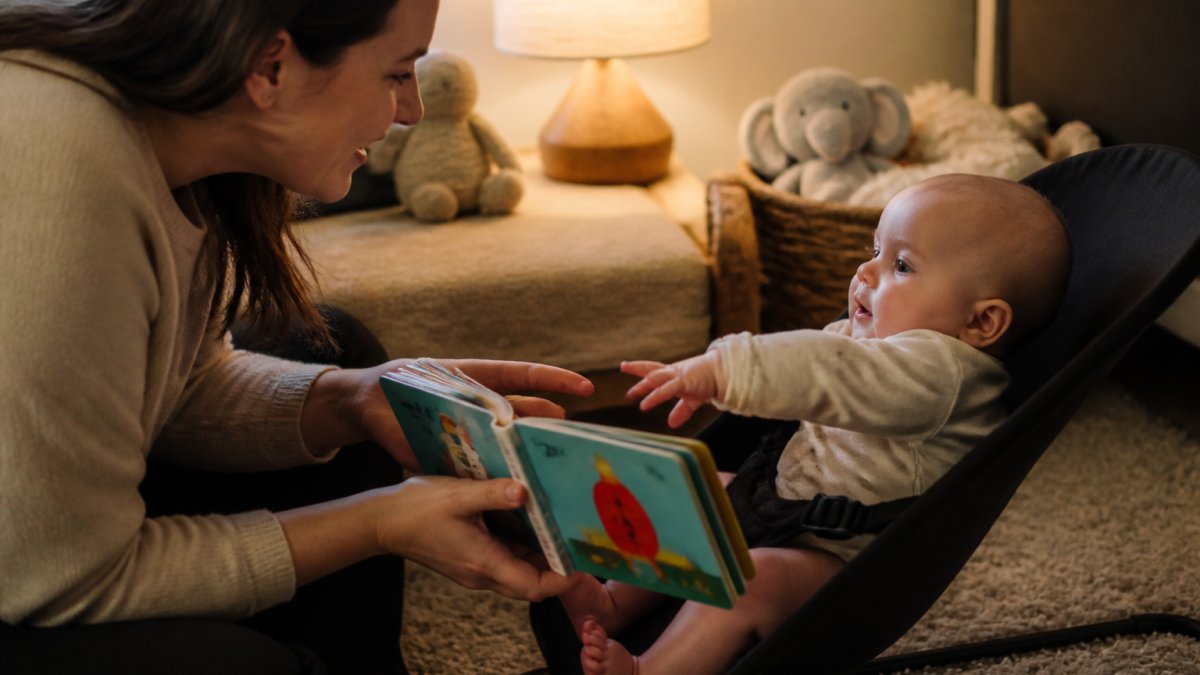
Reading to babies benefits go well beyond snuggles, though the snuggles matter too. When you read aloud, your baby hears the rhythm of language, learns new sounds, and connects words with pictures.
Here's the thing nobody tells you: you don't have to finish the book. If your 9-month-old wants to chew the corner and flip back three pages, that's fine.
A few easy ways to make reading part of the day:
- Keep a basket of board books where you already sit, like near the couch or the nursing chair.
- Read the same book again and again. Repetition builds memory and vocabulary.
- Point and name. "Look, a duck. Quack quack."
This is the heart of Literacy Roots.
When to Talk With Your Pediatrician About Communication Concerns
You've got a nagging feeling that something's a little different, and you keep talking yourself out of it. Please don't. Asking a question is not the same as getting a diagnosis.
Here's the reframe that helps most: you're not looking for a label, you're looking for information. Information turns a vague worry into a plan.
Signs That Are Worth a Call
Every child's timeline looks different, but these patterns are worth a call:
- No cooing or babbling by around 6 months. Some sound play should be showing up by then.
- No response to their name or to loud sounds. This one matters because it can point to hearing.
- No pointing, waving, or other gestures by around 12 months. Gestures come before words.
If you're nodding at one of these, take a breath. Noticing is the hard part, and you've already done it.
What Happens After You Call
Most parents have no idea what the next step looks like. Here's the general shape of it.
First, hearing. A pediatrician will almost always want a hearing screening first, because hearing is the front door to speech.
Then, a plan. Sometimes the answer is "let's watch and check back in three months," sometimes a few sessions, sometimes a referral to early intervention.
How to Say It Out Loud
A lot of parents freeze at the appointment because they don't want to sound alarmist. Try one of these:
- "I want to check in about communication. Here's what I've noticed at home."
- "I'm not sure if this is anything, but I'd rather ask now than wait."
- "Can we do a hearing check while we're here?"
That's it. You don't need a speech. You need a sentence and a date.
Early support tends to make things easier, not harder, and it works best when it starts sooner. That's why Literacy Roots devotes Chapter 6, "Navigating the Challenges," to this territory.
And if you're the parent who's been quietly worried for weeks, here's your permission slip: call. You'll feel better either way.
Milestone Variability, Hearing, and Multilingual Homes
Your friend's baby said "mama" at 9 months. Yours is 13 months and mostly points and grunts. Before you spiral, let's talk about what milestones are for.
Milestones Are a Pattern, Not a Pass or Fail
A milestone chart is a rough map of when most kids pick up a skill. It's not a scoreboard or a test your child can fail. Here's how to read one:
- Look at the whole picture, not one line. A child who isn't saying many words but points, waves, follows your gaze, and understands simple directions is showing strong communication in other channels. That matters.
- Watch the direction of travel. Is your child adding new sounds, new gestures, or new words over a month or two? Forward motion is the signal.
- Watch for lost ground. Skills disappearing is the one pattern that always deserves a call.
For a gut-check, ask one question: does my child seem to be connecting with me more this month than last month? If yes, you're probably fine to keep watching.
Hearing: The Quiet Factor
Hearing is the piece parents skip, and it's often the first thing a pediatrician checks. Babies learn speech by hearing it, so even a mild hearing issue can slow language down without anyone realizing it.
A few things worth knowing:
- Newborn hearing screening is standard, but it doesn't catch everything. Some hearing differences show up later, and some come and go with ear infections.
- Frequent ear infections are worth mentioning. Fluid behind the eardrum can muffle sound for weeks at a time.
- A simple screening can rule it out. If you have any concern about speech, ask for a hearing check. It's low effort and high information.
If your child doesn't startle at loud sounds, doesn't turn toward your voice, or seems to watch your face more than listen, that's a good reason to ask.
Multilingual Homes: Two Languages Is Not a Delay
If your family speaks more than one language at home, here's the reassurance you may not have gotten: learning two languages does not cause a speech delay or confuse a baby.
What it does do is split the vocabulary. A toddler learning two languages might have 30 words total, spread across both, instead of 30 in one. That's not a smaller vocabulary.
A few things that help:
- Talk and read in the language you're most comfortable in. A rich home language builds the bridge to every other language. This is the heart of Chapter 7, "Cultural Literacy," and Dr. Jim Cummins' work backs it up.
- Don't drop a language to "help" English. Research consistently shows that a strong first language supports, rather than delays, a second.
- Tell your pediatrician what languages are spoken at home. It changes how they read the milestone chart.
A Note on Screen Time and Milestones
One more factor worth naming: screens. Common Sense Media found in 2023 that 98% of kids under 8 use mobile devices at home, and it's easy for a phone to quietly replace the back-and-forth that builds language.
If you take one thing from this section, take this: milestones are a guide, hearing is worth checking, and two languages are a gift, not a delay.
A Simple Tracking Tool for Caregivers
You don't need an app. A piece of paper on the fridge works. Copy this tracker:
| What to Watch | First Noticed (Date) | Notes |
|---|---|---|
| Makes eye contact | ||
| Coos and giggles | ||
| Babbles (ba-ba, da-da) | ||
| Responds to name | ||
| Points at things | ||
| Says first word | ||
| Uses two-word phrases |
Jot the date you first notice each one. This gives you a real record to share at checkups, and it's a sweet keepsake too.
Conclusion: Small Moments Build Big Talkers
The pressure to get milestones "right" can make any parent second-guess themselves. Here's the truth: you don't need flashcards, apps, or a teaching degree.
If you want a warm, practical guide to keep going, Literacy Roots: Nurturing Your Child's Reading Journey from Birth to Brilliance walks through all of this chapter by chapter, from babbling to first words and beyond.
Get the book on Amazon and start with Chapter 2, "Parents as First Teachers." You've already got everything you need. The book just helps you trust it.
Frequently Asked Questions
Why are communication milestones important for infants?
Communication milestones give you a rough map of how your baby is learning to understand and be understood. They matter because early back-and-forth interaction builds the brain pathways that later support reading, writing, and social skills. When you notice your baby cooing, babbling, or pointing, you are watching language development in action. These milestones also help you spot a possible delay early, when support works best. Think of them as friendly checkpoints, not a report card.
What are common communication milestones in the first year?
In the first few months, many babies coo, giggle, and turn toward familiar voices. Around 6 to 9 months, babbling with one- or two-syllable sounds like 'ba' or 'mama' often appears, along with gestures and pointing. By 12 months, many babies respond to their name, understand simple words, and may say their first words. Every baby moves at their own pace, so use these as general age ranges, not strict deadlines.
How can I encourage my baby to talk?
Talk back to every coo and babble like it is a real conversation. Narrate your day, pause to let your baby respond, and repeat the sounds they make. Read board books together and point at pictures. Sing songs with gestures. These simple baby language development activities work because they turn ordinary moments into back-and-forth interaction. You do not need special tools or a big budget.
When should I talk with a pediatrician about my baby's communication development?
If your baby is not responding to sounds or their name, is not babbling by around 9 months, or is not using gestures or words by 12 to 15 months, bring it up at your next visit. Also speak up if your baby stops doing something they used to do. A pediatrician can check hearing, answer questions, and refer you to a speech-language evaluation if needed. Early support works best, and asking is never overreacting.


