 How-to
The Impact of Early Reading on Child Vocabulary
Table of Contents
- The Impact of Early Reading on Child Vocabulary
- What the Research Says About Reading and Word Learning
- How Shared Reading Grows Language Development in the Early Years
- The Benefits of Reading Aloud to Children at Every Age
- Reading Aloud Strategies for Parents That Build Vocabulary
- Ways to Build a Toddler's Vocabulary During Everyday Routines
- How Often Should I Read Aloud to My Child?
- From Word Exposure to Reading Readiness: What Parents Can Expect
- Conclusion
- Frequently Asked Questions
Last Updated: October 21, 2026
The Impact of Early Reading on Child Vocabulary
You know that moment when your toddler points at a dog and says "dog" for the first time?
The impact of early reading on child vocabulary starts earlier than most parents think.
Here's the good news: you don't need a teaching degree. You need a lap, a book, and a few minutes.
Here's what the research says and simple strategies you can try tonight.
What the Research Says About Reading and Word Learning
The short answer: reading aloud is one of the most powerful vocabulary builders we have.
Researcher Patricia Kuhl studied how babies tune into language sounds long before they speak. Her "serve-and-return" work shows that back-and-forth exchanges, like when your baby coos and you coo back, build language pathways.
The key takeaway: every word your child hears during shared reading is a deposit in their vocabulary bank.
How Shared Reading Grows Language Development in the Early Years
Language development in the early years happens through repetition and warm interaction, not worksheets. Think about the tenth read of the same board book: your child hears the same words again and again, then starts to finish your sentences.
Dr. Catherine Snow at Harvard has written about how children build language through conversation, not just exposure. Reading aloud creates it: you pause, ask "What do you think happens next?", and your child answers.
A few things shared reading does for language growth:
- Builds word recognition through repeated exposure
- Strengthens comprehension as kids connect words to pictures
- Grows spoken language through back-and-forth talk
- Creates emotional ties to books, which keeps kids coming back
The Benefits of Reading Aloud to Children at Every Age
Reading aloud helps kids at every stage, from newborn to big kid. The format changes, but the benefits stay steady.
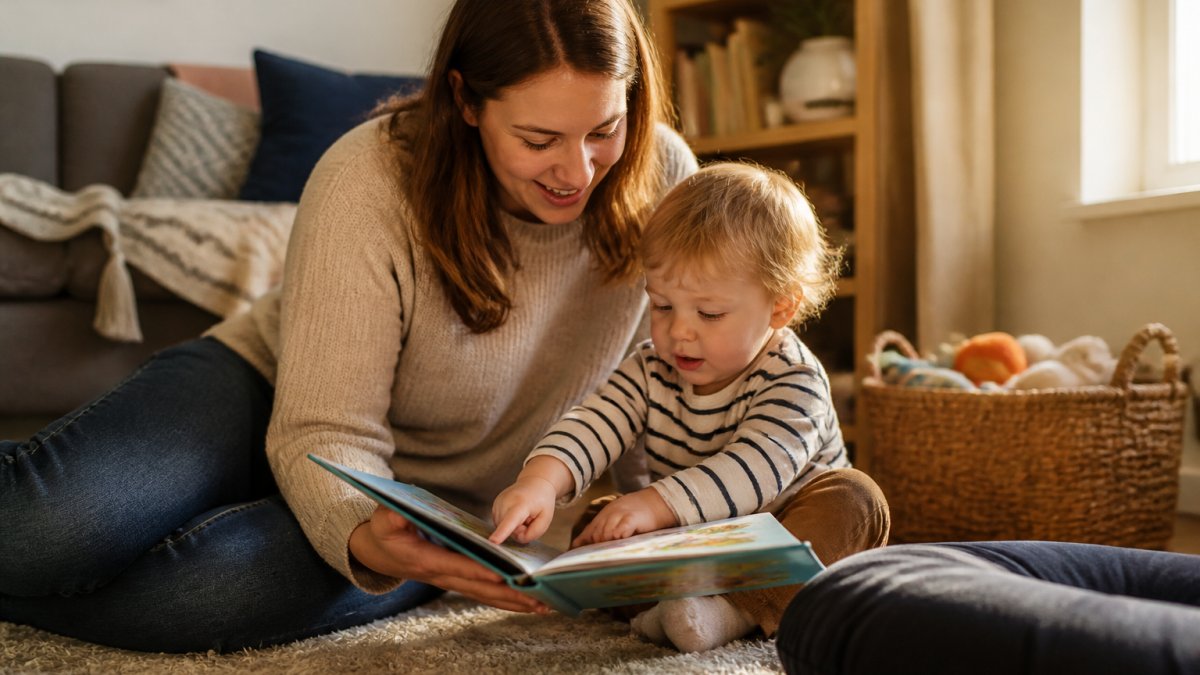
Babies (0 to 12 months): Sounds, Rhythm, and Face Time
Babies don't need to understand the story.
What to read: high-contrast board books, one image per page, songs and nursery rhymes in board form.
What to do: hold the book so your baby can see your mouth. Point and name slowly. "Dog. Ruff." Pause.
Vocabulary mechanism: your baby is cataloging the sounds of your language and linking a spoken word to a picture.
Toddlers (1 to 3 years): Naming, Pointing, and Word Explosions
Toddlers are word sponges, naming everything and asking "what's that?" on repeat.
What to read: bright board books with simple text, lift-the-flap books, books about routines (bedtime, meals, animals). Repetition is a feature, not a bug.
What to do: point and name. "Ball.
Vocabulary mechanism: every label you attach to a picture is a hook for later.
Preschoolers (3 to 5 years): Comprehension and Word Meanings
Preschoolers start asking questions. "Why is he sad?" Each one is a chance to expand word meanings.
What to read: picture books with a real story arc, books about feelings, books with a few unfamiliar words ("enormous," "patient," "curious").
What to do: answer fully. "He's sad because he lost his teddy bear.
Vocabulary mechanism: preschoolers are moving from single words to sentences and starting to understand that words have shades of meaning.
Early Elementary (5 to 8 years): Longer Stories and Deeper Talk
By early elementary, kids can handle longer stories, and comprehension takes off.
What to read: chapter books read aloud, early readers they can try themselves, nonfiction about topics they love (bugs, space, sports).
What to do: ask open questions.
Vocabulary mechanism: kids this age learn words from context, not just labels.
One more thing: vocabulary comes in two flavors. Receptive vocabulary is what your child understands when they hear it. Expressive vocabulary is what they can say themselves. Receptive usually runs ahead, which is why your toddler may follow a two-step direction long before they can say the words. Both grow through read-aloud, so watch for new words in their play talk.
Every child develops at their own pace, and multilingual households, kids with developmental differences, and kids with limited book access may show a different timeline.
Reading Aloud Strategies for Parents That Build Vocabulary
The best reading aloud strategies for parents are simple and free. Here are the moves research leans on most, plus how to try each one tonight.
Dialogic reading: the back-and-forth method
Dialogic reading is a fancy name for a simple idea: instead of reading to your child, you read with them. You ask questions, they answer, you follow their lead. It works best with toddlers and preschoolers.
Try it: before you turn the page, ask "What's happening here?" After they answer, repeat it and add one detail. "Yes, the bear is running.
Repeated reading: the same book, again and again
Reading the same book for the tenth time is not wasted time. Each reread lets your child hear the same words in the same context, which is how words move from "heard it" to "know it."
Try it: keep two or three favorites in rotation and let your child pick. On the second or third read, pause before a familiar word and let them fill it in.
Open-ended questions: talk beyond the text
Open-ended questions ("What do you think will happen next?" "Why is she crying?") do more for vocabulary than yes-or-no questions. They invite your child to use known words in new ways and reach for words they're still learning.
Try it: ask one open question per book. That's enough. If your child shrugs, model an answer: "I think she's sad because her friend moved away. What do you think?"
Explaining unfamiliar words: the one-sentence definition
When you hit a word your child probably doesn't know, explain it in one kid-friendly sentence, then keep reading. A quick "Enormous means really, really big" is enough.
Try it: pick one word per book to explain. Point to the picture if it helps. "See how big that giant is? That's enormous." Then use it again later: "That pile of laundry is enormous." Hearing it in a new context makes it stick.
Point and name: the baby and toddler move
For babies and toddlers, the simplest strategy is still the best. Point to a picture and say the word. "Cow. Moo." Keep it short. Let them touch the page. This is how ways to build a toddler's vocabulary start, and it costs nothing.
Which technique should you start with?
If your child is a baby or young toddler, start with point and name. If they're a preschooler who loves to talk, try dialogic reading and open-ended questions. If they beg for a favorite book nightly, lean into repeated reading. If they're an early elementary reader, the one-sentence definition is your best friend. Pick one, try it for a week, and see what your child responds to.
Ways to Build a Toddler's Vocabulary During Everyday Routines
Ways to build a toddler's vocabulary don't have to happen at the bookshelf. Here's a quick reference for turning routines into word-learning time:
| Routine | Simple Move | Vocabulary Boost |
|---|---|---|
| Grocery store | Name items as you shop | "Crunchy," "smooth," "ripe" |
| Bath time | Describe actions | "Splash," "scoop," "drain" |
| Getting dressed | Talk through choices | "Soft," "scratchy," "zipper" |
| Cooking | Narrate steps | "Stir," "pour," "warm" |
| Walks | Notice and name | "Bumpy," "tall," "shadow" |
The Martinez family story in Literacy Roots shows this in action. Grocery runs became vocabulary lessons just by talking through the aisles. No flashcards. No screen. Just words shared in real life. Try one tonight: narrate your next bath time or dinner prep. That's free vocabulary exposure, and it works.
How Often Should I Read Aloud to My Child?
Aim for at least once a day, ideally at the same time. Ten to fifteen minutes is plenty for most young kids. Consistency matters more than length. Every day if you can, but don't beat yourself up if you miss a night. The goal is a habit, not a streak. Some weeks your child begs for one more chapter. Other weeks they squirm. Follow their lead and keep offering books.
From Word Exposure to Reading Readiness: What Parents Can Expect
Reading readiness doesn't happen overnight. It grows from small moments: bedtime stories, grocery store chatter, bath time naming games.
Dr. Susan Neuman, who endorsed Literacy Roots, has studied how book access shapes reading achievement.
Kids develop at their own pace. What matters is that you keep reading together. The impact of early reading on child vocabulary builds over months and years, not days.
Conclusion
Here's the truth: you don't have to be perfect. You don't need a fancy program or a teaching background. You need to show up, open a book, and talk with your child.
Literacy Roots: Nurturing Your Child's Reading Journey from Birth to Brilliance by Lauren Daugherty walks through all of this chapter by chapter. Chapter 2, "Parents as First Teachers," is a great place to start.
Frequently Asked Questions
Can reading increase your vocabulary?
Yes. Shared reading exposes children to words they may not hear in everyday conversation, and hearing those words in a story gives them context. The more often kids encounter a word, the more likely they are to recognize and understand it later. That is why reading the same book again and again helps: repetition builds word learning. In Literacy Roots, Chapter 2 explains how everyday talk and read-aloud time work together as language nutrition for a growing brain.
How often should I read aloud to my child?
Aim for a little every day rather than a big block once a week. Short, frequent reading periods do more for vocabulary exposure than one long session. Ten minutes before bed, a few minutes while waiting for dinner, or a book in the car all count. The key is consistency, not perfection. If you miss a day, just pick it back up. Chapter 2 of Literacy Roots has simple ways to fit reading into busy family routines.
What should I do when my child asks what a word means?
Answer in plain language, then connect the word to something your child already knows. For example, if a story says an animal is enormous, you might say, 'Enormous means really, really big, like the bus we rode yesterday.' You can also point to the picture or act it out. These small explanations turn a question into a vocabulary lesson. Chapter 4 of Literacy Roots calls this building a literacy mosaic, where talking, listening, and reading all work together.
How can parents build a young child's vocabulary at home?
Talk with your child during everyday routines: narrate the grocery store, name objects in the bath, and ask simple questions. Read aloud together and pause to point at pictures and talk about them. Repeat favorite books so new words come back around. You do not need flashcards or a teaching background. Free moments like these are the foundation. Chapter 3 of Literacy Roots covers how a home literacy environment, including book access and everyday conversation, supports vocabulary growth.
You don't need a degree to be your child's first teacher. You need a few minutes and a book. Literacy Roots gives you the research, real family stories, and practical exercises to make those minutes count, all in a 12-chapter guide endorsed by Dr. Susan Neuman. Pick up your copy on Amazon for $14.99 and start building your child's vocabulary tonight. If you're feeling overwhelmed or your child is struggling with reading, Lauren offers a free 1:1 chat to help you find your next step.


