 How-to
How to Make Reading Engaging for Toddlers: 7 Proven Steps
Table of Contents
- Interactive Reading Techniques for Toddlers That Actually Work
- How to Choose Books for Toddlers Based on Their Interests
- Early Literacy Activities for Babies: Starting Before They Talk
- Sensory-Based Reading Activities for Toddlers Who Won't Sit Still
- Reading for Neurodivergent Toddlers: Adapting Without Pressure
- Emotional Regulation During Reading: Handling Meltdowns and Resistance
- Conclusion
- Frequently Asked Questions
Last Updated: October 4, 2026
Interactive Reading Techniques for Toddlers That Actually Work
Interactive reading is the answer to how to make reading engaging for toddlers, it turns storytime into a two-way conversation instead of a performance. You pause, point, ask, and let your toddler's reactions steer the pace. Our whole approach rests on one idea: a toddler who helps tell the story stays with the story.

The techniques below take no prep time and no special training. You already own every tool you need.
Voice, Pace, and Pause: The Three Tools You Already Have
Your voice is the first engagement tool. Change it.
- Slow down on suspenseful pages and speed up on silly ones
- Whisper the quiet parts and use a big voice for surprises
- Pause after a page turn and count to three in your head
That pause does more work than any prop. It gives your toddler a beat to think, point, or babble a response. Zero to Three on early brain development explains that back-and-forth exchanges, not one-way talking, build language pathways fastest.
Pointing, Naming, and Asking: Building Print Awareness
Print awareness is a child's understanding that words on a page carry meaning. It starts with your finger.
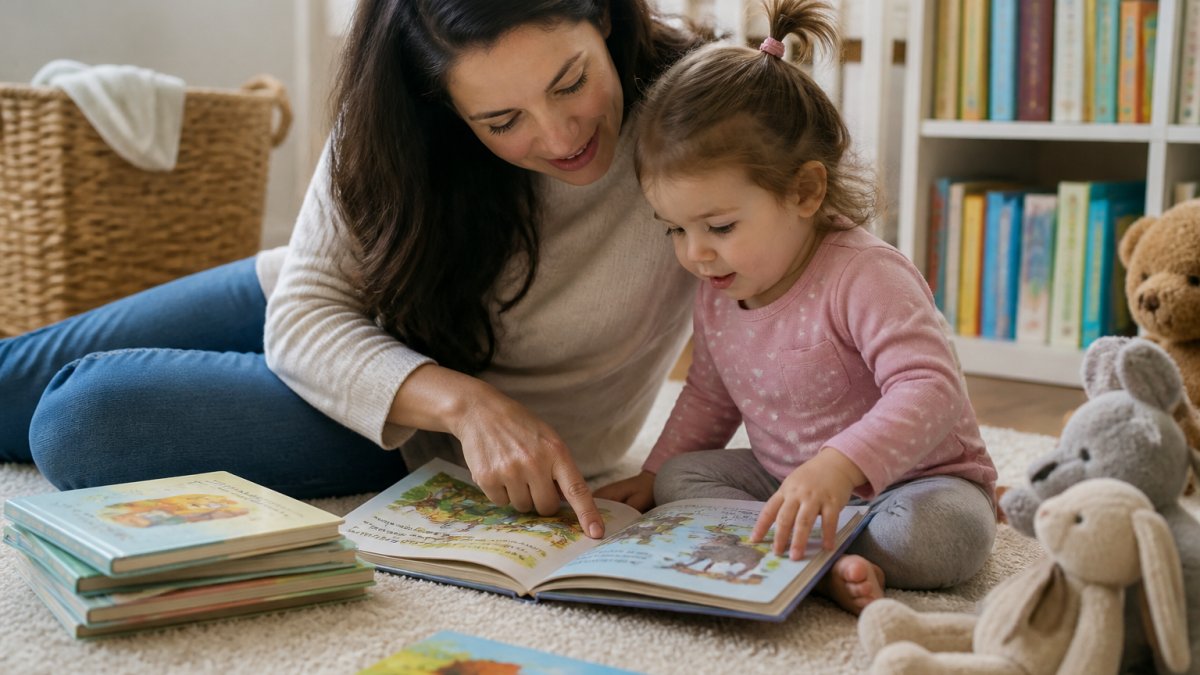
Run it under the text as you read. Stop on a picture and name what you see. Then ask easy questions your child can answer with a point or a sound:
- "Where's the dog?"
- "What sound does the truck make?"
- "Can you find the red ball?"
Your toddler does not need words to answer. A point counts. A grunt counts. Every response tells you they are tracking the story with you.
How to Choose Books for Toddlers Based on Their Interests
The best toddler book is the one your child asks for again, interest beats award lists every time. But "follow your child's interests" is useless if you have never tracked what those interests are. So track them.
The Interest Inventory: A Two-Week Method
For two weeks, keep a running note on your phone.
At the end of two weeks, you will have a list, usually shorter and stranger than expected. A toddler who ignores every farm-animal book may be obsessed with one specific digger.
Then map it:
- Match the obsession directly. Search your library catalog for that exact object. Board books exist for almost every truck, animal, and household machine.
- Match the obsession sideways. If your child loves the garbage truck, a book about a mail carrier or a fire engine often lands too, because the underlying interest is "big vehicles that do a job."
- Match the feeling, not the topic. A toddler who loves a book about a bear who is scared of the dark may not care about bears at all. They care about being scared and being comforted. Look for that emotional shape in other books.
A truck-obsessed toddler will sit through a mediocre truck book but bolt from a beautiful book about bunnies. That is not a reading problem, it is a match problem.
Board Books, Flaps, and Textures: Matching Format to Age
Format matters as much as topic at this age.
- Under 18 months: board books with high-contrast pictures and few words. At this stage the book is a chew toy that happens to have pictures, and that is developmentally correct.
- 18 to 30 months: lift-the-flap books and touch-and-feel pages. The flap gives a busy hand a job on every spread, which buys you extra seconds of attention.
- Near age three: simple stories with a repeated line your child can chant. The repetition lets your child "read" along before they can read, which is a powerful motivator.
Sturdy pages survive grabbing and chewing, which is normal at this stage. Flaps and textures give busy hands something to do while ears listen.
One trade-off: pop-up and novelty formats look impressive but rarely survive a toddler. Save those for supervised reading and keep board books in the rotation your child can handle alone.
The Five-Finger Rule and Other Quick Selection Tests
The five-finger rule works for toddlers too, adapted: open to a random page and count the words your child does not know. More than five means the book is too hard for now.
Three faster tests:
- The page-turn test: Does something interesting happen on every page? Toddlers judge a book one spread at a time. If a page is just scenery, you will lose them there.
- The picture test: Can your child point to at least one familiar object per spread? Familiarity is the hook. A page of entirely new things is a page of nothing.
- The repeat test: Would you happily read it four nights in a row? Because you will. If the answer is no, the book will not survive your household regardless of how good it is.
If a book passes all three, buy or borrow it.
When to Let a Book Go
Some books fail no matter what you do. If your child has rejected a book three separate times across different moods and times of day, it is not a match, return or donate it. A shelf full of rejected books makes storytime feel like a chore, and the goal is a shelf your child reaches for.
Early Literacy Activities for Babies: Starting Before They Talk
Early literacy activities for babies look nothing like reading. They look like talking, singing, and chewing on a board book. That is exactly right.
Babies build phonemic awareness, hearing the small sounds inside words, long before they speak. Rhymes, songs, silly sounds, and naming everything you see all do this work.
- Sing the same three songs at diaper changes
- Narrate your grocery run out loud
- Let baby hold the book and turn pages, even backward
A common mistake is waiting for words before starting. The foundation gets poured in month one, not month twenty.
Sensory-Based Reading Activities for Toddlers Who Won't Sit Still
Sitting still is not the goal. Knowing how to make reading engaging for toddlers is. Some toddlers listen best with their whole bodies moving, and that is fine.
Try pairing books with movement and touch:
- Act out the story with stuffed animals while you read
- Let your child hold a small toy that matches the main character
- Add a sound effect for every page turn
A wiggly toddler answering questions is more engaged than a still one staring at the wall. Judge the session by responses, not posture.
Reading for Neurodivergent Toddlers: Adapting Without Pressure
Most reading advice assumes a toddler who can sit, look, and listen at once. Some cannot, not from unwillingness, but because their nervous system is processing the room, the light, your voice, and the chair all at once. That includes children with autism, ADHD, sensory processing differences, or speech delays.
This is the section most reading guides skip. Here is what helps.
Start With the Sensory Environment, Not the Book
Before you change anything about how you read, change where you read.
- Reduce competing input. Turn off the TV, the fan, and the background music. For a child with sensory processing differences, a humming refrigerator can be louder than your voice.
- Give the body what it needs first. A toddler who needs deep pressure will settle better after being squeezed, swung, or rolled in a blanket than after being told to sit. Do the movement, then open the book.
- Offer a seat alternative. Some children listen better lying on the floor, standing at a table, or draped over a beanbag. Posture is not the point; attention is.
Follow the Child's Lead, Not the Page Order
For many neurodivergent toddlers, the book is a starting point, not a script.
- Let your child open to any page. Let them flip backward. Let them skip.
- If your child fixates on one picture, stay there. That page is doing the work right now.
- Read the same book every night for months if that is what your child wants. Repetition is not a rut for these children, it is a scaffold. The predictability frees up attention for language.
Shorten Sessions and Stop While It Is Still Fun
Two minutes of genuine engagement beats fifteen minutes of resistance. End the session before your child signals they are done, ideally right after a successful page, not after a struggle.
A pattern many families land on: read one book, then stop, even if your child wants more. Ending on a high note makes the next session easier to start.
Read the Signals, Not the Behavior
If your child covers their ears, pushes the book away, or runs from the room, that is information, not rejection. It usually means one of a few things:
- The room is too loud or too bright
- The book is too long or too wordy for right now
- The time of day is wrong, bedtime is often the hardest slot for a tired, dysregulated toddler
Many families find bedtime too tired for everyone and switch to after breakfast or after nap. That single change resolves more reading resistance than any technique here.
When to Talk to a Professional
If your child is not using words by around 18 months, is losing skills they once had, or consistently avoids all back-and-forth interaction, not just books, bring it up with your child's pediatrician. Early intervention services are free in most states and do not require a diagnosis to start. You are not diagnosing anything by asking. You are just opening a door.
Emotional Regulation During Reading: Handling Meltdowns and Resistance
Reading resistance is normal and usually about the moment, not the book.
What to do when it goes sideways:
- Close the book without a fight and try again later
- Offer two choices: "This book or that one?"
- Let your child "read" to you instead
The goal is to protect the feeling that books are safe and good. One skipped session costs nothing. A nightly battle costs a lot.
| Problem | Quick Fix | Why It Works |
|---|---|---|
| Won't sit still | Add movement or a toy | Gives the body a job |
| Grabs and chews pages | Switch to board books | Meets the mouthing stage |
| Cries at bedtime stories | Move storytime earlier | Avoids the overtired window |
| Refuses new books | Repeat a favorite | Comfort fuels attention |
American Academy of Pediatrics guidance on shared reading notes that even brief, positive reading moments support language growth, so short and happy beats long and tense.
Conclusion
The hardest part of reading with a toddler is not finding the right book. It is letting go of what storytime is supposed to look like.
Literacy Roots: Nurturing Your Child's Reading Journey from Birth to Brilliance is built for parents who want to be their child's first and best teacher, with simple routines you can start tonight. Get started with Lauren's Literacy Lounge and turn a few minutes a day into a reading habit that lasts.
Frequently Asked Questions
How do I get my toddler interested in reading when they only want to play?
Start by pairing books with what they already love. If your toddler is obsessed with trucks, find board books about trucks and read them during play. Keep sessions short, two to five minutes, and let your child turn pages or hold a small toy while you read. Interactive reading techniques like asking 'Where is the dog?' or making animal sounds turn storytime into a game. Over time, these small moments build reading habits without forcing focus.
What is the five-finger rule for choosing toddler books?
The five-finger rule helps you match a book to your child's attention span and vocabulary. Open to any page and count how many words your child does not know or seem to understand. If there are five or more unfamiliar words on one page, the book is likely too advanced for independent enjoyment. For toddlers, aim for books with one or two simple sentences per page, bold pictures, and repeated phrases they can join in on.
How long should a toddler be able to sit for a story?
Most toddlers can focus for two to five minutes at a time, and that is completely normal. Attention span grows with age and practice. Instead of aiming for a full book, try reading one or two pages, then let your child move. You can return to the book later. Building reading stamina happens gradually through daily routine, not through forcing longer sessions. Follow your child's cues and stop while they are still interested.
Is it normal for a two-year-old to lose interest in books quickly?
Yes, it is very common. Toddlers are wired to explore, so sitting still for a whole story can feel unnatural. If your child loses interest after a page or two, try interactive reading techniques: let them lift flaps, point to pictures, or hold a stuffed animal related to the story. You can also try sensory-based reading activities, like reading a book about animals while playing with animal figures. Short, frequent sessions work better than one long one.
This article was written with the team at Lauren's Literacy Lounge, where we help parents build early literacy routines at home. For more on how we support families, visit our site.


