 How-to
How to Build Vocabulary in Babies Before 1 Year
Table of Contents
- Your Baby's Brain Is Built for Words: How to Build Vocabulary Babies Before 1 Year
- Language Development Milestones 0-12 Months: What to Expect Each Month
- How to Talk to Your Baby to Increase Vocabulary Every Day
- The Serve and Return Model: Turning Babbles into Back-and-Forth Talk
- Interactive Reading Techniques for Infants: Books That Build Words
- How to Encourage First Words and Early Communication
- Bilingual Homes, Neurodivergent Babies, and Screens: What Most Guides Miss
- Conclusion: Small Daily Moments Build Big Vocabulary
- Frequently Asked Questions
Last Updated: October 2, 2026
Your Baby's Brain Is Built for Words: How to Build Vocabulary Babies Before 1 Year
Babies start learning language before they speak a word. The first year is a critical window for how to build vocabulary in babies before 1 year: early exposure shapes later reading and thinking skills. This guide from Lauren's Literacy Lounge covers the milestones, daily habits, and interaction models that build that foundation.
What is serve and return?
Serve and return is a back-and-forth pattern where a baby "serves" a sound, gesture, or look, and the caregiver "returns" it with a response. This loop builds language brain connections long before words appear.
Language Development Milestones 0-12 Months: What to Expect Each Month
Language development milestones 0-12 months follow a fairly predictable path, though every baby moves at their own pace. They describe what most babies do, not what every baby must do.
0-3 Months: Cries, Coos, and First Attention
In the first three months, babies tune in to voices, start cooing, turn toward sound, and calm at a familiar voice.
Talk to your baby during feeding and diaper changes. Describe what you are doing in simple words.
- Say "I'm changing your diaper" during changes
- Hum or sing during feedings
- Pause and wait for a coo or gaze
4-8 Months: Babbling and Joint Attention
Babbling usually starts between four and eight months. Babies repeat sounds like "ba-ba" and "da-da."
Joint attention, looking at the same thing at the same time, is a key step for word learning.
Point at a dog, say "dog," and wait for your baby to look.
9-12 Months: Gestures, First Words, and Receptive Vocabulary
By nine to twelve months, many babies use gestures like pointing and waving. Receptive vocabulary, the words a baby understands, grows faster than spoken words now.
Your baby may understand "no," "bye-bye," and their own name. First words often arrive near the first birthday.
Some babies say their first word at ten months; others wait until fifteen. Both can be normal.
How to Talk to Your Baby to Increase Vocabulary Every Day
Learning how to talk to your baby to increase vocabulary comes down to one habit: narrate your day out loud. You do not need special tools or a teaching background. The everyday moments you already have are the lesson.
But volume alone is not the goal.
Narrate Routines and Name Objects
Narrating daily activities is one of the simplest ways to build words. Say what you see, touch, and do.
- "Here is your bottle. It's warm."
- "Let's put on your socks. One sock, two socks."
- "Look, the cat is sleeping."
Name objects your baby looks at, not just ones you choose: label what your baby is already attending to and the word sticks.
Use Parentese and Verbal Cues
Parentese, also called infant-directed speech, is the high-pitched, slow, sing-song way adults naturally talk to babies. It is not baby talk. It uses real words with exaggerated sounds.
Research from the American Academy of Pediatrics on early language supports that parentese helps babies tune in to speech sounds. The stretched vowels and lifted pitch make the boundaries between words easier for an infant brain to detect.
Try these verbal cues:
- Stretch out vowel sounds: "Hiiii, baby"
- Pause after questions to let your baby respond
- Repeat key words: "Ball. Big ball. Red ball."
- Get face-to-face, about 12 inches away, so your baby can watch your mouth
The 3-Second Pause: The Habit Most Parents Skip
The single most common mistake is talking nonstop without pausing. Babies need silence to take a turn. After you speak, count to three in your head.
Here is what a real exchange looks like:
- You say, "Look, a dog!"
- You wait three seconds.
- Your baby coos, kicks, or looks at you.
- You treat that as a reply: "Yes! A dog. Woof woof."
- You wait again.
That loop, speak, pause, respond to whatever comes back, pause again, is the engine of vocabulary growth.
Match Your Words to Your Baby's Focus
A baby cannot learn a word for something they are not paying attention to. Before you name an object, check where their eyes are: if your baby is staring at the ceiling fan, talk about the fan, not the toy you want them to notice.
Build a Small Set of High-Value Words
You do not need a huge vocabulary to teach one. Most babies learn first words from a small, repeated set: names of people, body parts, animals, food, and action words like "up," "more," and "all gone."
Pick five to ten and use them daily in the same contexts: "Up" every time you lift your baby, "more" every time you offer another bite.
When to Talk Less
There is a limit. Constant narration with no pauses, eye contact, or response to your baby's signals builds background noise, not vocabulary. If your baby turns away, fusses, or looks past you, stop and reset, a quiet, attentive minute beats a loud, one-sided hour.
The Serve and Return Model: Turning Babbles into Back-and-Forth Talk
The serve and return model turns a one-way monologue into a real conversation. When your baby babbles, you respond as if they said something.
- Your baby makes a sound or gesture (the serve).
- You respond with words, a smile, or a sound (the return).
- You wait for your baby to serve again.
Do this ten times during a single play session, simple, but easy to forget when you are tired.
The Center on the Developing Child at Harvard University describes serve and return as a core building block for early brain development.
Interactive Reading Techniques for Infants: Books That Build Words
Interactive reading techniques for infants look different from reading to an older child. With a baby, you are not finishing the story. You are sharing the page.
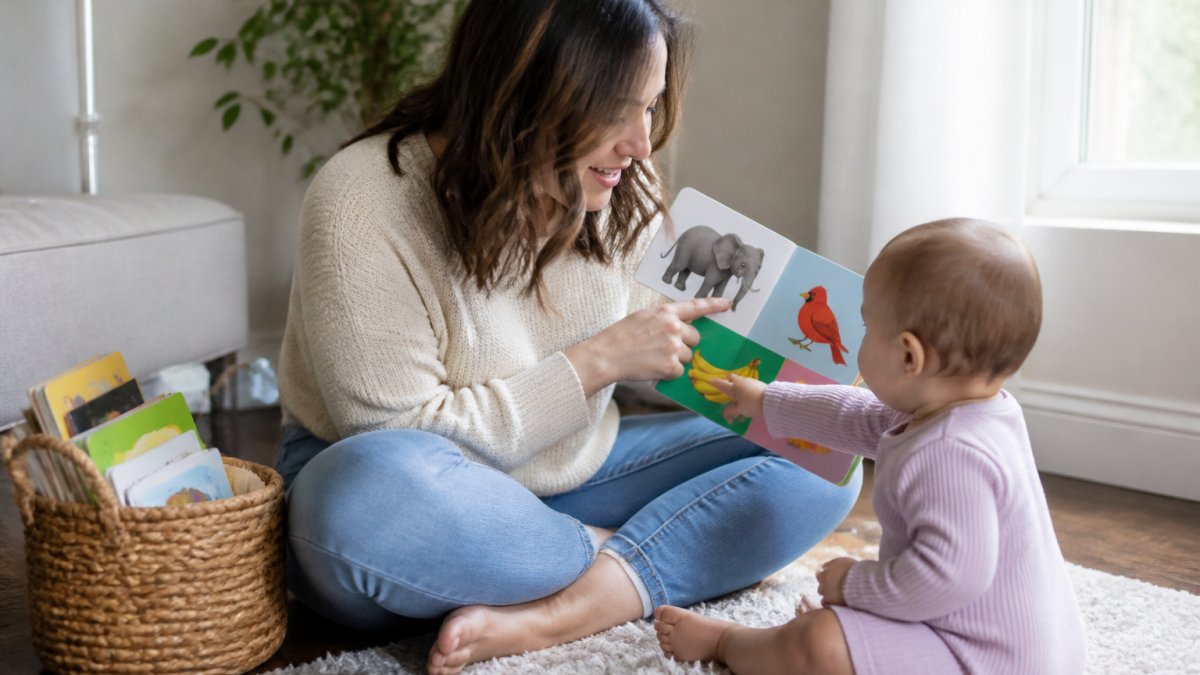
Choose the Right Books and Point as You Read
Pick board books with clear, simple pictures. High-contrast images work well for younger babies.
Point at each picture and name it, without rushing.
- Choose books with one image per page
- Name the object, then wait
- Let your baby turn pages, even backward
Repetition, Songs, and Nursery Rhymes
Repetition builds memory. Read the same book again and again.
Songs and nursery rhymes add another layer: rhyme and beat help babies hear the smaller sounds inside words.
This is an early form of phonological awareness, the ability to notice sounds in language.
How to Encourage First Words and Early Communication
To encourage first words, create reasons for your baby to communicate. Do not hand over everything before they ask.
Pause before giving the cup. Wait for a sound, a point, or a reach.
Try these moves:
- Offer choices: "Milk or water?"
- Pause mid-song and wait
- Pretend not to understand a point at first
Bilingual Homes, Neurodivergent Babies, and Screens: What Most Guides Miss
Most vocabulary guides assume one language and one type of baby. Real homes are more varied. This section covers the three situations parents search for most and find the least useful advice on.
Bilingual Homes: Two Languages, One Brain
Babies can learn two languages at once. The worry that two languages confuse a baby or delay speech is not supported by research. What matters is the total number of words your baby hears across both languages, not whether they come from one or two. A few practical rules:
- One person, one language is a common pattern: one caregiver speaks Language A, another speaks Language B. It is not the only way, but it gives babies a consistent cue about which sounds go together.
- Do not translate in the same sentence. Saying "milk, leche" every time can slow the mapping between a word and its meaning. Use one word per object in a given moment, then switch languages in a different moment.
- Expect a slightly different timeline, not a delay. Bilingual babies sometimes say their first word a little later than monolingual babies, but by age two most are within the normal range across both languages combined.
- Count total words, not words per language. A baby who knows 30 words split across two languages is not behind a baby who knows 30 words in one.
If one language is spoken only by a grandparent or an occasional caregiver, it will grow more slowly. That is normal, consistency of exposure matters more than equal exposure.
Neurodivergent Infants: Same Tools, Different Pacing
Some babies develop language on a different timeline. If your baby is autistic or has a developmental delay, the same tools still help, but the how changes.
- Follow your baby's interest, not your lesson plan. If your baby is fascinated by spinning wheels, use wheels to teach words. Interest is the doorway.
- Reduce competing input. Many neurodivergent babies are sensitive to noise, light, and motion. A quieter room with one toy and one adult often produces more language than a busy playgroup.
- Use visual supports earlier. Simple picture cards, gestures, and sign language can give a baby a way to communicate before speech arrives. This reduces frustration and often speeds up spoken words later.
- Watch for regression, not just delay. Losing words or skills your baby already had is a different signal than simply being slower to start. That is a reason to talk to your pediatrician sooner rather than later.
A speech-language pathologist can guide you. Early intervention services for infants are available in every state, usually free or low-cost, and you do not need a diagnosis to ask for an evaluation.
Screens: The Difference Between a Video Call and a Video
Digital interaction is not the same as a live person. A video cannot pause and respond to your baby. A video call with a grandparent can.
That distinction matters. Passive screen time, a baby watching a video alone, does not build vocabulary, and research from the American Academy of Pediatrics on screen time recommends limiting it in the first year. But a live video call where a familiar adult talks, waits, and responds to your baby's sounds is a different category. It is not as rich as in-person talk, but it is not the same as a cartoon.
A practical rule:
- Under 18 months: avoid solo screen time. Video calls with family are the main exception.
- If you use a video call: stay in the frame with your baby. Narrate what is happening. "Look, Grandma! Say hi!" Your presence turns a screen into a shared moment.
- Do not use screens to replace talk. A video is not a babysitter for language. It is a tool for connection when distance makes in-person talk impossible.
A Note on Mixed Situations
Many families are more than one of these at once: a bilingual home with a neurodivergent baby, or a family relying on video calls because a parent works away. The principles stack, follow your baby's lead, protect turn-taking, and do not let any single rule override what you see in front of you.
Conclusion: Small Daily Moments Build Big Vocabulary
Building your baby's vocabulary does not require a curriculum, expensive tools, or a teaching degree. It requires your voice, your attention, and a few minutes of back-and-forth talk each day. Lauren's Literacy Lounge created Literacy Roots to help parents become their child's first and best teacher, with simple routines that fit real life, including for families who move often.
Frequently Asked Questions
What vocabulary should a one year old have?
Most one year olds say one to three clear words beyond mama and dada, and they understand far more than they speak. Receptive vocabulary at this age often includes simple commands like 'come here' or 'give me,' plus the names of familiar people, pets, and daily objects. If your baby is not babbling with consonant sounds or responding to their name by twelve months, mention it to your pediatrician, who can check speech milestones and refer you to a speech-language pathology specialist if needed.
Does reading to a baby help with vocabulary development?
Yes. Interactive reading gives babies repeated exposure to words, speech sounds, and joint attention, all of which support vocabulary acquisition. Board books with clear pictures make it easy to name objects, pause, and wait for a response. Even a two-minute session counts. The key is interaction, not finishing the book: point, label, and let your baby grab or babble back, which turns story time into a serve and return exchange.
How much should I talk to my baby to help them learn language?
There is no magic number, but more back-and-forth talk is better than one-way chatter. Aim to narrate what you are doing throughout the day, such as diaper changes, meals, and walks, and then pause to let your baby respond with a sound, look, or gesture. Short, responsive exchanges build more vocabulary than long monologues. If you are ever unsure whether your baby is hearing enough language, focus on quality interactions during routine care rather than adding more background noise.
What are the signs of language delay in infants?
By nine months, most babies babble with different sounds and respond to their name. By twelve months, they typically use gestures like pointing or waving and may say a first word. Signs worth checking include no babbling by nine months, no gestures by twelve months, or no response to familiar voices. If you notice these, ask your pediatrician about a hearing test and a developmental screening. Early support from a speech-language pathology professional can make a real difference.


