 How-to
How do you build a home library for preschoolers?
Last Updated: October 27, 2026
Quick Summary
A home library for preschoolers is simply books stored where your child can reach them independently. It doesn't have to be fancy or big. What matters is that books are visible, within reach, and part of your daily life.
- Book access in the home is one of the strongest predictors of reading success.
- You can start with a few favorites, picture books, and nonfiction about topics your child enjoys.
- Free and low-cost sources include your library card, book swaps, gifts, and Little Free Libraries.
- Organize books by front-facing displays or rotation systems so your child can browse easily.
- A living room corner, hallway end, or bedroom side works as a reading space without needing a spare room.
Table of Contents
- Why a home library for preschoolers matters
- Step 1: Choose preschool books for your home library
- Step 2: Create an inviting reading space
- Step 3: How to organize children's books for easy access
- Step 4: Build your collection with budget-friendly home library ideas
- Step 5: Implement book rotation for preschoolers
- Step 6: Keep books safe and repair what matters
- Start your family's reading habit tonight
- Frequently Asked Questions
You're standing in your child's room at bedtime, and they're asking for the same book. Again. You're tired. You wonder if you should be buying more books instead of rereading the same three. But repetition can be part of a child's reading life. A home library for preschoolers isn't about a massive collection. It's about books in a space where your child can spend time.
Book access matters. You don't need a library's worth of titles or a Pinterest-perfect corner, just books your child can reach and a system that stays manageable.
Why a home library for preschoolers matters
A home library for preschoolers is simply books stored where your child can reach them independently. It doesn't have to be fancy or big. What matters is that books are visible, within reach, and part of your daily life.
Research shows that book access in the home is one of the strongest predictors of reading success. According to research on early literacy environments, children who grow up with books at home develop larger vocabularies and stronger comprehension skills. When books are easy to grab, kids reach for them more often. That's the whole game.
Here are some ideas for a home library:
- Your child sees reading as something they choose, not something you make them do
- You have go-to activities for quiet time, car rides, and waiting rooms
- Books become part of your family's routine, like meals and bedtime
- Your child learns that stories are everywhere
Step 1: Choose preschool books for your home library
Start with books your child enjoys. How to Choose Age-Appropriate Picture Books for Preschoolers offers specific guidance on selecting titles that match your child's stage and interests.
Books by age and stage
For babies and young toddlers (birth to 18 months):
- High-contrast board books with simple shapes
- Touch-and-feel books with different textures
- Repetitive stories with rhythm and rhyme
- Books about everyday moments (eating, sleeping, playing)
Babies can explore books as objects and look at pictures.
For toddlers (18 months to 3 years):
- Board books with one or two words per page
- Stories with animals, vehicles, and familiar people
- Books with flaps or buttons they can interact with
- Predictable stories where they can guess what comes next
Toddlers may point to pictures and enjoy repetition. Board books are one option to consider.
For preschoolers (3 to 5 years):
- Picture books with richer stories and more text
- Books about feelings, friendship, and family
- Stories with humor and surprise
- Non-fiction about animals, nature, and how things work
Picture books are one option for preschoolers.
Picture books and board books that last
Look for illustrations and stories that interest your child.
research on book selection for young children shows that children engage more deeply with books that reflect their interests and experiences. Choose books about things your child loves: dogs, trucks, rain, siblings, going to the doctor. Personal connection matters more than prestige.
You can find books through your local library, book swaps, and thrift stores. Free is better than perfect.
Here's what kinds of books work best at each stage, from babies through preschoolers.
| Age | Best book types | What kids do with them |
|---|---|---|
| Birth to 18 months | High-contrast board books, touch-and-feel, repetitive rhymes | Explore books as objects, look at pictures |
| 18 months to 3 years | Board books with one or two words per page, interactive flaps or buttons | Point to pictures, enjoy repetition |
| 3 to 5 years | Picture books with richer stories, books about feelings and friendship | Engage with humor and surprise, ask questions |
Step 2: Create an inviting reading space
You don't need a spare room. You could set aside a place where a preschooler can reach books.
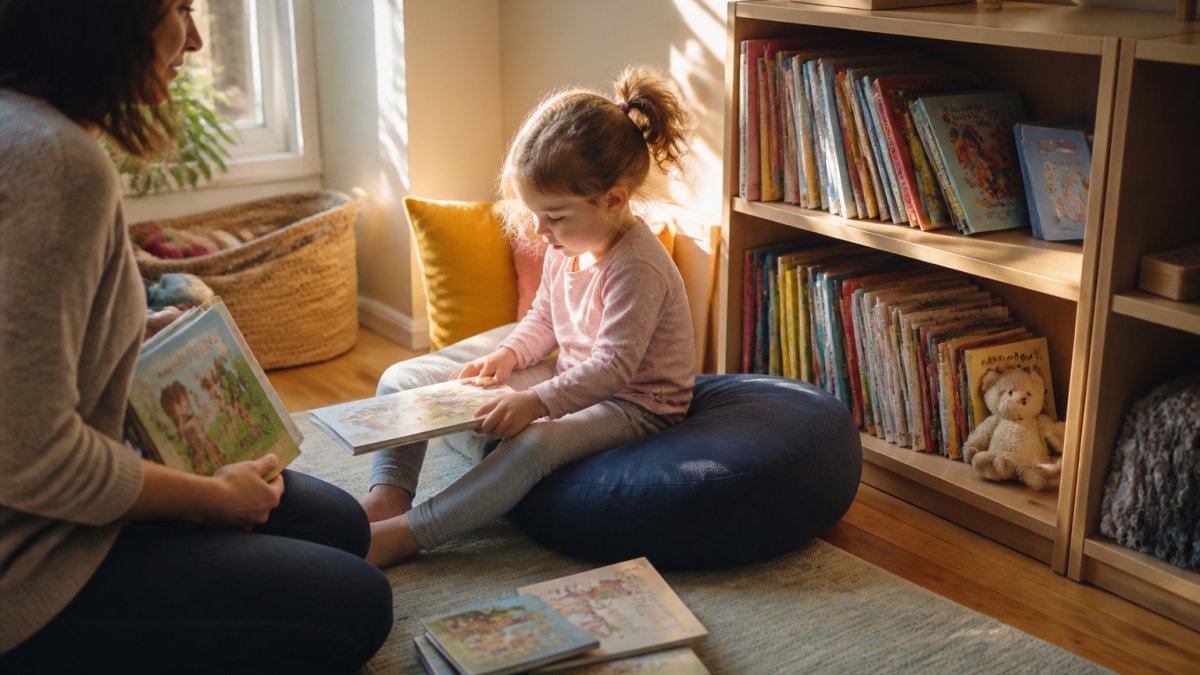
Pick the spot first, then make it safe
A living room corner, hallway end, or bedroom side could work as a place for books.
Before arranging the space, consider general safety.
Make it comfortable without spending
You could add a cushion or folded blanket as a place to sit.
If your space is tiny, a single basket under a side table is one option. Building a Portable Home Library for Military Kids offers practical strategies for families who move frequently or have limited space. The goal is a place for books that works for your family.
A quick setup checklist
- Books are in a place your child can reach
- Books are easy to see or browse
Chapter 3 of Literacy Roots discusses the home literacy environment.
Step 3: How to organize children's books for easy access
You could organize books so they're visible and within reach.
Front-facing displays and rotation systems
Front-facing display: Turn some books so the cover shows, not just the spine. A low shelf or basket with covers showing are options.
Rotation systems: Keep some books accessible and store the rest. Swap them from time to time. Store extras in a bin or closet.
Organize by category if it helps you:
- Picture books
- Board books
- Stories about feelings or family
- Non-fiction and learning books
- Books your child chose at the library
Don't overthink it. The system you'll actually use beats the perfect system you won't.
Step 4: Build your collection with budget-friendly home library ideas
How many books do you actually need? There is no required number. Build your collection from books your child enjoys.
A realistic starter collection
You could include a mix of books, such as:
- A few favorites your child enjoys.
- Picture books that interest your child.
- Nonfiction books about topics your child enjoys.
- Books about feelings or friendship if those topics interest your child.
- A book in your home language if you speak one.
- Books that reflect your family and others: different cultures, abilities, and family structures.
You don't have to buy all of this. You could use books from the library, swaps, and gifts.
Where free and low-cost books come from
Your library card. You could check out books and let your child choose some.
Book swaps. Ask friends and family to trade. A neighborhood swap or parent group pass-around is one way to exchange books. Lauren is a Little Free Library steward.
Gifts. When grandparents and relatives ask what your child needs, you could suggest books.
Author and publisher resources. Some authors post free printable activities or reading lists. It's worth a quick look for your child's favorites. reading resources for families
Build slowly and let your child lead
You could build your collection gradually and notice which books interest your child.
Chapter 3 of Literacy Roots covers the home literacy environment, including book access and a writing station. Chapter 10 discusses community and book access.
Step 5: Implement book rotation for preschoolers
You could rotate books by keeping some out, storing others, and swapping them from time to time.
Step 6: Keep books safe and repair what matters
If a book is damaged, you could consider whether to repair it:
Start your family's reading habit tonight
Building a home library for preschoolers is one way to make books part of your home and daily life.
Start tonight. Grab a book your child loves and read it together.
Literacy Roots discusses the home literacy environment in Chapter 3. The core message: parents are their child's first teachers, and literacy grows in small, warm, daily moments.
Get the book on Amazon. Or schedule a free chat with Lauren if you're feeling stuck or overwhelmed. You've got this.
Frequently Asked Questions
How many books should a preschooler have in their home library?
There's no magic number. You could start with books your child can reach easily and add to your collection through library visits, swaps, and gifts.
What are the best preschool books for a home library?
You could choose books that interest your child and reflect your family's culture and languages.
How can I organize children's books so my preschooler uses them independently?
You could keep books in a place your child can reach and display some covers face-forward. You could also group books by theme.
What are budget-friendly home library ideas for families on a tight budget?
You could ask friends or family to trade books, suggest books as gifts, or look for book swaps.



