 How-to
Fostering Reading Love in Toddlers: 7 Real Tips
Table of Contents
- Why Fostering Reading Love in Toddlers Matters More Than Early Instruction
- Early Literacy Activities for Babies That Build the Foundation
- How to Read to a Toddler Who Won't Sit Still
- Build a Daily Reading Routine for Toddlers That Actually Lasts
- Choosing Books That Spark Curiosity and Engagement
- Keep the Reading Momentum During Big Life Changes
- What to Skip: Common Advice That Kills Reading Joy
- Conclusion: Your Role in Fostering Reading Love in Toddlers
- Frequently Asked Questions
Last Updated: September 4, 2026
Fostering reading love in toddlers is less about teaching letters and more about creating moments of warmth, curiosity, and connection around books. Many parents worry they are falling behind if their two-year-old isn't reciting the alphabet, but the real goal is building a positive emotional bond with stories. At Lauren's Literacy Lounge, we help parents become their child's first and best teacher, and we have found that parents who focus on joy rather than milestones raise children who choose books for life.
Why Fostering Reading Love in Toddlers Matters More Than Early Instruction
Fostering reading love in toddlers is the single strongest predictor of lifelong literacy habits, outweighing early phonics drills or flashcard sessions. A child who associates books with snuggles, laughter, and parental attention will seek out reading independently later. This emotional foundation, often called print motivation, matters more than any isolated skill you can drill before kindergarten.
Early instruction that feels like work can actually suppress curiosity. Toddlers are wired to explore, not to perform. When reading becomes a test, many children resist, and that resistance can harden into a long-term avoidance of books. The American Academy of Pediatrics recommends daily reading from infancy not to create early readers, but to build language exposure and bonding, which the American Academy of Pediatrics literacy guidance identifies as crucial for healthy development.
Early Literacy Activities for Babies That Build the Foundation
Language development begins long before a child utters their first word. Early literacy activities for babies focus on exposure: hearing varied vocabulary, seeing faces animate with expression, and touching books as physical objects. These experiences build neural pathways for phonological awareness and comprehension years before formal schooling.
Sensory Play with Books for the First Year
During the first twelve months, treat books as toys with a bonus feature: your voice. Board books with high-contrast patterns, crinkle pages, and textured inserts engage a baby's sense of touch while you narrate what they see. Let your infant chew, drop, and grab the book, this hands-on exploration teaches babies that books are safe, interesting objects.
Narrate your day even when no book is open. Describe the banana you are peeling, the dog barking outside, the blue shirt going over their head. This running commentary builds vocabulary acquisition at a staggering rate. Research from Stanford University's language exposure studies shows that the sheer quantity of words a child hears in the first three years directly correlates with later language skills and school readiness.
How to Read to a Toddler Who Won't Sit Still
The biggest mistake parents make is assuming a toddler must be seated and attentive for reading to "count." A toddler crawling under the chair, spinning in circles, or grabbing the book away is still absorbing your voice, expression, and the rhythm of the story. Active toddlers listen with their bodies in motion; this is normal, developmentally appropriate behavior, not failure.
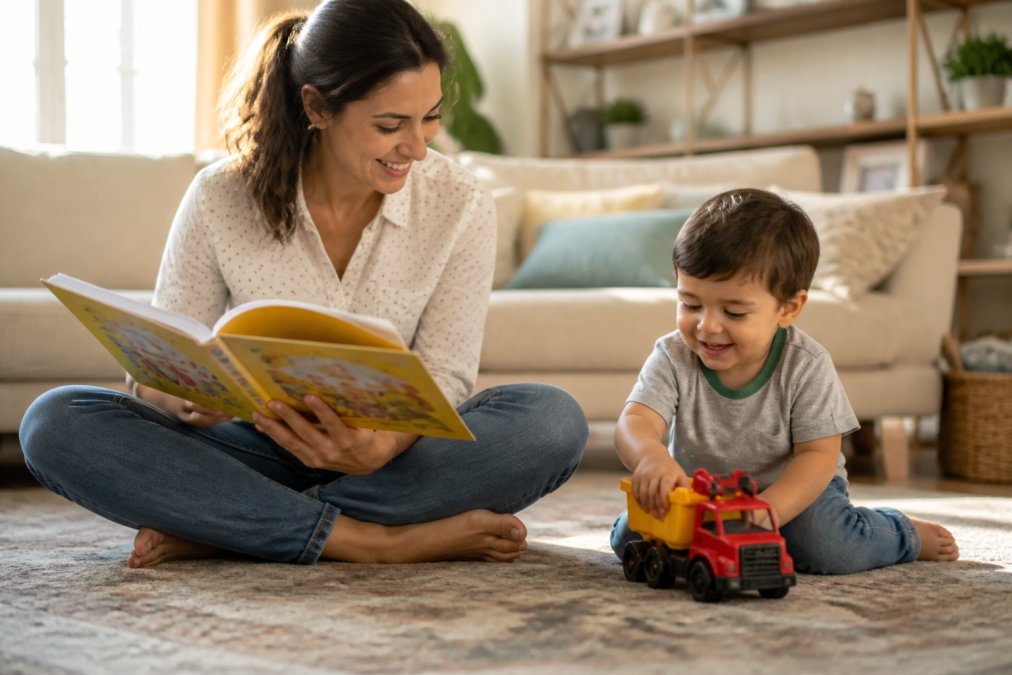
Stop chasing the perfect reading posture. Instead, meet them where they are. If they are building a block tower, sit nearby and read aloud, animated and expressive. If they pause to glance at a page, point to a picture and name it. Follow their lead, and let the book be background music to their play. Many parents find that a toddler who refuses story time will happily "overhear" a parent reading to a stuffed animal or sibling.
Build a Daily Reading Routine for Toddlers That Actually Lasts
A daily reading routine for toddlers works only when anchored to an existing habit, not added as a separate task. Attach reading to something that already happens every day: after breakfast, before bath, or during the wind-down after dinner. The routine should be short, consistent, and non-negotiable in spirit, even if the execution is messy. Five joyful minutes beat thirty forced ones.
Keep the routine flexible enough to survive chaos. For military families facing frequent relocations, the routine itself becomes a portable anchor. A box of favorite books that travels with the household, read in the same order each night, gives a toddler a sense of control and normalcy when everything else is changing. The Zero to Three parenting resource on routines notes that predictable routines help young children feel secure, which makes them more open to learning experiences like reading.
Here is a simple structure that works:
- Choose a consistent time tied to an existing daily event.
- Let your toddler pick the book from a small selection of two or three options.
- Read with animation, using different voices and pointing to pictures.
- End with a positive ritual, like a high-five or a hug, to close the session.
Troubleshooting the Routine When It Falls Apart
Every parent hits a wall where the routine that once felt magical now triggers a meltdown. Here is how to troubleshoot the most common routine breakers without abandoning the habit.
The “Not That Book” Tantrum. Your toddler suddenly rejects the book they picked yesterday. This is not defiance; it is a toddler exercising their emerging autonomy. Offer a binary choice (“Do you want the truck book or the animal book?”) and accept either answer without negotiation. If they still refuse, say, “Okay, I am going to read the truck book to your teddy bear,” and start reading with exaggerated animation. Most toddlers will wander over within sixty seconds.
The Mid-Book Escape. If your toddler bolts from your lap halfway through, do not chase them. Keep reading aloud with expression, as if the story is the most thrilling thing you have ever heard. Toddlers have a powerful “fear of missing out” instinct. When they hear you laughing at a silly phrase or gasping at a plot twist, they will often return. If they do not, close the book and move on. Forcing them back teaches that reading is a power struggle.
The Bedtime Resistance. If you have anchored reading to bedtime and your toddler starts fighting it, the problem is usually not the book, it is the transition to sleep. Separate the reading ritual from lights-out by ten minutes. Read in the living room, then move to the bedroom for a quick lullaby or cuddle. This breaks the association that “book time” means “sleep time coming immediately,” a common trigger for resistance.
The Attention Span Crash. Some days your toddler will sit for twenty minutes; other days, twenty seconds. This is normal. The key is to never let a bad day erase the routine. On low-attention days, read a single page, point to one picture, and close the book with a high-five. The routine survives because it is short and pressure-free. Over time, the good days will outnumber the bad ones.
The “Non-Negotiable” Mindset Shift
The most important shift is to stop thinking of the routine as a daily quota and start thinking of it as a weekly rhythm. Some days you will read five books; other days, zero. What matters is that the opportunity is always there. A routine that survives a chaotic Tuesday is worth more than a perfect one that collapses under the first disruption.
Choosing Books That Spark Curiosity and Engagement
Book selection is where fostering reading love in toddlers succeeds or stalls. A two-year-old does not care about literary classics; they care about trucks, animals, and themselves. Choose age-appropriate books with sturdy pages, bright illustrations, and rhythmic or rhyming text. Repetition is not boring to a toddler; it is the mechanism of learning. Reading the same book forty times builds print awareness and narrative skills through familiar patterns.
Look for books that invite participation. Lift-the-flap books, touch-and-feel textures, and books with sound buttons create sensory engagement that holds attention far longer than passive listening. Let your toddler turn the pages, even if they skip three at a time. Let them point to the dog on every page, even if it slows the story to a crawl. This interactive reading builds comprehension and emotional awareness by connecting stories to their own world.
If your toddler is obsessed with dinosaurs, find five different dinosaur books. If they love trains, lean in. Following their interests signals that reading is a vehicle for their passions, not a chore you impose. This builds intrinsic motivation, the engine of all lasting literacy habits.
Keep the Reading Momentum During Big Life Changes
Reading routines inevitably fracture during moves, new siblings, or starting daycare. The key to keeping reading momentum is to lower your standards temporarily and protect the ritual's core. During a move, reading one board book in a sleeping bag on the floor still counts. When a new baby arrives, let the toddler "read" to the infant, narrating the pictures in their own invented words.
Toddlers regress during transitions. A child who sat through whole books may suddenly throw them across the room. This is not a rejection of reading; it is a reaction to stress. Offer books without pressure, leave them scattered in reachable places, and model reading yourself. When a toddler sees a parent curled up with a novel, they learn that reading is something grown-ups choose for pleasure. This modeling is one of the most powerful forces in early literacy.
For families navigating frequent relocations, the continuity of a shared book ritual provides critical emotional stability. The familiar cadence of a beloved story reassures a toddler that some things remain constant, even when the address changes. Our program at Lauren's Literacy Lounge is built specifically for parents who want to maintain these educational routines through upheaval, without adding stress to an already full plate.
What to Skip: Common Advice That Kills Reading Joy
Not all well-meaning advice serves your goal of fostering reading love in toddlers. Some popular strategies actively undermine it. Phonics flashcards before age three, forced "repeat after me" drills, and quizzes about story details all turn reading into a performance. When a toddler senses they are being tested, the joy drains out of the interaction. The National Institute for Literacy research summary emphasizes that skill-based instruction is far less effective than rich language exposure in the preschool years.
The Digital vs. Physical Book Dilemma
Digital books present a particular challenge that most parenting advice ignores. While interactive e-books can be engaging, they often encourage tapping and swiping rather than listening and comprehending. Physical books allow for the back-and-forth of pointing, turning pages, and snuggling that builds parent-child interaction. But screens are everywhere, and a blanket ban is rarely sustainable. The goal is not to eliminate screens but to use them strategically.
When a physical book is always the better choice:
- Bedtime. The blue light from screens can delay melatonin production, making it harder for a toddler to fall asleep. The American Academy of Pediatrics recommends avoiding screens for at least one hour before bedtime. A physical book is the only choice for the wind-down routine.
- Car rides and waiting rooms. These are prime opportunities for board books and cloth books that a toddler can chew, grab, and manipulate without a battery.
- When you want to model deep focus. A physical book shows a toddler that reading is a sustained, quiet activity. A screen, even with a book app, signals that reading involves glowing rectangles and intermittent sounds.
When a digital book can be a useful tool:
- During travel or medical appointments. A tablet loaded with a single, static e-book page (not an animated app) can be a lifesaver on a long flight or in a waiting room. The key is to read it together, pointing at the screen and talking about the pictures, just as you would with a physical book.
- For toddlers with fine motor delays. Some children struggle to turn physical pages. A tablet with a simple page-turn swipe can remove that barrier and let them focus on the story.
- When you need a portable library. If you are visiting family for a week, a tablet can carry twenty books without adding weight to your luggage. Use this as a supplement, not a replacement, for the physical books at home.
The rule of thumb: Prefer static e-book pages you read aloud together over apps with animations, sound effects, and interactive hotspots. Research on children's media, summarized by Common Sense Media's research on e-books and young children, shows that animated enhancements often distract toddlers from the narrative, reducing comprehension. A toddler who is tapping a screen to make a character jump is not following the story. A toddler who is looking at a static page while you point and talk is building the same comprehension skills as with a physical book.
The “Word Count” Trap
Also skip the pressure to hit a daily word count or a specific number of books. The quality of your shared attention matters far more than quantity. A single book read with genuine engagement, where you pause to let your toddler point at the dog, ask a question about the moon, or turn the page themselves, builds more literacy than five books rushed through to meet a quota. The American Academy of Pediatrics recommends daily reading, but it does not prescribe a minimum number of minutes or books. The goal is consistency, not volume.
The “Finish the Book” Fallacy
Do not force a toddler to finish a book they are clearly done with. Snatching a toddler back to the page to "complete" the story teaches them that reading ends in a power struggle. Close the book, smile, and try again later. A toddler who learns they can leave a book without a fight will be more willing to start the next one. This is the same principle behind the "one more bite" trap at dinner, forcing it creates resistance, not appetite.
Conclusion: Your Role in Fostering Reading Love in Toddlers
The path to a lifelong reader is paved with ordinary, repeated moments: a book read sideways on a couch, a story interrupted by a question about the moon, a well-worn board book read for the hundredth time. You do not need a teaching degree or a curriculum. You need patience, a willingness to follow your child's lead, and a few good books within arm's reach. Fostering reading love in toddlers is less about what you teach and more about who you are in those moments: warm, present, and delighted by the story unfolding together.
At Lauren's Literacy Lounge, we believe parents are the best first teachers, and we built our Literacy Roots program to help you with evidence-based strategies that fit real family life, including the chaos of relocations and busy schedules. Our approach meets you where you are, without costly programs or rigid scripts. Get started with Lauren's Literacy Lounge and turn your daily moments into the foundation of your child's reading journey from birth to brilliance.
Frequently Asked Questions
How much time should I spend reading to my toddler daily?
Aim for 10 to 15 minutes of shared reading spread across the day, not one long sitting. Consistency matters more than the clock. If your child loses interest after five minutes, stop and try again later. The goal is to make books a familiar, pleasant part of the day, not a chore to endure.
How can I make reading fun for my toddler?
Drop the idea that reading means sitting still and listening. Use silly voices, let your toddler turn the pages, and pause to talk about the pictures. If they run around, keep reading aloud while they play; they are still absorbing the language. Ask open-ended questions like 'What do you think happens next?' and connect the story to their world. Fostering reading love in toddlers comes from joy, not perfect posture.
What are signs that my toddler is ready for early literacy activities?
Most toddlers show readiness between 12 and 24 months. Look for them pointing at pictures, babbling along while you read, or handing you a book to read again. They might turn board book pages on their own or name objects they recognize. These behaviors signal print awareness and narrative skills are developing. You can start early literacy activities for babies as soon as they show interest in grabbing or mouthing books, usually around 6 months.
This article was written using GrandRanker


