 Listicle
Early Literacy Activities for Babies: 10 Best
Table of Contents
- Early Literacy Milestones for Babies (What to Expect Month by Month)
- 10 Early Literacy Activities for Babies That Actually Work
- 1. Read Aloud Every Day, Even to Newborns
- 2. Sing Nursery Rhymes to Build Phonological Awareness
- 3. Narrate Your Daily Routine for Vocabulary Development
- 4. Try Sensory Bins and Tactile Books for Hands-On Exploration
- 5. Use High-Contrast Images to Engage Young Infants
- 6. Practice Interactive Reading with Questions and Pauses
- 7. Introduce Print Awareness Through Labels and Signs
- 8. Add Baby Sign Language to Support Expressive Language
- 9. Raise a Multilingual Reader from Day One
- 10. Build a Literacy-Rich Environment on Any Budget
- How to Read to a Baby: Step-by-Step for Total Beginners
- Best Books for 0-12 Month Olds: What to Look For
- Early Literacy Activities for Babies with Neurodivergent Needs
- Screen Time vs. Digital Literacy: Where Babies Actually Benefit
- Early Literacy Activity Summary
- Frequently Asked Questions
Last Updated: August 26, 2026
Early literacy activities for babies are one of the most impactful investments a parent can make, and the window starts far earlier than most people realize. At Lauren's Literacy Lounge, we work with parents surprised to learn that literacy development begins at birth. The brain builds its language architecture from day one, shaping everything that follows.
Below, we cover 10 specific early literacy activities grounded in child development research, organized by what works at each age, plus a step-by-step guide for parents new to this practice and a clear-eyed look at screen time, neurodivergent needs, and multilingual households.
The five foundational practices of early literacy are: talking, singing, reading, writing, and playing. Every activity maps to at least one of them.
Early Literacy Milestones for Babies (What to Expect Month by Month)
Early literacy milestones describe the predictable sequence of pre-reading skills that emerge across the first year of life, from auditory discrimination at birth to early book-handling behaviors by twelve months.
0-3 Months: Auditory Stimulation and Facial Recognition
Newborns recognize their mother's voice from the womb and distinguish their home language from other languages within days of birth. During these first weeks, your voice is the most powerful literacy tool available. Talking, singing, and reading aloud all count; content matters far less than exposure to speech patterns, rhythm, and intonation. A caregiver's animated face during storytime is itself a form of language input.
4-6 Months: Reaching for Books and Responding to Rhythm
By four months, most babies begin reaching for objects, including books. This marks the beginning of book handling skills, a genuine pre-literacy behavior. Babies at this stage respond visibly to rhythm and rhyme, which is why nursery rhymes produce such obvious delight. The bouncing cadence of "Humpty Dumpty" or "Baa Baa Black Sheep" builds phonological awareness that later underlies reading fluency.
7-12 Months: Book Handling Skills and Receptive Language
Receptive language, the ability to understand words before producing them, develops rapidly in the second half of the first year. A nine-month-old who looks toward the dog when you say "dog" demonstrates receptive language. Babies begin to understand that books have a specific purpose. They turn pages, point at pictures, and babble in response to a reading caregiver.
10 Early Literacy Activities for Babies That Actually Work
The activities below reflect what works at different stages, but most can be adapted across the full 0-12 month range.
1. Read Aloud Every Day, Even to Newborns
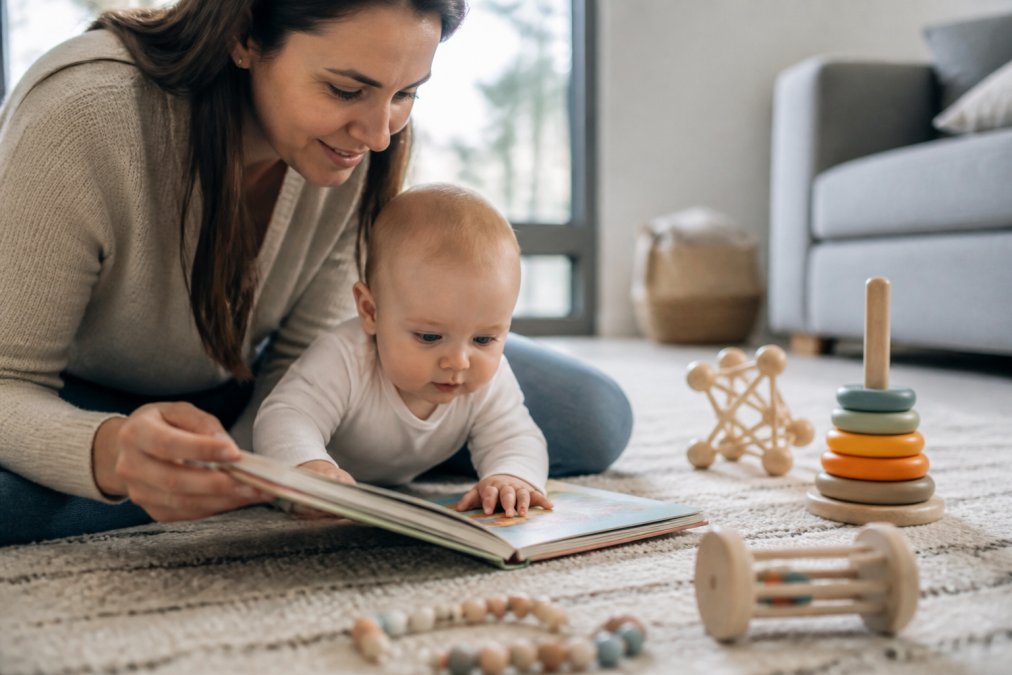
Shared reading is the single most researched early literacy activity and works from day one. A newborn cannot understand the words, but their developing auditory system processes rhythm, pitch variation, and phoneme patterns. According to American Academy of Pediatrics guidance on early literacy, reading aloud to infants from birth supports language acquisition and parent-child bonding.
Read for five minutes a day to start. The topic does not matter; a board book, magazine, or recipe card read aloud gives your baby the auditory stimulation they need.
2. Sing Nursery Rhymes to Build Phonological Awareness
Phonological awareness, the ability to hear, identify, and work with sound units of language, is one of the strongest predictors of later reading success. Nursery rhymes are one of the most effective ways to build it in infancy. The repetitive rhyme and rhythm of songs like "Itsy Bitsy Spider" and "Row Your Boat" train the ear to detect patterns in spoken language. Sing the same songs repeatedly; repetition builds neural pathways.
3. Narrate Your Daily Routine for Vocabulary Development
Vocabulary development happens all day in the running commentary you provide while changing a diaper, making breakfast, or folding laundry. Say what you are doing: "Now I'm putting on your left sock. Left sock. Now the right one." This oral language exposure builds expressive and receptive language simultaneously.
4. Try Sensory Bins and Tactile Books for Hands-On Exploration
Sensory play connects physical experience to language. When a baby touches a rough texture and you say "rough," the word attaches to a real sensation. Tactile books like Pat the Bunny by Dorothy Kunhardt give babies a structured way to explore this connection.
Sensory bins for very young babies can be as simple as a shallow container with dried pasta, smooth river stones, or crinkled fabric squares. Sit with your baby, name every texture they touch, and let them explore.
5. Use High-Contrast Images to Engage Young Infants
Young infants have limited visual acuity. High-contrast images, black-and-white patterns, and bold geometric shapes are easiest for developing eyes to process. Print a set of high-contrast cards, prop them near your baby's play mat, and narrate what you see: "That's a circle. Big circle. Black and white."
6. Practice Interactive Reading with Questions and Pauses
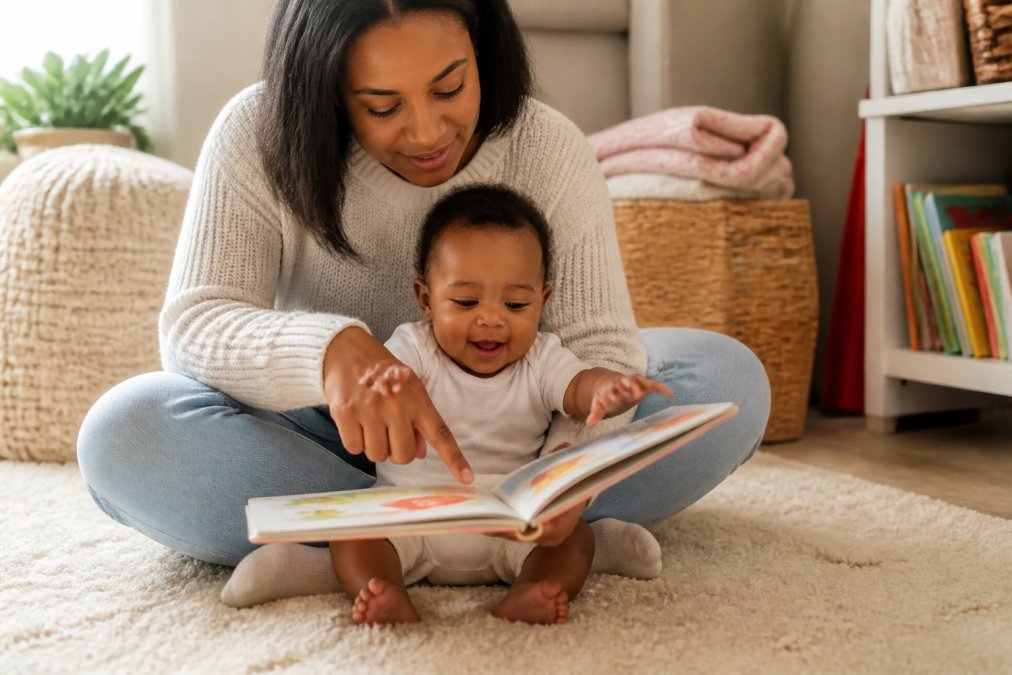
Interactive reading transforms storytime into a conversation. Ask questions your baby cannot yet answer: "Where's the duck? Can you see the duck?" Then pause, point, and answer yourself. The pause is the key ingredient most parents skip. A two-second pause after pointing gives your baby's brain time to process the visual and auditory input together.
7. Introduce Print Awareness Through Labels and Signs
Print awareness is the understanding that written symbols carry meaning. Point to and read labels, signs, and environmental print during your daily routine. Point to the label on the shampoo bottle at bath time. Read the sign on the grocery store aisle. Say "That says 'milk'" when you pass the dairy section. Babies cannot decode these words yet, but they are building the foundational understanding that print is meaningful.
8. Add Baby Sign Language to Support Expressive Language
Baby sign language bridges the gap between what a pre-verbal baby understands and what they can communicate. Most babies can produce simple signs, "more," "milk," "all done", well before they can form words. The Baby Signs Program, developed by child development researchers Dr. Linda Acredolo and Dr. Susan Goodwyn and backed by decades of research including studies supported by the National Institutes of Health, is one of the most established approaches. Use the same sign every time you use the corresponding word, and your baby will make the connection within a few weeks.
9. Raise a Multilingual Reader from Day One
Multilingual literacy is not a complication; it is an advantage. Babies raised in multilingual households develop stronger phonological awareness because they track two or more sound systems simultaneously. The most effective approach is one person, one language: each primary caregiver speaks consistently in one language. Read and sing in both languages. As documented in research from the National Institute of Child Health and Human Development, early multilingual exposure supports broader cognitive development alongside language skills.
10. Build a Literacy-Rich Environment on Any Budget
A literacy-rich environment requires books within reach, print on the walls, and a caregiver who talks, sings, and reads consistently. Budget-friendly options include your local public library's free baby storytime programs and board book lending, high-contrast images printed from free online resources, fabric scraps made into a DIY tactile book, and recycled cardboard packaging into simple alphabet cards.
How to Read to a Baby: Step-by-Step for Total Beginners
Reading to a baby is simpler than most first-time parents expect. The goal is to build the auditory, cognitive, and relational foundations that make reading possible later.
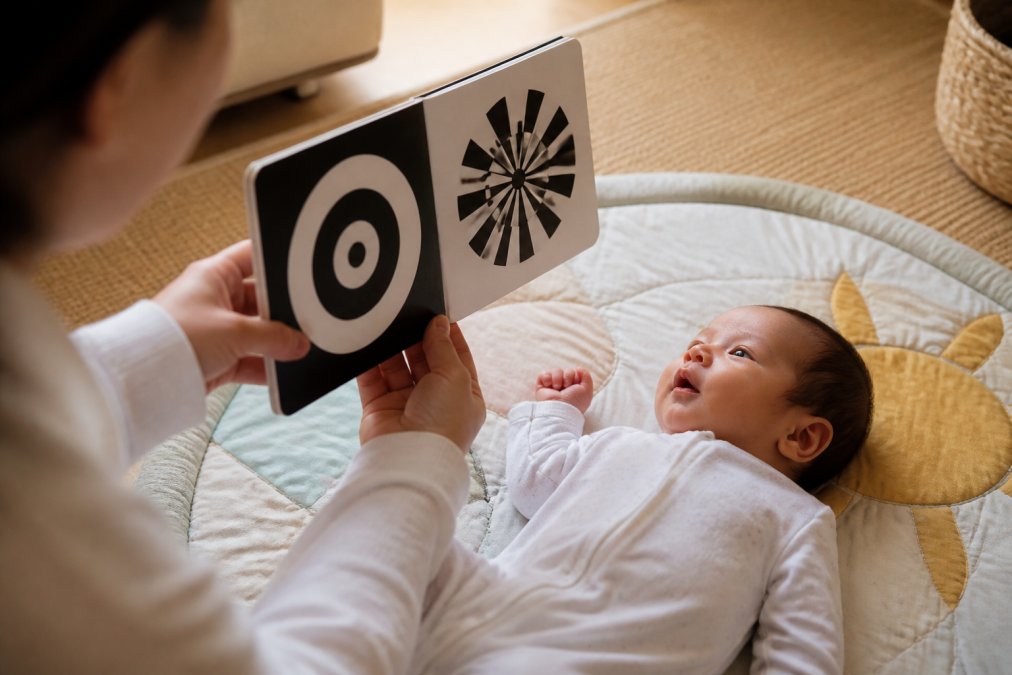
Step 1: Choose the right moment. Pick a time when your baby is alert and calm, not hungry, overstimulated, or ready for sleep. Five to ten minutes is plenty for young infants.
Step 2: Get face-to-face. Position your baby so they can see both the book and your face. For newborns, hold the book about 20-30 centimeters from their eyes. For older babies, seated in your lap works well.
Step 3: Open the book and start talking. You do not have to read the text verbatim. Point at pictures and name them. Make animal sounds. Ask questions. The conversation around the book is as valuable as the text itself.
Step 4: Follow your baby's lead. If your baby loses interest after two pages, stop. If they grab the book and try to chew it, let them; mouthing books is normal book interaction.
Step 5: End warmly. Close the book and say something simple: "We read a book together. Good job." This signals that reading is a positive, completed experience.
Do this daily. Consistency matters more than duration.
Best Books for 0-12 Month Olds: What to Look For
The best books for 0-12 month olds share key characteristics that match infant developmental needs.
| Feature | Why It Matters | Examples |
|---|---|---|
| High-contrast images | Supports limited visual acuity in newborns | Black-and-white board books |
| Tactile elements | Builds fine motor skills and sensory vocabulary | Pat the Bunny, cloth sensory books |
| Simple, repetitive text | Supports phonological awareness and prediction | Nursery rhyme collections |
| Board book format | Survives mouthing and rough handling | Most major publishers offer these |
| Mirrors | Supports facial recognition and self-awareness | Scholastic Shake Look Touch series |
Avoid books with small parts, loose pages, or paper pages for babies under six months. The Scholastic Early Learners: Shake Look Touch, which includes a rattler, teether, and mirror alongside bright, touchable pages, is purpose-built for this age range. The best book for your baby is the one you will actually read together.
Early Literacy Activities for Babies with Neurodivergent Needs
Neurodivergent babies, including those with sensory processing differences, autism spectrum characteristics, or developmental delays, benefit from the same foundational early literacy activities, but delivery often needs adjustment.
The core principle is sensory regulation first. A baby who is overwhelmed cannot process language input effectively. If your baby becomes distressed during storytime, try reading in a quieter space, reducing visual clutter, or switching to a softer voice. Tactile books and sensory bins are often particularly effective for babies with sensory processing differences.
For babies who show limited response to face-to-face reading, try side-by-side positioning instead. Some babies process language better when they are not also managing direct eye contact.
According to CDC guidance on developmental milestones, developmental milestones exist on a range, and early intervention support is available through Early Intervention programs for children under three who show developmental differences. Do not wait for a diagnosis to start. Every early literacy activity is appropriate and beneficial regardless of developmental profile.
Screen Time vs. Digital Literacy: Where Babies Actually Benefit
Screen time and digital literacy are not the same thing. Screen time is passive consumption of content on a screen. Digital literacy is the developing understanding that screens are tools that carry information, a form of print awareness for the digital age.
For babies under 18 months, the American Academy of Pediatrics recommends avoiding screen use other than video chatting. Babies learn language through contingent interaction, exchanges where their response shapes what happens next. Recorded video cannot do this.
Video chatting is the one genuine exception. A grandparent reading a book over video call with a baby who can see and respond to their face delivers real language input because the interaction is live and contingent.
Digital tools add genuine value for parents when they support the parent's practice, not the baby's screen exposure. A parent who uses a digital guide to learn how to narrate, sing, and read more effectively is using technology appropriately. This is exactly the model behind Lauren's Literacy Lounge's Literacy Roots program, equipping parents with the knowledge and confidence to be their child's primary literacy teacher, without adding more screen time to the baby's day.
Early Literacy Activity Summary
| Activity | Best Age Range | Core Skill Targeted |
|---|---|---|
| Read aloud daily | 0-12 months | Language acquisition, shared reading |
| Sing nursery rhymes | 0-12 months | Phonological awareness, rhythm |
| Narrate daily routine | 0-12 months | Vocabulary development, oral language |
| Sensory bins and tactile books | 3-12 months | Fine motor skills, sensory vocabulary |
| High-contrast images | 0-4 months | Visual development, print awareness |
| Interactive reading | 6-12 months | Narrative skills, receptive language |
| Environmental print labels | 6-12 months | Print awareness, alphabet knowledge |
| Baby sign language | 6-12 months | Expressive language, communication |
| Multilingual reading | 0-12 months | Phonemic awareness, cognitive flexibility |
| DIY literacy environment | 0-12 months | Literacy-rich environment, all skills |
Building an early literacy foundation does not require a teaching degree, an expensive curriculum, or hours of structured activity each day. What it requires is consistency, presence, and the confidence to know that your voice, reading, singing, and narrating is doing real developmental work. Lauren's Literacy Lounge's Literacy Roots program is designed to address this uncertainty, giving parents a clear, structured path from birth through the early years so that everyday moments become purposeful literacy practice. Visit laurendaughertyauthor.com to learn more about getting started.
Frequently Asked Questions
At what age should I start literacy activities with my baby?
You can start early literacy activities from birth. Newborns recognize their caregiver's voice immediately after delivery, so reading aloud, singing, and narrating daily routines all count as literacy-building from day one. You do not need to wait until your baby shows interest in books. The earlier you build these habits, the stronger the oral language and vocabulary foundation becomes before formal schooling begins.
What are the 5 basic early literacy skills?
The five foundational pre-literacy skills are: vocabulary (knowing what words mean), print awareness (understanding that print carries meaning), narrative skills (retelling stories and events), phonological awareness (hearing and playing with sounds in words), and alphabet knowledge (recognizing letters and their sounds). All five can be introduced during the first year through shared reading, nursery rhymes, and everyday conversation, long before a child can read independently.
How do daily routines support early literacy development?
Every diaper change, bath, and meal is a language lesson. When you narrate what you are doing, 'Now I'm pulling on your socks, one foot, two feet', you build receptive and expressive language simultaneously. Consistent routines also teach narrative skills because babies begin to anticipate sequences of events, which is the same cognitive structure behind understanding stories. No special materials are needed; your voice is the most effective literacy tool available.
My baby is only 8 months old, is it too early for literacy activities?
Eight months is an ideal time to ramp up early literacy activities for babies. At this stage, infants are actively developing receptive language, reaching for objects, and responding to rhyme and rhythm. Tactile books like Pat the Bunny, simple call-and-response songs, and pointing at pictures while naming them all match this developmental window perfectly. Early engagement at this age supports cognitive development milestones that researchers connect to stronger reading readiness at school age.
Can I support early literacy if we speak more than one language at home?
Yes, and research consistently shows that multilingual environments support rather than delay language acquisition. Reading, singing, and talking to your baby in every language your family uses builds a broader phonemic awareness base. Babies exposed to multiple languages from birth develop stronger auditory discrimination skills. Use books and nursery rhymes in each language, and do not worry about mixing them, code-switching is a normal and healthy part of multilingual literacy development.
This article was written using GrandRanker