 Listicle
Banned Books Week Activities for Classrooms and Libraries
Table of Contents
- Why Banned Books Week Matters in Schools and Libraries
- Interactive Banned Books Week Display Ideas
- Book Tasting Activities for Students
- How to Talk to Students About Book Challenges
- Banned Books Week Research Projects
- Choosing Age-Appropriate Challenged Books by Grade Level
- Virtual and Remote Banned Books Week Engagement
- Inclusive Activities for Neurodivergent Learners
- Frequently Asked Questions
Last Updated: September 30, 2026
Why Banned Books Week Matters in Schools and Libraries
Banned Books Week (October 4-10, 2026) draws attention to ongoing challenges books face in schools and libraries, celebrating the freedom to read while educating students about censorship and intellectual freedom.
Book challenges have accelerated in recent years.
Interactive Banned Books Week Display Ideas
Display ideas create visual impact and spark curiosity. The best displays invite students to engage, not just observe.
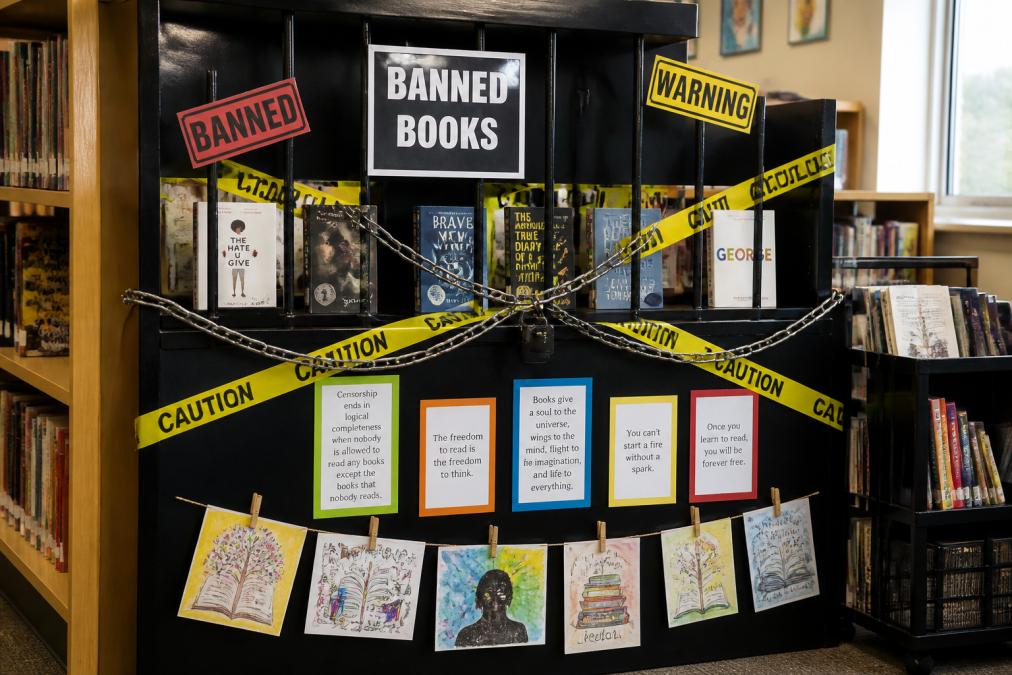
Jailbreak Display Concept
The "jailbreak" display is one of the most popular banned books week activities for classrooms and libraries. Books are arranged behind decorative jail bars or chains with signs explaining why each title was challenged, inviting students to "free" a book by deciding whether they agree with the challenge.
To set this up:
- Create cardboard or PVC pipe "jail bars" in front of a bookshelf
- Print challenge cards for 8-12 frequently challenged titles
- Include the reason each book was challenged and a quote from the author defending their work
- Add a "Free These Books" sign with information about intellectual freedom
- Let students vote on which book they'd most want to "free"
Banned Books Spotlight Wall
A spotlight wall celebrates challenged books as important literature by displaying covers and stories prominently, reframing them from controversial to celebrated.
Design elements that work:
- Large book covers printed and mounted at eye level
- Pull quotes from positive reviews or author statements
- A "Why This Book Was Challenged" card with facts, not opinion
- A "Why This Book Matters" section highlighting themes or representation
- QR codes linking to author interviews or book trailers
- A sticky-note wall where students add their own reasons for reading the book
Book Tasting Activities for Students
A book tasting is an interactive event where students sample multiple books in a short time, similar to a wine tasting. It's one of the most engaging banned books week activities because it removes pressure and invites exploration.
Setting Up Your Book Tasting
Choose 8-12 challenged titles across genres and reading levels. Arrange tables café-style with one book per table, and have students rotate every 3-5 minutes.
Setup steps:
- Select diverse titles (fantasy, contemporary, poetry, graphic novels, nonfiction)
- Arrange tables with one book per table, open to an engaging page
- Place a "tasting card" next to each book with the title, author, and a brief description
- Provide sticky notes for students to leave reactions
- Set a timer so students rotate every 5 minutes
- Play soft background music to create a relaxed atmosphere
Tasting Cards and Reflection Sheets
Create tasting cards with title, author, why the book was challenged (neutral language), an opening excerpt, and a reflection question like "What surprised you about this opening?"
How to Talk to Students About Book Challenges
Discussing why books are challenged requires age-appropriate language and a commitment to helping students form their own opinions rather than accepting adult decisions uncritically.
Age-Appropriate Conversation Starters
For elementary students (K-5):
- "Some grown-ups think this book shouldn't be in the library. What do you think?"
- "The person who challenged this book was worried about [specific concern]. Do you think that's a fair reason to remove it?"
- "Who should decide what books you're allowed to read?"
For middle school students (6-8):
- "This book was challenged because it includes [topic]. How do you feel about that reason?"
- "If you were a librarian, would you remove this book? Why or why not?"
- "What's the difference between a book being inappropriate for you personally and a book being inappropriate for everyone?"
For high school students (9-12):
- "What responsibility do schools have to protect students, and what responsibility do they have to expose students to diverse ideas?"
- "How do book challenges relate to broader questions about free speech and censorship?"
- "When is it appropriate for adults to restrict access to information, and when does that cross a line?"
Facilitating Respectful Debate
Guidelines: separate the book from the person, focus on reasons not judgments, acknowledge legitimate concerns, distinguish between personal preference and censorship, and document the discussion so students summarize arguments they heard.
Banned Books Week Research Projects
Research projects deepen student understanding of censorship history and current challenges while developing information literacy skills.
Censorship Timeline Investigation
Students research the history of book challenges and censorship in America, creating a timeline that spans from early American history to 2026.
Project structure:
- Assign students 3-4 decades or significant historical periods
- Have them research major book challenges or censorship events from that period
- Students identify the book, the reason it was challenged, and the outcome
- Create a class timeline showing patterns: Which decades had the most challenges? Which types of books were most frequently targeted? How have reasons for challenges changed?
Author Interview and Advocacy Project
Students select an author of a challenged book and research how that author has responded to censorship, then create an interview asking about their work and thoughts on challenges.
Choosing Age-Appropriate Challenged Books by Grade Level
Selecting the right books for your banned books week activities ensures students engage meaningfully without encountering content that's genuinely inappropriate for their developmental stage.
Elementary School Selections (K-5)
Frequently challenged elementary titles include:
- Books featuring LGBTQ+ families or characters (challenged for "promoting" non-traditional families)
- Books with characters of color in lead roles (challenged for "reverse racism" concerns)
- Books addressing mental health, grief, or difficult emotions
- Fairy tales with darker elements or non-traditional endings
For banned books week activities, choose titles students can understand independently but that spark conversations about why adults might object.
Middle School Selections (6-8)
Middle school frequently challenged titles include young adult novels addressing identity and mental health, graphic novels with social commentary, and books featuring realistic violence or substance use.
High School Selections (9-12)
High school students can engage with frequently challenged classics like "The Handmaid's Tale," "1984," and "Beloved," as well as contemporary YA novels addressing sexuality, violence, and systemic injustice.
Virtual and Remote Banned Books Week Engagement
Virtual book tastings work through video calls where students share a selected book for 2-3 minutes, explaining why they chose it and what surprised them.
Inclusive Activities for Neurodivergent Learners
Neurodivergent students, including those with ADHD, autism, dyslexia, and processing differences, benefit from banned books week activities designed with sensory and cognitive accessibility in mind.
Frequently Asked Questions
What are some fun classroom activities for Banned Books Week?
Banned Books Week activities range from interactive to academic. Book tastings let students sample different challenged titles and discuss their reactions. Interactive displays with 'jailbreak' themes make censorship visible and engaging. Research projects asking students to investigate why specific books were challenged develop critical thinking. Discussion circles focused on intellectual freedom help students understand the First Amendment. Scavenger hunts, social media campaigns, and student-led book clubs also work well across grade levels.
How can I explain the importance of Banned Books Week to students?
Frame Banned Books Week around the concept of intellectual freedom and diverse perspectives. Explain that books get challenged when adults disagree with content, but that reading different viewpoints helps us think for ourselves. Use real examples: ask students why they think certain books might be controversial, then discuss what readers miss when books are removed from shelves. Connect it to the First Amendment and students' own right to make choices about what they read. This approach makes the concept concrete rather than abstract.
What are the most frequently challenged books in school libraries?
Frequently challenged books include titles like 'The Handmaid's Tale,' 'To Kill a Mockingbird,' 'The Bluest Eye,' 'Gender Queer,' and graphic novels like 'Maus.' Challenges often focus on language, sexual content, or discussions of race and identity. Current data from organizations tracking censorship shows that books addressing LGBTQ+ themes and books by authors of color face increasing challenges. When selecting books for Banned Books Week activities, these frequently challenged titles create powerful teaching moments because students can understand real reasons behind the challenges.
How do I choose age-appropriate challenged books for my students?
Start by identifying which books were challenged for reasons relevant to your curriculum and age group. Elementary students benefit from picture books and chapter books challenged for themes like family diversity or mild language. Middle schoolers can handle young adult novels addressing identity and social issues. High schoolers can engage with complex texts challenged for mature themes. Review the specific reasons each book was challenged, then decide whether that content fits your learning goals. Use reading level and maturity of themes, not just the challenge reason, to guide selection.
What is the theme for Banned Books Week in 2026?
Banned Books Week in 2026 runs October 4-10. While specific theme announcements come from the American Library Association closer to the event, the overarching focus remains celebrating the freedom to read and raising awareness about censorship. Check the official Banned Books Week website (bannedbooksweek.org) in late summer 2026 for the official theme, promotional materials, and activity kits. The ALA provides free downloadable posters, bookmarks, and educational guides each year to support your planning.