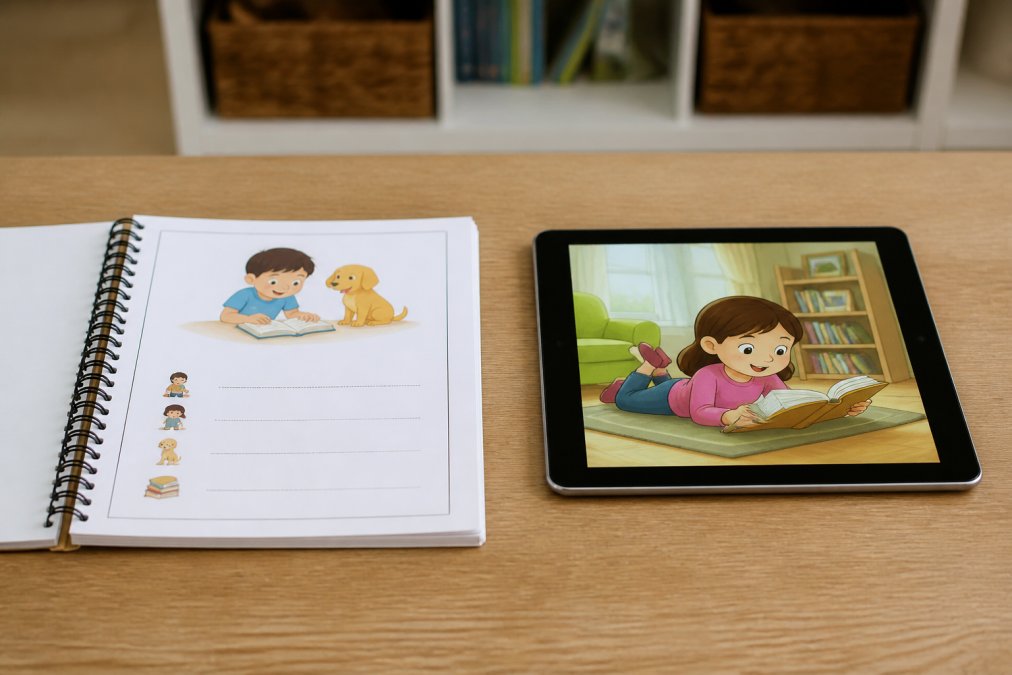
 Comparison
Workbooks vs Digital Apps for Reading Instruction
Table of Contents
- Workbooks vs Digital Apps for Reading Instruction: A Quick Comparison
- What the Science of Reading for Parents Actually Says
- The Benefits of Handwriting for Literacy Development
- Screen Time Guidelines for Early Learners Using Digital Reading Apps
- Comparing Features and Pricing of Workbooks and Digital Apps
- How to Choose the Right Reading Instruction Approach for Your Child
- Building a Hybrid Reading Instruction Framework for Home Use
- Frequently Asked Questions
Last Updated: September 25, 2026
Workbooks vs Digital Apps for Reading Instruction: A Quick Comparison
Choosing between workbooks and digital apps for reading instruction is one of the first real decisions parents face when teaching a child to read. At Lauren's Literacy Lounge, we see families wrestle with this constantly, and the honest answer is that neither format wins outright. Workbooks build handwriting and focus; apps build engagement and instant feedback. This comparison breaks down what actually matters: the science, the screen time trade-offs, the costs, and how to combine both.
What the Science of Reading for Parents Actually Says
The science of reading for parents is simpler than the academic version: children need systematic phonics, phonemic awareness, fluency practice, and comprehension work, delivered consistently. Reading instruction that skips foundational skills and jumps to sight words tends to produce struggling readers later.
The Benefits of Handwriting for Literacy Development
The benefits of handwriting for literacy go beyond neat penmanship. Forming letters by hand activates memory pathways that typing and tapping do not, which helps children lock in letter-sound connections and build decoding and fluency over time.

- Fine motor control develops through pencil grip and letter tracing
- Active recall strengthens when a child writes a word from memory
- No notifications, no autoplay, no cognitive load from a digital interface
- Progress is visible on paper, which motivates young children
Screen Time Guidelines for Early Learners Using Digital Reading Apps
Screen time guidelines for early learners should focus on quality, not just minutes. The American Academy of Pediatrics recommends prioritizing interactive, co-viewed content over passive video, especially for children under five. A phonics app used with a parent counts differently than autoplay cartoons.
For reading apps specifically, watch for three things:
- Does the app require your child to respond, or just watch?
- Does it teach decoding, or only drill sight words?
- Can you see a progress report that shows skill mastery?
Comparing Features and Pricing of Workbooks and Digital Apps
| Option | Format | Starting Price | Best For |
|---|---|---|---|
| Evan-Moor Workbooks | Print only | $15.99 per workbook | Handwriting, screen-free practice |
| Hooked on Phonics | Hybrid app + print | $1 first month, then subscription | Balanced multisensory learning |
| ABCmouse | Fully digital | $12.99/month | Game-driven engagement |
| Reading Eggs | Digital + printables | $99.99/year | Self-paced adaptive lessons |
| Lauren's Literacy Lounge | Parent-led program | See website for current pricing | Parents as first teachers |
The trade-off is honest: it asks more of you than pressing play on an app. That involvement is the point.
How to Choose the Right Reading Instruction Approach for Your Child
Choosing the right approach comes down to matching the medium to your child's attention span, working memory, and error-correction needs, not to price or brand. The format is a delivery vehicle; the instruction inside it is what moves the needle.
Start by answering four questions about your child, honestly:
- How long can they sustain focused effort before frustration? Under five minutes points to short app bursts; ten to fifteen minutes supports a workbook page.
- Do they self-correct, or do they need immediate feedback? A child who guesses at words benefits from an app that flags the error in the moment. A child who already self-monitors can work independently in print.
- Do they need to move to learn? If sitting still is the battle, a workbook session becomes a discipline exercise instead of a reading lesson.
- How does your child respond to a visible record of progress? Some children are motivated by a filled page; others need a streak counter or a level-up sound.
- Under 3: Prioritize talking, singing, and board books. Apps add little here, and the American Academy of Pediatrics recommends avoiding solo screen media for this age group except for video chatting.
- Ages 3-4: Introduce letter tracing and short phonics games. Keep sessions under 15 minutes and stay within arm's reach.
- Ages 5-6: Add structured phonics work in a workbook plus a decoding app for practice. This is the age where the blend pays off most, because handwriting consolidates letter-sound mapping while the app supplies repetition without you having to drill.
- Ages 7+ still struggling: Lean on explicit, sequential phonics with more repetition, in print first. A common pattern is that a struggling reader has been given sight-word apps that never taught decoding; the fix is going back to sound-by-sound blending on paper before returning to screens.
Neurodivergent learners: the decision most guides skip
For children with ADHD or dyslexia, the workbook-versus-app question has a different answer than the generic advice suggests.
Building a Hybrid Reading Instruction Framework for Home Use
A hybrid framework uses both formats on purpose, assigning each one the job it does best. Print handles writing, decoding practice, and sustained focus. Digital handles engagement, instant feedback, and spaced review. The goal is not a 50/50 split, it is the right tool for each specific task.
The three jobs, and which medium does each
| Job | Best medium | Why |
|---|---|---|
| Introduce a new sound | Print, with you | You can watch the mouth, correct in the moment, and slow down |
| Drill for automaticity | App | Repetition without your fatigue, immediate feedback |
| Apply to real reading | Decodable text on paper removes the temptation to tap for hints | |
| Review last week's sounds | App | Spaced review is easy to schedule and track |
| Build handwriting and spelling | Motor memory consolidates letter-sound mapping |
A four-week starting schedule
This is a starting point, not a permanent structure. Adjust the balance as your child's needs shift.
Week 1, Establish the print habit.
- Monday: 10 minutes handwriting and letter tracing in a workbook
- Tuesday: 10 minutes workbook decoding practice, you sitting beside your child
- Wednesday: Read aloud together, then write two new words
- Thursday: 10 minutes workbook decoding practice
- Friday: Review the week's sounds with a game or app
- Weekend: Library visit or read-aloud, no formal lesson
Week 2, Add the app for drill only.
- Keep the print sessions from Week 1.
- Insert a 10-minute app session on Tuesday and Thursday, focused only on the sounds introduced that week.
- Do not let the app introduce new material yet. Its job this week is repetition, not instruction.
Week 3, Let the app carry review.
- Reduce workbook decoding practice to two days.
- Add a third app session on Saturday for spaced review of Weeks 1-2 sounds.
- Keep handwriting every weekday. This is the piece most families drop first and the one that pays off most.
Week 4, Assess and rebalance.
- Check whether your child can read the month's target sounds without help in a decodable passage on paper.
- If yes: shift more drill to the app and use print time for comprehension and writing.
- If no: return to Week 1's print-heavy structure for two more weeks before reintroducing app-led review.
The one metric that matters
Track one thing only: whether your child can read the week's target sounds without help, in print, without a picture cue. That single measure tells you more than any app dashboard, because it tests transfer, the ability to use the skill outside the format that taught it.
When to shift the balance
- Toward print: if your child guesses at words, skips endings, or reads fast and wrong. These are signs the app's pace is outrunning their decoding.
- Toward the app: if your child can decode accurately but slowly, or if your own patience is the bottleneck. Drill is the app's strength; save your energy for instruction and read-alouds.
- Toward neither: if sessions have become a fight. A two-week break from formal instruction, with read-alouds only, resets the relationship with reading better than pushing through.
Frequently Asked Questions
Do children learn to read better with physical workbooks or digital apps?
Neither format is universally superior. Research on reading instruction shows that the method matters more than the medium. Systematic phonics teaching, whether delivered through a workbook or an app, produces stronger outcomes than non-systematic approaches. Workbooks support fine motor skills and deep reading, while digital apps offer adaptive pacing and high engagement. Many families find a hybrid approach works best, using apps for practice and workbooks for handwriting and comprehension.
What are the benefits of using workbooks for phonics instruction?
Workbooks provide tactile learning and reinforce phonemic awareness through writing. The benefits of handwriting for literacy include stronger letter recognition and spelling retention. Physical workbooks also eliminate screen time concerns and allow children to work at their own pace without digital distractions. For beginning readers, tracing letters and writing words by hand builds a muscle memory that supports decoding and fluency.
How much screen time is appropriate for early literacy development?
The American Academy of Pediatrics recommends limiting screen time for children ages 2 to 5 to one hour per day of high-quality programming. For early learners, screen time guidelines should prioritize interactive, educational content over passive video. Digital reading apps that require active recall and decoding count as quality screen time, but they should not replace hands-on activities like reading print books and handwriting practice.
Can digital reading apps replace traditional reading instruction?
Digital apps can supplement but rarely replace comprehensive reading instruction. While apps excel at gamification and adaptive practice, they often lack the depth of print-based instruction for building cognitive patience and deep reading. A balanced approach that includes workbooks, read-alouds, and limited app use aligns with the science of reading for parents and supports long-term retention.
How do I combine workbooks and apps for a balanced literacy approach?
Start with a structured phonics workbook for 10 to 15 minutes daily to build handwriting and decoding skills. Then use a digital app for 15 to 20 minutes as a supplemental resource for engagement and practice. Choose apps that align with the same phonics sequence as your workbook. This blended learning model keeps screen time in check while leveraging the strengths of both mediums for skill mastery.