 Comparison
Phonics vs Whole Language for Early Readers: 2026 Guide
Table of Contents
- Phonics vs Whole Language: The Core Comparison
- Science of Reading vs Balanced Literacy: What the Research Shows
- How to Teach Phonics at Home: A Practical Walkthrough
- Sight Words vs Decodable Books: Which Comes First?
- Programs That Blend Both Approaches
- Supporting Neurodiverse Readers and Digital Literacy
- Conclusion
- Frequently Asked Questions
Last Updated: September 26, 2026
Phonics vs Whole Language: The Core Comparison
The phonics vs whole language for early readers debate has divided classrooms for decades, and the stakes are real: how a child first learns to read shapes everything that follows. The truth is simpler than the headlines suggest.
How Each Method Approaches Reading
The two methods start from opposite ends of the same problem. Phonics begins with the code, while whole language begins with meaning.
- Phonics: Teaches letter-sound correspondence first, then blends sounds into words. Children practice decoding with phonemes and graphemes before encountering irregular text.
- Whole language: Surrounds children with rich literature, predictable text, and context clues. The theory holds that reading comprehension develops naturally when children are motivated by real stories.
- Sight words: Whole language leans heavily on memorizing high-frequency words by sight. Phonics treats sight word recognition as the result of repeated decoding, not memorization.
Science of Reading vs Balanced Literacy: What the Research Shows
The science of reading is not a single study or a branded curriculum. It is a converging body of cognitive, linguistic, and educational research on how the human brain learns to read, and it consistently points to explicit, systematic instruction in phonemic awareness and phonics as the strongest lever for early literacy.
The Frameworks Researchers Actually Use
Three models show up again and again in the reading research, and knowing them makes the debate far less abstract:
- The Simple View of Reading holds that reading comprehension is the product of two separate skills: decoding (word recognition) and language comprehension. If either factor is near zero, comprehension collapses, which is why a child who can decode but doesn't understand, and a child who understands but can't decode, both struggle for different reasons.
- Scarborough's Reading Rope visualizes skilled reading as interwoven strands: phonological awareness, decoding, and sight recognition on the word-recognition side; background knowledge, vocabulary, language structures, verbal reasoning, and literacy knowledge on the language-comprehension side. Instruction that pulls only one strand leaves the rope weak.
- The National Reading Panel (convened by Congress and reporting in 2000) reviewed thousands of studies and identified five essential components of reading instruction: phonemic awareness, phonics, fluency, vocabulary, and comprehension. That report is the reason most states now mandate systematic phonics in early grades.
What 'Systematic' Actually Means
A common confusion is treating any phonics worksheet as 'science of reading aligned.' The research distinguishes between:
- Systematic phonics: a defined scope and sequence, short vowels before long vowels, consonant blends before digraphs, with cumulative review.
- Incidental phonics: sounds taught as they come up in a story, with no guaranteed coverage.
- Analytic phonics: starting from whole words and breaking them down.
- Synthetic phonics: starting from individual sounds and building up.
Orthographic Mapping: The Mechanism Behind Fluency
Brain research on reading acquisition shows that skilled readers rely on orthographic mapping, the process of connecting a word's letters, sounds, and meaning so tightly that the word becomes instantly recognizable, or 'sight.' This is not the same as memorizing a shape. It requires phoneme-grapheme knowledge, which is why explicit teaching beats exposure alone. A child who has mapped thousands of words reads fluently; a child who has only memorized a few hundred sight words hits a wall around second grade.
How to Teach Phonics at Home: A Practical Walkthrough
Teaching phonics at home takes 10 to 15 minutes a day, not a curriculum overhaul. A parent and child at the kitchen table, letter cards spread out, is enough to build real decoding skill.
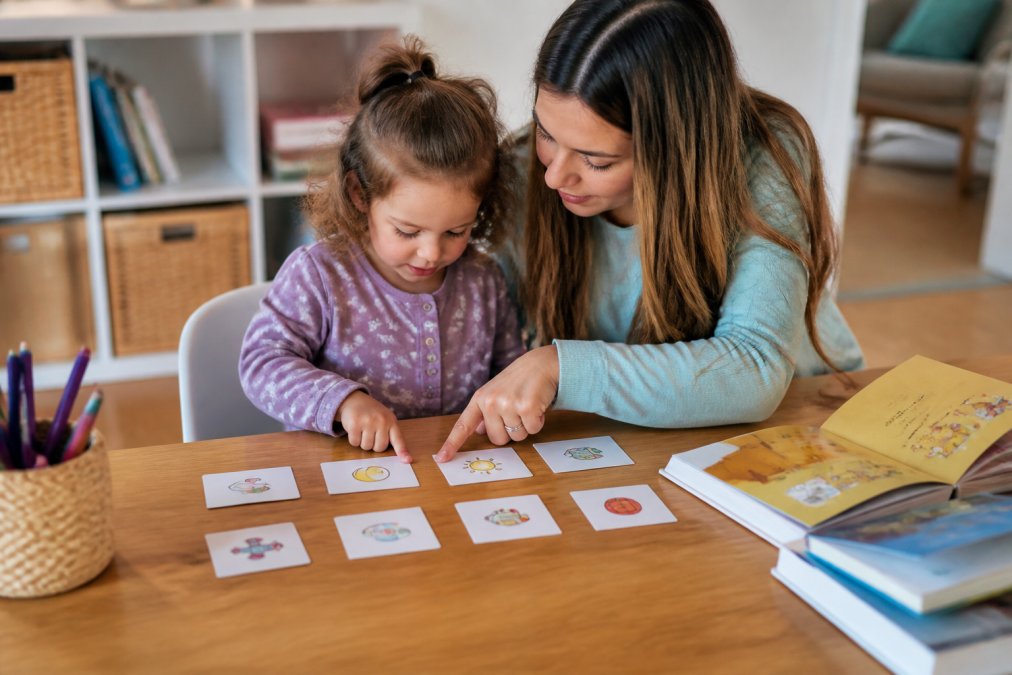
Here's a simple sequence that works:
- Start with sounds, not letters. Play with phonemes: "What sound does /m/ make?" before showing the letter M.
- Introduce letter-sound correspondence slowly. Two or three new sounds per week is plenty.
- Blend and decode. Build simple words with letter tiles: m-a-t, s-u-n, p-i-g.
- Practice daily, briefly. Short sessions beat long ones. Ten focused minutes beats a tired half hour.
- Add decodable books. These use only the sounds your child has learned, so decoding succeeds instead of frustrating.
Sight Words vs Decodable Books: Which Comes First?
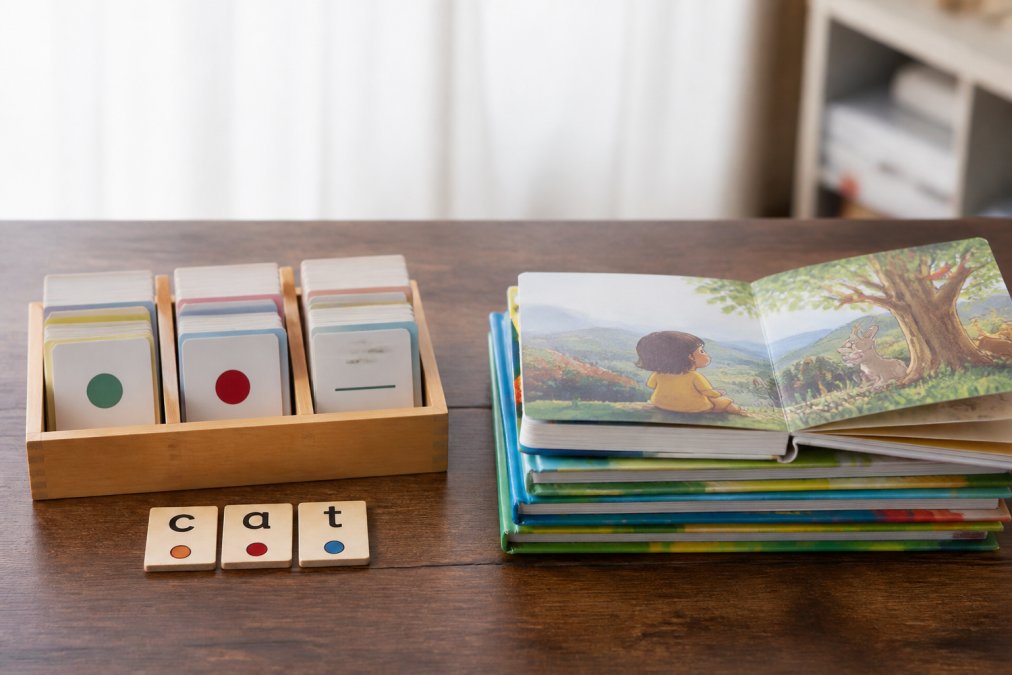
Decodable books should come first for most beginning readers, with sight words layered in gradually. Decodable texts reinforce the letter-sound patterns a child is learning, while sight words handle the irregular high-frequency words that don't follow the rules.
- Decodable books: Build confidence and reinforce phonics patterns. Best for the first year of reading instruction.
- Sight words: Cover words like "the," "said," and "was" that break phonetic rules. Introduce a few at a time.
- Both together: The strongest approach. Decoding builds the skill; sight words build fluency.
Programs That Blend Both Approaches
The best early reading programs don't pick a side; they sequence phonics instruction and meaning-based reading together. Several well-known options show how this works in practice.
| Program | Approach | Format | Best For |
|---|---|---|---|
| Lauren's Literacy Lounge | Parent-led, birth-to-early-reading framework | Guide-based, home use | Parents building literacy routines from infancy |
| Lexia Core5 Reading | Systematic, explicit phonics | Adaptive digital platform | Schools and districts |
| Explode The Code | Sequential phonics practice | Print workbooks | Home phonics supplement |
| Reading Eggs | Phonics plus digital story library | Subscription app | Engaging hybrid practice |
| All About Reading | Multisensory, mastery-based phonics | Scripted curriculum | Homeschooling and dyslexia support |
Supporting Neurodiverse Readers and Digital Literacy
Children with dyslexia and other reading differences benefit most from explicit, multisensory phonics instruction delivered at their own pace. This is where the phonics vs whole language debate stops being academic: for neurodiverse readers, systematic phonics isn't one option among many, it's often the difference between reading and giving up.
Why Dyslexia Changes the Equation
Dyslexia is a neurobiological difference that affects phonological processing, the ability to hear, manipulate, and map sounds to letters. It is not a vision problem and not a motivation problem. Because whole language depends on a child inferring the code from exposure, it tends to leave dyslexic readers guessing, memorizing, and eventually avoiding text. Explicit phonics gives them the code directly, in a sequence their brain can absorb.
What Multisensory Instruction Looks Like
'Multisensory' is a buzzword until you see it in action. In practice, an Orton-Gillingham-based lesson typically includes:
- Visual: letter cards, color-coded vowels, word-building tiles.
- Auditory: saying each sound aloud, blending sounds into words.
- Kinesthetic: tracing letters in sand, shaving cream, or on a textured surface while saying the sound.
- Tactile: tapping out phonemes with fingers or chips before writing them.
Early Warning Signs Worth Acting On
A common pattern parents notice: a child who speaks well but struggles to rhyme, can't blend /c/-/a/-/t/ into 'cat,' confuses similar letters past age seven, or guesses wildly at words based on the first letter. Any of these is a reason to ask for a structured literacy assessment rather than wait for a 'reading readiness' phase that may never arrive.
How Digital Tools Bridge the Two Camps
Digital literacy adds a second layer, and it's the part most articles skip. Modern ed-tech tools increasingly blend phonics practice with whole-language-style exposure to real text:
- Adaptive phonics apps adjust the sequence based on error patterns, so a child who keeps confusing b and d gets more of those, something a worksheet can't do.
- Speech-recognition readers listen to a child read aloud and flag miscues in real time, mimicking the role of a teacher's ear.
- Digital libraries with audio support let a child hear a story while following the words, combining meaning and code in one activity.
- Progress dashboards give parents and teachers data on which phonemes are solid and which aren't, the kind of feedback that used to require a reading specialist.
When School Keeps Changing
For families who move often, a consistent home routine matters even more, since the school, teacher, and reading curriculum may change every year or two. A parent-led program keeps instruction steady no matter the zip code, and for a neurodiverse reader, that continuity is often the single most important variable.
Conclusion
The phonics vs whole language for early readers debate has a practical answer: teach phonics explicitly, and surround your child with real books. That combination builds decoding skill and reading comprehension together.
Get started with Lauren's Literacy Lounge.
Frequently Asked Questions
Which is better, phonics or whole language?
Decades of reading research, including the findings of the National Reading Panel in 2000, point to systematic phonics as the stronger foundation for early readers. Phonics teaches children how letters map to sounds, which supports decoding and spelling. Whole language builds comprehension and a love of stories, but it assumes children absorb word recognition naturally. Most effective classrooms now combine explicit phonics with rich reading experiences, so the two methods are not mutually exclusive.
Is balanced literacy the same as whole language?
They overlap but are not identical. Whole language rejects explicit phonics instruction in favor of immersion in real texts. Balanced literacy, popularized in the 1990s, includes some phonics but often embeds it in context rather than teaching it systematically. The science of reading vs balanced literacy debate centers on this distinction: balanced literacy offers phonics as one part of a broader approach, while science of reading advocates argue that phonemic awareness, decoding, and orthographic mapping need explicit, sequential instruction to work for most children.
How can parents support phonics instruction at home?
Start with phonemic awareness games, such as clapping syllables or identifying the first sound in a word. Then introduce letter-sound correspondence using a systematic sequence, not alphabet order. Practice blending sounds into words daily in short sessions. Pair this with decodable books that match the phonics rules your child has learned. Programs like All About Reading or Explode The Code provide scripted lessons if you want structure. Keep sessions brief and consistent, and follow your child's pace.
What is the most effective method for teaching reading?
The evidence favors explicit, systematic phonics instruction paired with activities that build vocabulary and comprehension. The National Reading Panel identified phonemic awareness, phonics, fluency, vocabulary, and comprehension as the five pillars of reading instruction. Effective programs teach letter-sound correspondence directly, provide decodable texts for practice, and read aloud to children daily. No single method works for every child, but approaches grounded in the science of reading consistently outperform those that rely on context clues or whole word recognition alone.
What is the 'Science of Reading' and how does it relate to phonics?
The science of reading is a body of research from cognitive science, neuroscience, and education that explains how children learn to read. It confirms that skilled reading depends on phonemic awareness, phonics, fluency, vocabulary, and comprehension. Phonics is one essential component because it builds the decoding skills that lead to orthographic mapping, the process by which words become instantly recognizable. Programs aligned with the science of reading use explicit teaching and systematic instruction rather than relying on guessing from pictures or context.