 Comparison
Is Early Reading Program Worth It? A Parent's Guide
Table of Contents
- When Early Reading Programs Actually Deliver Results
- Best Reading Programs for Toddlers: What Sets Them Apart
- Signs of Reading Readiness in Children: Do You Actually Need a Program?
- How to Teach a Child to Read at Home Without Expensive Programs
- The Hidden Cost of Early Reading Programs: Burnout and Overwhelm
- Neurodiversity and Reading Programs: One Size Does Not Fit All
- Making the Decision: Cost-Benefit Analysis for Your Family
- Frequently Asked Questions
Last Updated: September 2, 2026
When Early Reading Programs Actually Deliver Results
The question isn't whether your child can learn to read early. The question is whether a structured early reading program is worth your time, money, and emotional energy. At Lauren's Literacy Lounge, we help parents wrestling with this exact decision, and the answer depends entirely on your child, your situation, and what you're actually trying to accomplish.
Early literacy development matters. Research shows that children who develop strong foundational literacy skills in the preschool years tend to maintain reading advantages through elementary school (peer-reviewed research). But "matters" doesn't mean "requires a paid program." Many families successfully build literacy skills through free resources, everyday conversations, and shared reading without ever opening a subscription app.
Best Reading Programs for Toddlers: What Sets Them Apart
When evaluating an early reading program, you're choosing between structured, multi-sensory learning with physical materials versus gamified, screen-based personalized pathways. Both work for some children; both frustrate others. The programs that gain traction excel at combining digital lessons with tangible practice materials or using adaptive algorithms to personalize the learning journey.
Hooked on Phonics: Structured Phonics with Physical Materials
Hooked on Phonics pairs interactive app lessons with physical workbooks and storybooks, creating a multisensory learning environment. The structure is explicit and sequential: children learn individual letter sounds, blend them into words, then read simple sentences. This synthetic phonics approach aligns with how phonemic awareness develops in young brains (the NIH). The program includes motivational elements like stickers and certificates for ages 3-8.
Best for: Children who need concrete, hands-on practice alongside digital lessons. Families who want a clearly defined phonics curriculum without overwhelming choice.
Pros:
- Combines app-based lessons with physical practice materials
- Structured, step-by-step phonics progression
- Motivational elements keep younger children invested
Cons:
- Physical practice packs incur additional shipping costs
- Focuses primarily on phonics; you'll need supplementary materials for vocabulary, comprehension, and fluency
Reading Eggs: Gamified Learning for Ages 2-13
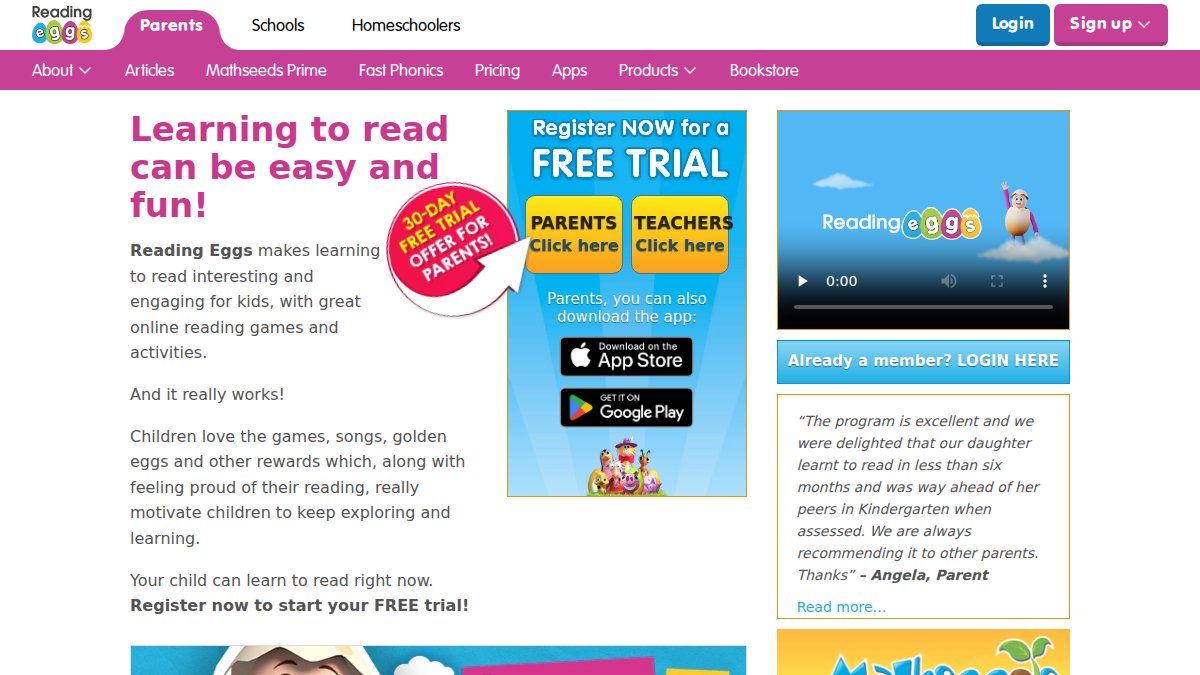
Reading Eggs uses game mechanics, virtual pets, and golden eggs to maintain motivation across hundreds of lessons. Each child takes a diagnostic test, then follows a personalized learning path. The program includes access to over 4,000 books in an online library, allowing children to practice decoding skills on actual stories rather than isolated word lists.
Best for: Children who respond well to game-based learning and parents seeking a comprehensive reading curriculum.
Pros:
- Highly engaging gamified format maintains motivation
- Personalized learning paths adapt to each child's pace
- Extensive digital book library provides authentic reading practice
- 30-day free trial available
Cons:
- No human tutor element; entirely self-paced digital learning
- Annual plans offer better pricing but require larger upfront commitment
ABCmouse Early Learning Academy: Comprehensive Subject Coverage
ABCmouse provides a broad early learning curriculum covering reading, math, science, social studies, and art through over 13,000 activities. The reading component uses interactive games, animated videos, and digital books. The program supports multiple children per subscription and maintains personalized learning paths in an ad-free, safe environment.
Best for: Parents wanting a holistic early learning platform beyond reading. Families with multiple young children.
Pros:
- Extensive activity library reduces repetition and boredom
- Covers multiple subjects for well-rounded early learning
- Safe, ad-free environment designed for young children
- 30-day free trial available
Cons:
- Monthly pricing is higher than some competitors
- Some annual subscriptions renew at higher rates after the first year
HOMER Learn & Grow: Personalized Learning Paths
HOMER learns your child's age, interests, and learning pace, then builds a unique learning journey that evolves as your child progresses. The program includes games, lessons, and offline printable activities covering reading, math, creativity, and social-emotional skills. It emphasizes fostering a genuine love of reading rather than just drilling phonics.
Best for: Young children (ages 2-8) who benefit from interest-driven, personalized learning that balances literacy with creativity.
Pros:
- Personalized learning journeys match children's interests
- Broader focus on creativity and critical thinking alongside literacy
- Generous free trial (30-60 days)
- Lowest starting price among major competitors
Cons:
- Vast number of games and videos can feel overwhelming to monitor
- Annual subscriptions require yearly commitment
| Program | Starting Price | Best For | Key Differentiator |
|---|---|---|---|
| Hooked on Phonics | $14.99/month | Structured phonics with physical materials | Combines app + workbooks |
| Reading Eggs | $13.99/month | Game-based learning ages 2-13 | Gamified motivation + 4,000 books |
| ABCmouse | $14.99/month | Comprehensive early learning | 13,000+ activities across subjects |
| HOMER Learn & Grow | $7.99/month | Interest-driven personalization | Personalized journeys + creativity focus |
Signs of Reading Readiness in Children: Do You Actually Need a Program?
Before committing to any program, ask whether your child is actually ready to benefit from structured reading instruction. Reading readiness isn't about age, it's about developmental signs.
Signs of readiness include: sustained attention to stories (sitting through a 10-minute picture book), ability to rhyme or notice similar sounds, recognition of some letters, interest in how words work, and emerging phonemic awareness (clapping syllables, identifying words that start with the same sound) (the CDC).

If your child shows most of these signs and is genuinely interested in reading, a structured program can accelerate progress. If your child is 2 years old, shows little interest in books, and can't sit still for five minutes, a paid reading program is premature.
Many children benefit from simply reading aloud together daily and letting curiosity drive exploration. This costs nothing and often works better than programs designed for children who aren't ready.
How to Teach a Child to Read at Home Without Expensive Programs
If your child shows reading readiness but you're not ready to commit to a subscription, you have powerful free tools available.
Start with shared reading as your foundation. Read aloud daily, let your child choose books, point to words as you read, and ask questions about the story. This builds vocabulary, phonemic awareness, and positive associations with reading.
Add explicit phonemic awareness activities into everyday moments: clap syllables in family members' names, play rhyming games, notice words that start with the same sound during walks or meals. These activities take five minutes and cost nothing.
Once your child shows interest in letters, introduce letter-sound relationships through play: magnetic letters on the refrigerator, alphabet blocks, or writing letters together in sand. When your child asks "what letter is that?" answer it and celebrate their curiosity.

Use free resources strategically. Reading Rockets offers evidence-based literacy activities. Reach Out and Read provides book recommendations and parent guidance. Your local library offers free story times, book lending, and literacy resources.
The biggest advantage you have as a parent is consistency and responsiveness. You know your child and can adjust your approach based on their interests, celebrate small wins, and take breaks when frustrated.
The Hidden Cost of Early Reading Programs: Burnout and Overwhelm
Many parents buy a program with enthusiasm, commit to daily practice, then hit a wall around week three. The child resists. The parent feels guilty. The program becomes another source of friction. This happens because programs assume consistent daily use, but family life isn't consistent.
There's also the screen time concern. Most popular reading programs are digital. If you're already managing screen time, adding another educational app can feel like choosing between literacy and healthy development. The cognitive load of managing one more subscription, login, and app notification adds up quickly.
The programs that work best fit your family's actual rhythm, not the rhythm the program assumes. Before buying, ask: Can we realistically commit to this most days of the week? Will this add stress or ease? Is my child actually ready, or am I trying to force readiness?
Neurodiversity and Reading Programs: One Size Does Not Fit All
Children with ADHD, autism spectrum differences, dyslexia, or other neurodevelopmental variations often struggle with the standard approach these programs use. A child with ADHD might find gamified motivation helpful but struggle with sustained focus for phonics drills. A child with autism might excel at pattern recognition but find social-emotional learning elements confusing. A child with dyslexia might need multisensory, structured phonics but find the pace too fast or too slow.
Programs offering flexibility, adjustable pacing, customizable difficulty, and support for different learning modalities, work best for neurodivergent children. But if your child has identified or suspected neurodivergence, working with a literacy specialist, speech-language pathologist, or educational psychologist often yields better results than any commercial program.
Making the Decision: Cost-Benefit Analysis for Your Family
The decision to invest in an early reading program should be practical, not emotional.
First, define what you're actually trying to achieve: accelerate reading skills, build confidence, create a consistent learning routine, or reduce parental stress? Different goals point toward different solutions.
Second, assess your child's readiness honestly. If they're not showing reading readiness signs, no program will change that.
Third, calculate the real cost. Most programs cost between $7.99 and $14.99 per month, $96 to $180 per year per child. Add the opportunity cost: time not spent on other activities, screen time management, and daily commitment. Is that investment proportional to expected gains?
Fourth, identify what you can do for free. Daily shared reading, phonemic awareness games, and library resources are powerful. The question is whether a paid program meaningfully accelerates results.
Finally, commit to a trial period with clear success metrics. Use the free trial fully. Commit to two weeks of genuine daily use. Watch whether your child engages, whether you feel less stressed, and whether you see progress. Then decide whether to continue.
The decision about whether an early reading program is worth it depends on three things: whether your child is developmentally ready, whether the program's approach matches how your child learns best, and whether your family can sustain the commitment without adding stress.
Lauren's Literacy Lounge exists to help parents make this decision with clarity. Our approach focuses on helping you as your child's primary educator, not replacing your role with a program. We provide evidence-based strategies you can use in the moments you already have with your child, guidance on reading readiness, phonemic awareness activities, and how to create a literacy-rich home environment. Start with our foundational resources to understand your child's specific needs, then decide whether additional tools serve your family's goals.
Frequently Asked Questions
What makes an early reading program worth the investment compared to free resources?
Structured early reading programs provide a sequenced curriculum, progress tracking, and accountability that free resources often lack. Programs like HOMER and Reading Eggs offer personalized learning paths calibrated to your child's level, multisensory approaches combining phonics instruction with comprehension, and consistent engagement tools. Free resources like Reading Rockets are valuable for supplementary activities, but they require parents to design the sequence themselves. The value depends on whether you have time to curate materials or prefer guided instruction, programs excel when parents want a complete, research-backed framework without piecing together strategies.
Can early reading programs work for infants and very young toddlers under 2?
Most structured early reading programs target ages 2 and up, though literacy development begins at birth through read-aloud interactions. For infants under 18 months, traditional read-alouds, nursery rhymes, and language-rich conversation matter more than formal programs. Programs like Reading Eggs Junior and ABCmouse start at age 2 with picture recognition and letter sounds. If your child is under 2, focus on daily reading together and phonemic awareness through songs and rhymes, formal programs become relevant once your child shows interest in letters or can engage with a screen for short periods.
How do early reading programs help military families who move frequently?
Early reading programs provide consistency across relocations by maintaining the same curriculum and progress tracking regardless of school changes. Digital programs like HOMER and Reading Eggs allow you to resume lessons immediately in a new location without waiting for school enrollment or adjusting to new teaching methods. This continuity is especially valuable for phonics instruction and sight word mastery, which benefit from uninterrupted practice. However, programs do not replace school-based instruction, they supplement it. The real advantage is that your child builds foundational literacy skills on your schedule, reducing the academic gap when school environments change.
What evidence shows early reading programs actually improve reading outcomes?
HOMER reports a 74% increase in early reading scores with 15 minutes of daily use, though independent peer-reviewed validation would strengthen this claim. Phonics-based programs like Hooked on Phonics align with evidence that synthetic phonics instruction supports decoding skills in early readers. Reading Eggs and ABCmouse use gamified engagement to increase daily practice time, which research shows improves fluency and vocabulary acquisition. The strongest outcomes occur when programs are used consistently (15-30 minutes daily) and paired with parent-child reading interaction. Programs alone do not guarantee success, outcomes depend on child engagement, parental involvement, and whether the approach matches your child's learning style.
This article was written using GrandRanker